Hot Docs 2026: Ghost in the Machine
Ghost in the Machine presents a thesis about AI that I’ve never encountered before, so it earns points for novelty and clarity. Directed by Valerie Veatch, the documentary is essentially a video essay that argues AI is built on far right philosophical models and, thus, doomed to empower the worst aspects of humanity as it becomes increasingly adopted. The film is skeptical of AI technology and damning of its philosophical underpinnings. Too bad the argument becomes more and more unconvincing and suspect the deeper you dig into it all.
Through video calls with academics, archival footage, and more AI generated footage than you’d expect from an anti-AI film, Ghost in the Machine charts a straight line from the formation of eugenics, IQ, and racialism in the late 19th century through to AI and intelligence computing in the early 21st century. It makes the assumption that the racist foundations of intelligence theory can partially explain the anti-democratic worldviews of the men who fuel AI in the modern day, namely Sam Altman, Mark Zuckerberg, and Elon Musk. The premise is convincing until you give it any thought. Initially, as I watched the archival footage of Nazi rallies and contemporary philosophers theorizing about the dangers of AI, I found myself drawn in, but the repetitive argument and ugly footage started to puncture whatever rhetorical effect it was having; in the end, I left the screening baffled by the film’s logic and thoroughly underwhelmed and annoyed by its presentation.
Even if you’re more convinced by the argument than I am—I don’t necessarily have to agree with a documentary’s thesis to appreciate it as a work of art—you’d be hard pressed to come away from the film enamoured of its form. All due respect to Valerie Veatch, but Ghost in the Machine demonstrates the formal rigour of a video essay on YouTube, not a feature you’d expect to watch at a documentary festival. Almost all the original footage is recordings of video calls. The archival footage presented of past eugenicists, technologists, and computational innovation is relatively well assembled, but it’s also surface level. And the AI footage and seemingly-ironic assemblages of pro-AI content are haphazard and ungainly.
The film is best when it raises specific issues about AI that have real-world consequences. In the most compelling sequence, we learn about Meta’s outsourcing practices in which they hire Kenyan developers and pay them less than a dollar an hour to train their AI models. In the process, these Kenyan developers are tasked with the dregs of content churning, having to process vast quantities of violent, hateful, and sexually deranged content in order to teach the AI bots what is not acceptable to generate in their interactions with users. That these developers enjoy scant pay and restless nights while the new Meta datacentres in Kenya suck up the nearby available freshwater (which isn’t even sufficient to supply clean water to most citizens) is proof of the cascading impact of AI scale on the world stage—emotionally, socially, and environmentally. Credit to Veatch for shining a light on topics like this.
But such a take is rare for a movie that is mostly content to wax poetically about how awful the Silicon Valley tech bros are because they are too close to Donald Trump. God knows it’s not hard to critique Trumpism, but curated archival footage mocking Sam Altman and Mark Zuckerberg for being lame isn’t the most coherent argument. Sure, many of the videos that Zuckerberg posts on his personal Instagram account are cringeworthy demonstrations of a lame guy trying desperately to be cool, but they hardly show that Zuckerberg shares anything more with the ideological monsters of yesteryear than any other 21st century billionaire.
Worse, the film pulls out hackneyed formal treatments to amplify its critique in these moments. Throughout, when we hear a sound byte from the likes of Altman or Zuckerberg, the clip will often end with a key phrase repeated with the sort of cheap distortion you get on TV docudramas: bass rumble and anonymous digitization. It’s a tired approach, but it’s repeated throughout the film. We also get way too much B-roll footage of deranged AI videos and bizarre filler where we hear audio clips playing over innocuous but uncanny images of microphones and other pieces of technology used to forward the AI gospel. Hearing a clip of Sam Altman talking about technology and seeing a random close-up of a microphone made me question the authorial control on display. The copious use of AI-generated footage—sourced but not generated specifically for the film, to be clear—is also suspect, not just because of its redundancy but because Veatch didn’t realize that its presence would undermine her own thesis.
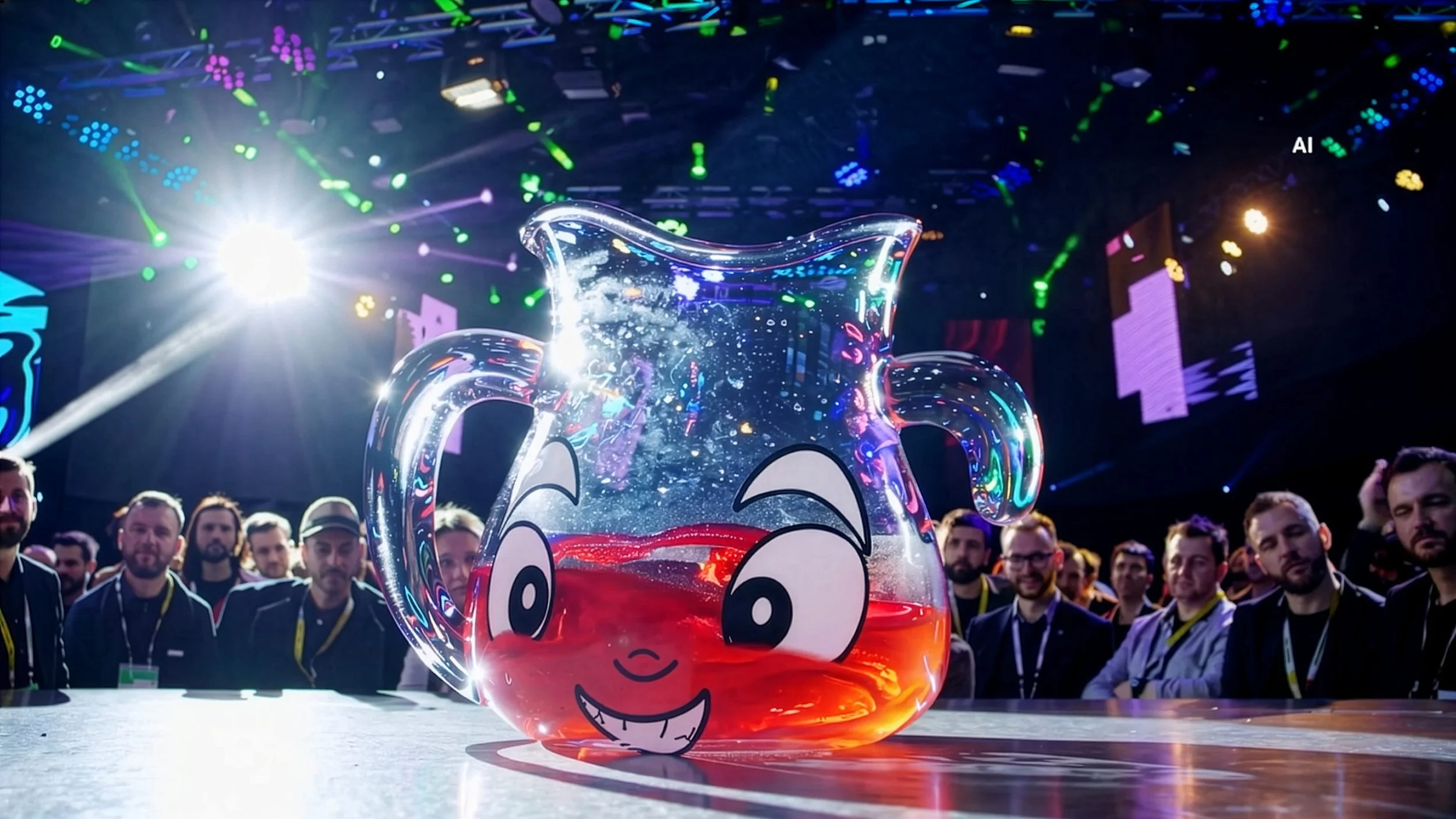
It all reaches a fever pitch during a sequence around two-thirds of the way through where we watch a long, ugly AI video of men partying in a glitzy ballroom and guzzling a Kool-aid-like red liquid. It’s meant to use the very product of AI boosters to showcase that these fools have drunk the Kool-aid of their own industry—they’re happy cultists guzzling down the poison that will kill them. Veatch wants to let the AI boosters hang themselves with their own rope, but she cedes almost the entirety of her artistic argument to footage that she doesn’t control. It’s ironic because she includes a watermark of “AI” or “Not AI” in the top-right corner throughout the entire film to transparently demonstrate which clip is and is not generated by the machine. It’s clever and honest, in theory, but in practice, it nakedly shows how Veatch relies so much on AI footage to make her argument. Sure, the inclusion of AI footage is meant to convey the film’s thesis, but any irony inherent in the footage of Ghost in the Machine seems more accidental than deliberate. At least we can acknowledge the film’s shortcomings as very human; it argues something that doesn’t hold up to scrutiny and lacks the formal rigour, the artistry, to compensate.
4 out of 10
Ghost in the Machine (2025, USA)
Directed by Valerie Veatch.
Read More Reviews

Matt Bettinelli-Olpin and Tyler Gillett’s action horror sequel is a mere reheat.