Review: The Parallax View (1974)

The Parallax View, directed by Alan J. Pakula, is the middle film in what has come to be known as Pakula’s “Paranoia Trilogy,” three independent thrillers from the 1970s that share common themes around investigation, surveillance, and conspiracy and that are marked by their uneasy atmospheres: they are Klute (1971), The Parallax View (1974), and All the President’s Men (1976). Klute is best known for its great performances by Donald Sutherland and Jane Fonda, and All the President’s Men remains the signature newspaper thriller, telling the story of Washington Post reporters Bob Woodward and Carl Bernstein unravelling the Watergate conspiracy. The Parallax View was the least successful of the three in the 1970s, and it remains the least remembered of the three today, but, in 2026, it just might be essential viewing.
The Parallax View opens with the shocking assassination of a popular senator and presidential aspirant atop Seattle’s Space Needle. As the film unfolds, Warren Beatty’s rebellious journalist, Joseph Frady, uncovers a secretive syndicate, the Parallax Corporation, which might link together numerous disparate political assassinations through the recruitment of alienated young men with a disposition towards psychopathology.
In 1974, America was still grappling with the aftermath of a decade of political assassinations, from JFK to MLK to Bobby Kennedy; domestic terrorism was widespread; and the Watergate coverup was distressing the nation. (The Parallax View was released in June 1974; President Nixon would resign from office that August.) In 2026, the United States is once again riven with political strife and political assassinations have again become almost routine: from Luigi Mangione’s slaying of the CEO of UnitedHealthcare in December 2024, to the attempt to burn down the residence of Pennsylvania Governor Josh Shapiro in April 2025, to the assassination of Charlie Kirk on September 10, 2025, to the now (at least) three attempts on President Donald Trump’s life, including the shooting in Butler, Pennsylvania and, most recently, the attempt at the White House Correspondents’ Dinner on April 25, 2026. As the wheels of history cycle, The Parallax View is once again a topical thriller.
But renewed relevance isn’t the only thing The Parallax View has going for it. It’s also just a well-made conspiracy thriller that alternates between being gripping and downright creepy. Pakula is an excellent, and I would say underappreciated, director. Throughout the film, Pakula varies between controlled compositions, often shooting Frady from a very wide distance, and more raw, intimate camera movements. He and his cinematographer, Gordon Willis (famous for shooting the Godfather movies), use dim lighting to great effect.
Pakula is also the kind of director who draws strong performances out of his actors. For example, Beatty is very good here, and Pakula gets the most out of Beatty’s reaction shots, often keeping the camera on Frady and choosing not to cut to the other person in the conversation. The choice to not cut back and forth as classical Hollywood editing would dictate makes the viewer feel a bit claustrophobic. It’s a little thing that contributes to the film’s overall artistic effect.
Pakula’s direction also suggests the theme that our viewpoints are limited, which accords with the film’s title. According to the New Oxford American Dictionary, “parallax” refers to “the effect whereby the position or direction of an object appears to differ when viewed from different positions, e.g. through the viewfinder and the lens of a camera.” The film explores this effect as a principle for the film’s cinematography as well as a metaphor for its themes.
Like many good films from the 1970s, however, it remains shaggy. There is some goofy humour, and Beatty’s character is a bit overwrought in his nonconformity. But it contains two standout scenes of suspense and two absolutely haunting sequences, which make the overall film memorable and significant.
The first comes when Frady’s investigations lead him to the small town of Salmontail in the Pacific Northwest. We get some cornball city-versus-country humour, with a bar fight and a car chase that are both a bit goofy. But that sequence in Salmontail also contains a great set piece at a dam, where Frady goes out with the local sheriff to see where the victim drowned. When he is told to just go out there in the middle of the river, we know something is off. And then we hear the siren for the dam opening. Sure, it’s a bit implausible but it reminds me of a Hitchcockian set piece, in which the novelty and effect of the scenario come first.
The second great suspense scene is the hands-down great climax, which slowly builds to the film’s dark conclusion (if you thought a thriller from 1974 would end happily, you don’t know the period). The setting is again key. A huge convention centre hall, often viewed from overhead, as Frady is up in the rafters, looking for a shooter, watching the set up for a political convention featuring another aspiring politician. The sequence relies on the marching band drumming of the political convention dress rehearsal to drive the momentum and increase our anxiety. The extremely wide angle on certain events unfolding below suggests a feeling of distance and helplessness.
In addition to those two capable sequences of suspense, the film contains two haunting sequences that have lodged themselves in my mind.
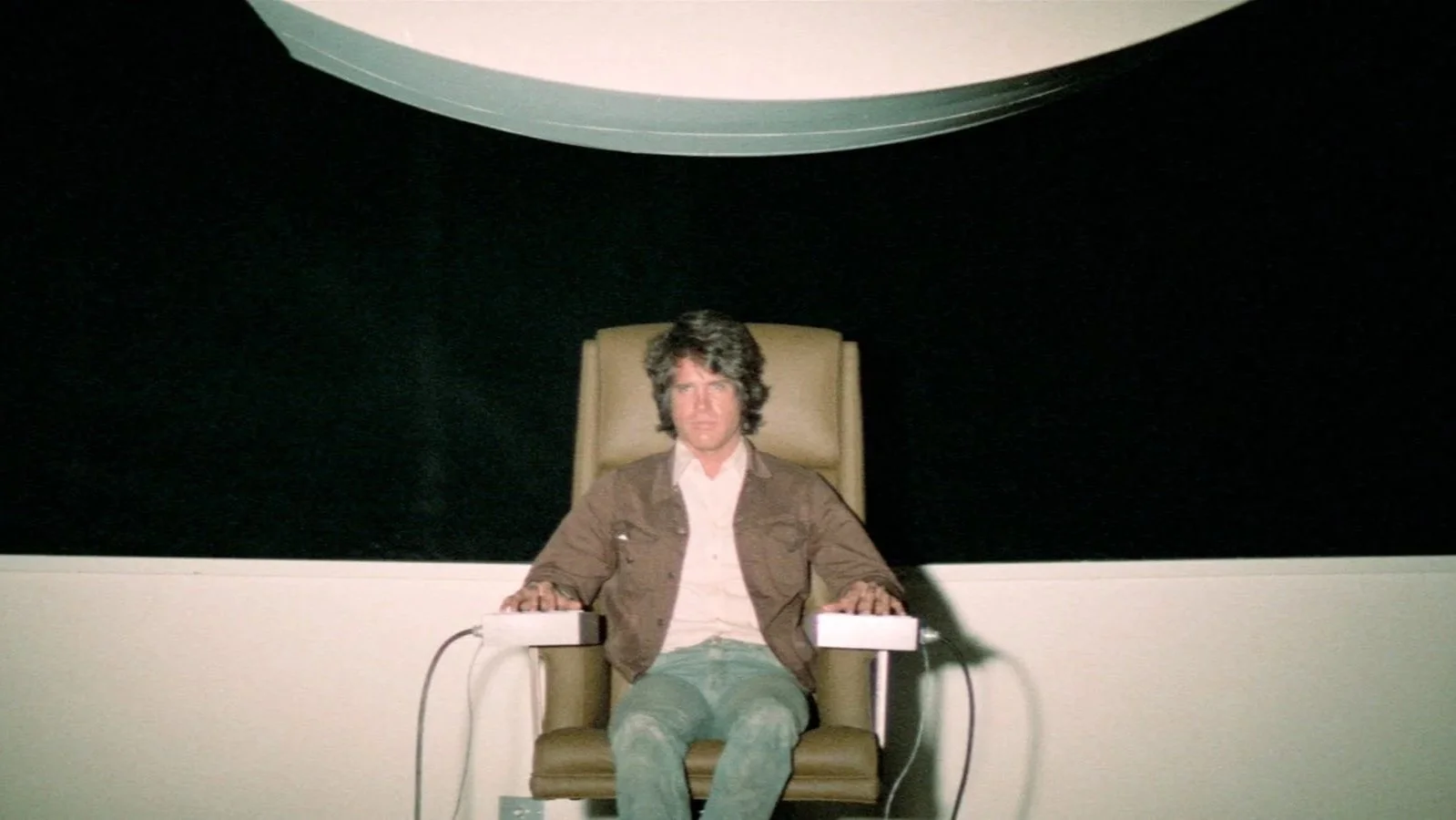
The first is a brainwashing scene that deserves to be mentioned alongside Kubrick’s A Clockwork Orange (1971) and Jordan Peele’s Get Out (2016). In fact, the brown leather of the arm chair that Daniel Kaluuya sits in recalls the chair that Beatty sits in during his brainwashing. Later in The Parallax View, Frady goes undercover posing as a psychopath in order to be recruited by the secretive Parallax Corporation. Pakula doesn’t just make us watch Frady’s reactions during his brainwashing. We watch the whole film he is shown, and it is extremely disturbing, intercutting archival footage of historical figures and news footage, from American history to Adolf Hitler, with black and white imagery of commonplace Americana figures, with generic captions such as: “Love,” “Mother,” “Father,” “Home,” “Enemy,” “Happiness,” and “Me.” As we watch, it slowly dawns on us that the captions are being scrambled and that flashes of sinister, subliminal imagery, from the sexual to the violent, are being inserted. The effect, the film suggests, is a discordant rewiring of primal associations, hijacking the mind of the subject to make him an alienated, destructive weapon. It’s the Kuleshov effect meets the parallax effect! I don’t think a modern movie would actually show the full brainwashing film to the audience, as it directly links the viewer with the victim-turned-killer. This also links the film back with another great thriller that was buried after the assassination of JFK, The Manchurian Candidate (1962), which is all about brainwashing assassins. The Parallax View self-reflexively admits that film is a medium of great influence, inviting us to even question the effect and persuasion of mass media artifacts, such as this thriller, on society.
Last of all, but certainly not least, is the magnificent closing shot, which is an inversion of the opening title credits shot. During the opening credits, the camera slowly pans in on the wooden high bench of a congressional hearing, ruling that the assassination on top of the Space Needle was the work of a mentally disturbed gunman, who “acted entirely alone.” The high bench, with congressional figures seated, is ominously framed against a blank black background. At the end, as the camera pulls back, we notice a similar statement benignly put forward by the congressional inquiry, and the blackness behind becomes larger and larger, slowly taking up most of the screen. In 1974, the beginning and ending must have recalled the Warren Commission, which raised doubts (and still does) about the official record of the assassination of JFK.
Such an ending also benefits from the film’s refusal to fix political labels on figures throughout the movie. It never says the problem is Democrats or Republicans. It’s not pointing fingers within the political system. It’s pointing at the larger system and the repetitions it creates, the patterns that seem to keep looping, however erratically. The Parallax View remains an eerie work of deep skepticism and paranoia, and I only expect the film’s reputation to grow as the troubled decade of the 2020s continues.
All that said, one doesn’t have to subscribe to elaborate conspiracies about government coverups, false flags and staged shootings, or sinister foreign involvement to recognize the significance of the film’s interest in the pattern of alienated young men brainwashed into killing. Of course, we don’t use that word, “brainwashing,” very much anymore. We now say, “radicalized.” But there’s a similarity between the concepts, as each typically involves exposure to specific forms of media, especially on repeat. The film’s interest in the shaping power of both object viewed and viewpoint are important.
Of course, viewing the film in 2026 is also a parallax effect. We aren’t seeing exactly the same Parallax View as in 1974, because we aren’t watching it from the same point in time. The object appears to have shifted, ever so slightly, reflecting the dislocations of our mad new century, from 9/11 through Covid to today.
9 out of 10
The Parallax View (1974, USA)
Directed by Alan J. Pakula; screenplay by David Giller and Lorenzo Semple Jr., based on Loren Singer’s novel of the same name; starring Warren Beatty, Hume Cronyn, William Daniels, and Paula Prentiss.
RELATED POSTS


The Great Escape is a hugely entertaining landmark in the prison camp and action team genres.