Review: The Great Escape (1963)
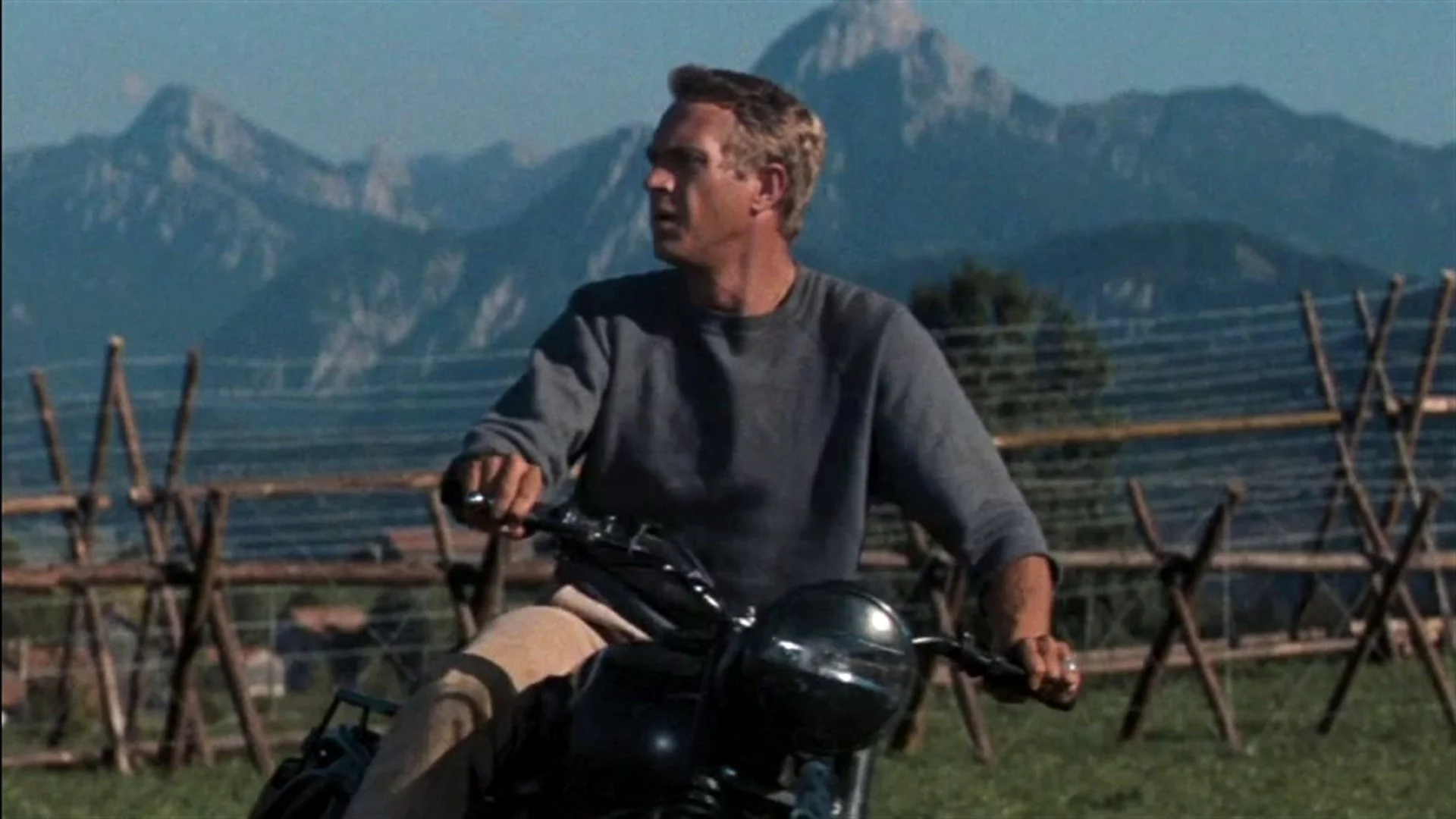

The Great Escape is great entertainment. Yes, it is a movie about British Commonwealth and American soldiers in a German prisoner-of-war camp during World War II. Yes, it runs nearly three hours long. Neither the subject matter nor the run time scream “Entertainment!” in 2025. But coming out in 1963, 18 years after the war and at the tail end of the classical Hollywood era, The Great Escape demonstrates classical Hollywood’s talent for making any subject matter engaging and telling clear, enjoyable stories. The Great Escape is also a landmark in the development of the prison movie and the action team picture, as we think of them today.
The Great Escape is based on true events about the mass escape of Allied POWs from the Stalag Luft III camp during the Second World War, drawing on the 1950 book by Paul Brickhill. The prisoners dug a complex system of tunnels to the outside which resulted in 76 escaped prisoners. The film warns us in early titles that many characters are composites and certain aspects have been changed, while also claiming high fidelity to the details of the escape. My preliminary research suggests this is largely accurate.
The most shameless change, however—and one that also deeply embodies classical Hollywood storytelling—is making three fictional Americans the central characters. In reality, Americans were only involved early in the digging process (being moved to another camp), apart from the American Johnnie Dodge, who was deeply involved, but who was a British army officer. As a Canadian, I’ll also grumble about the minimal mention of Canadians, who were involved in significant numbers (we seem to rarely get our due in war movies). Oh well. Making a story American is as Hollywood as it gets. The film still presents the British as the largest participant in the scheme, and it playfully probes at times the differences between the British and American soldiers, as well as their different relations with the Germans.
Director John Sturges, who had just come off success with an excellent group cast in The Magnificent Seven (1960), assembles another cast that is one of those legendary lists from the epics of this period. Steve McQueen (who had worked with Sturges in The Magnificent Seven) plays the American Hilts, “The Cooler King”; James Garner plays Hendley, “The Scrounger”; Richard Attenborough, in the role that brought him to the attention of American audiences, plays Bartlett or “Big X,” who is the mastermind of the plot; James Donald plays Ramsey, “The SBO,” the chief ranking British officer; an absolutely ripped Charles Bronson is Danny, the “Tunnel King;” Donald Pleasence, who was in an actual POW camp during WWII, is Blythe, “The Forger”; and James Coburn plays an Aussie called Sedgwick, “The Manufacturer.” There are more, but I’ll hold off mentioning them here. One of those end credit rolls that replays clips from the movie cements for the audience the names and roles of the main characters. Note also how the film helps establish the team dynamic used in most mission or heist movies, where the person’s distinct talent and role in the team is just as important as the person’s name and background. (This approach to characters can be traced all the way down to recent years with the nearly absent characterization of the dream heist team, apart from Leonardo DiCaprio’s Cobb, in Christopher Nolan’s Inception from 2010.)
Even though this is an ensemble cast, Steven McQueen’s Hilts is singled out. With his unwavering gumption and penchant for a baseball and glove, Hilts is positioned as the focus of audience sympathy, and McQueen certainly has star charisma. I was surprised that McQueen’s wry facial expressions and various tics reminded me of Michael Keaton. McQueen is blonde and handsome but very different in his mannerisms from many of the stiff leading men of the period. In this respect, James Garner, who is still likeable, seems like a perfect product of the 1950s and early 60s, whereas you can see why McQueen’s star only rose as the culture changed over the 1960s and 70s. The film leans into Hilts’ nonconformism in a way that positions him somewhere between the teen outcasts of late 1950s melodramas (who also often rode motorbikes) and the countercultural figures of the late 1960s (who rode motorbikes in Easy Rider).
As great as the cast is, though, the centre of the film is the escape. Scratch that. This isn’t the kind of film that does many things plus has an escape plot. The film is constructed entirely around the escape, dedicating its running time to following all the plans, and efforts, and details necessary for the escape. From the moment the prisoners arrive at the new camp at the start of the film, many of them are casing the joint for weaknesses they can exploit. As the German Kommandant (Hannes Messemer) says, this new camp is the basket for collecting all the rotten eggs, that is, all the prisoners who have tried to escape so many times before in other camps. This means the film isn’t about a bunch of regular guys trying their best; instead, the film derives pleasure from showing experts in their “fields” act ingeniously.
Like any mission or heist movie, the first third of the movie is largely about putting together the team to perform the big task, here being the escape. In the second act, there is much pleasure in watching the team assemble the materials and in following their ingenious ways to work out various problems, such as how to get rid of the dirt dug from the tunnels. The actual nighttime escape is tense and well drawn out, with all the curveballs and slip-ups you might anticipate, but it’s never boringly predictable.
Then we get the last act about how most of the escapees are actually caught. Only three ultimately escape, but I won’t say who. We follow their different threads, hoping, hoping, they can get through to the train or the ship, or across the border, or over the wire fence on the motorbike, in the famous stunt sequence, which saw McQueen ride a motorbike for much of it. That stunt, often considered one of the greatest in cinema, shows that the film prioritizes showcasing action as much as character.
The Great Escape is such a classic that it has put its hold on all subsequent escape movies, especially prisoner-of-war movies (but there are still connections to 1994’s The Shawshank Redemption, with the problem of getting rid of the dirt from tunnelling). There are obvious connections backwards to David Lean’s masterful epic from 1957, The Bridge on the River Kwai, with their similar marching tunes (which I mistook for the same tune until I looked it up), and the presence of James Donald in both (he plays the British ranking officer here and the doctor who utters the famous final line in Bridge on the River Kwai). There are certain movies that become so iconic they are the touchstone for all other works in the genre, whether consciously or not, and The Great Escape is such a film.
It’s also worth mentioning that the prison camp story became its own subgenre in the decades after the war, from Billy Wilder’s Stalag 17 in 1953 to the popular TV show Hogan’s Heroes, which ran from 1965 to 1971. As with all prison movies, part of the appeal in terms of storytelling is that the set-up creates a limited world to work with, a microcosm of larger society. Likewise, one can’t help but see not only the boys’ own adventure aspects of these tales, where war becomes an elaborate game, but also the idea of the freedom-loving individual being held down by an oppressive, authoritarian system. While the American interest in these themes obviously has roots all the way back to the American Revolution, you can see how the genre evolves over the period towards the idea of fighting against a (fascist or totalitarian) system. Patrick McGohan’s TV Show, The Prisoner, from 1967, would explore these themes in a distilled, surrealist fashion.
Released in 1963, The Great Escape anticipates, in small ways, aspects of the New Hollywood, while also still embodying much of the optimism and patriotism of the postwar years and the related narrative coherence. McQueen’s Hilts is detached and cool and a bit above the fray, but he never actually questions his obedience to higher ranks, his loyalties to team and country, or the necessity of sacrificing everything. The ending isn’t happy, but it has a roundness and completeness to the storytelling that is nevertheless very distinct from the purposefully open ambiguities of so many New Hollywood endings (which imitated the European arthouse pics of the previous two decades).
As the narrative comes full circle in the final scene, the theme of The Great Escape becomes clear, and it is nicely in accordance with the film’s own narrative engine: for both the characters and the audience, the whole point wasn’t getting out. It was the process of escape. The trouble trying to escape and then escaping causes for the Germans is reason enough, just as the film’s pleasures come from witnessing the process of escape as much as any seeing ending in definite freedom. These sorts of harmonies add to the film’s deeply enjoyable nature. Yes, this is a war movie based on a true story, but this is also a work of pure Hollywood escapism.
9 out of 10
The Great Escape (1963, USA)
Directed by John Sturges; screenplay by James Clavell and W. R. Burnett, based on the book by Paul Brickhill; starring Steve McQueen, James Garner, Richard Attenborough, James Donald, Charles Bronson, Donald Pleasence, James Coburn, and Hannes Messemer.
RELATED POSTS
Why Sam Raimi’s Spider-Man 2 remains one of the best superhero movies of all time.