Review: The Devil's Advocate (1997)

Taylor Hackford’s late nineties supernatural legal thriller, The Devil’s Advocate, is by no means a great film. It’s overwrought and melodramatic, but it’s entertaining in fits and starts, especially as it builds to its wild climax. The film’s attempt to meld a slick, sexy Hollywood legal thriller to a supernatural horror film doesn’t entirely work, but the concept itself is intriguing. When you add to that a star-studded cast, complete with Al Pacino as Lucifer himself, it’s hard to deny the film’s appeal. However, re-watching it nearly 30 years after its debut, what’s most interesting to me is its status as a time capsule of late-90s star-driven Hollywood filmmaking.
The high-concept elevator pitch for The Devil’s Advocate could be “John Grisham meets Rosemary’s Baby.” Truly, that gives you a pretty good sense of what this film is going for. The story begins in Gainsville, Florida, where a hotshot young lawyer, Kevin Lomax, portrayed by Keanu Reeves with a Foghorn Leghorn accent, succeeds in getting a sleazy client off the hook in a molestation case, even as he faces a moment of doubt as to the ethics of his chosen profession. Kevin Lomax has a perfect record as a defence attorney, and after a celebration with his young wife, Mary Ann (Charlize Theron, faring no better in the accent department), he’s recruited by an elite New York law firm that specializes in taking on the defense cases of guilty clients and also has a perfect record of getting acquittals. Kevin and Mary Ann move to the Big Apple, despite the protestations of Kevin’s fundamentalist Christian mother (Judith Ivey). There they meet the firm’s boss, John Milton (Al Pacino). Milton has recruited Kevin to work the case of Alex Cullen (Craig T. Nelson, playing against type as a complete sleazeball), a billionaire who has been accused of killing his wife, stepson, and a maid. Slowly, Kevin finds himself drawn deeper and deeper into the case and work, neglecting his wife, who begins to have visions of demons and a nightmarish baby. Kevin also finds himself fantasizing about his co-worker, Christabella (an early role for Danish actress, Connie Nielsen), as he quickly climbs the ladder of the law firm.
Unfortunately, the long middle stretches of The Devil’s Advocate, which rely on Kevin’s marital neglect and Mary Ann’s growing mental instability, take up too much of the film, and sadly Reeves and Theron are miscast as Southerners. What we really want to see is the crazy devil stuff which the film’s marketing did little to hide, even though it doesn't really manifest until the final third. The film is at its most entertaining when Pacino is let loose to chew the scenery, particularly in the final stretch when his “John Milton”—never let it be said this film is subtle—reveals his true identity—he’s actually Satan, surprise, surprise!— and his ultimate plan. He will bring about the Antichrist by having Kevin and Christabella, revealed as his children and half-siblings, consummate an incestuous union.
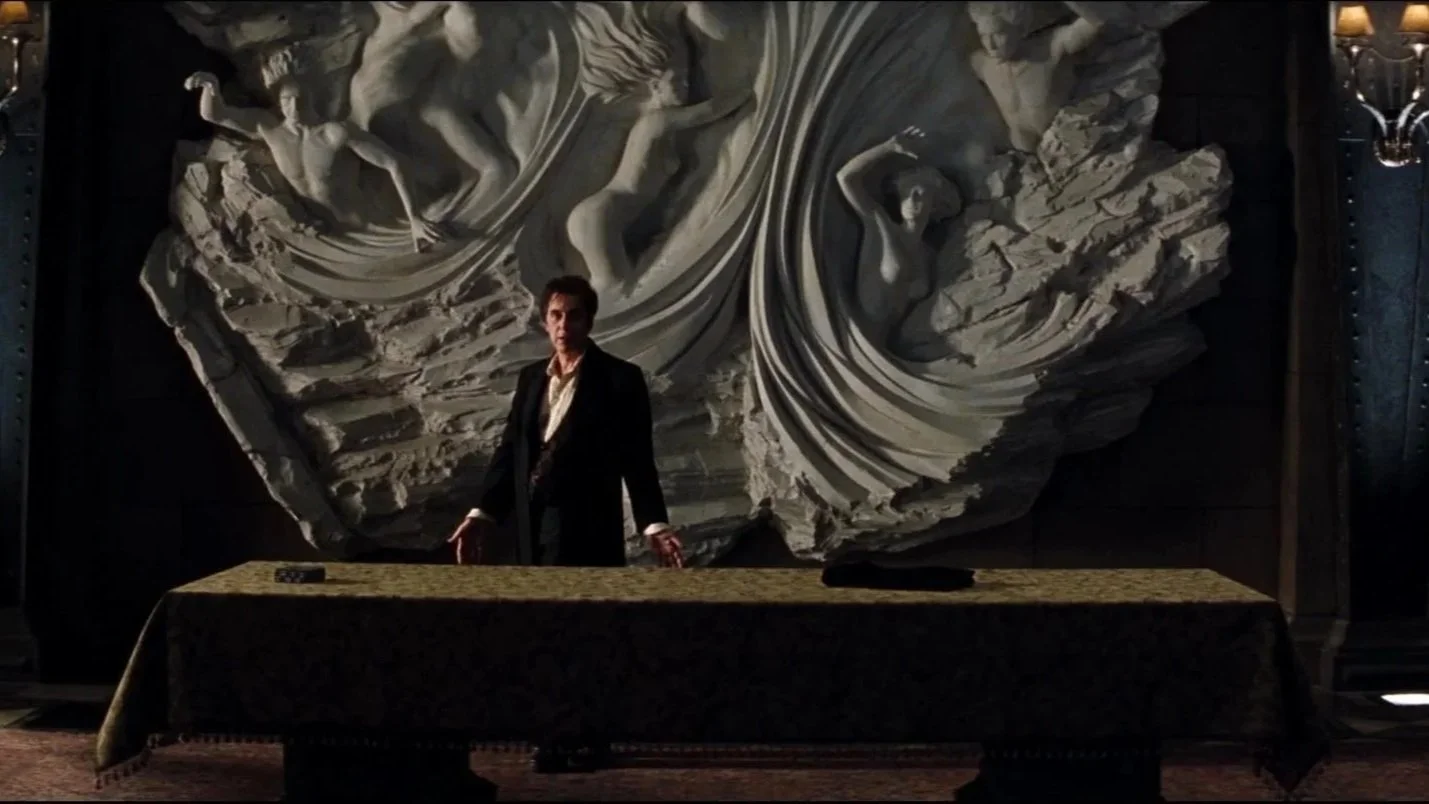
It’s the film’s final showdown between Kevin and “Milton,” in the latters’ penthouse office, that rightly is the film’s most memorable sequence, both for its bold use of imagery and the fact that that same imagery resulted in a major copyright lawsuit, Hart v. Warner Bros., Inc. Milton’s penthouse office overlooking the city is backdropped by a giant sculpture of angels and demons behind his massive desk, which becomes animated as Milton’s Satanic identity is made clear. It provides the film with its most striking images. But sculptor Fredrick Hart said the sculpture was too similar to his own work, Ex Nihilo, featured on the facade of the Episcopal National Cathedral in Washington, D.C. The lawsuit delayed the home video release of the film in 1998. The angel imagery backdrop provides a striking setting for Milton’s inner sanctum, a hellish structure with a demonic altar at the centre. Early CGI and make-up work by Rick Baker bring the angels and demons to life in the film, and it’s clear this was a big budget film.
The Devil’s Advocate was always conceived of as a big budget feature. The film is based on the 1990 novel by Andrew Neiderman. Neiderman himself shopped it as a film treatment for many years and it went through a number of variations, including Joel Schumacher being attached to a version with Brad Pitt as Kevin Lomax. When that earlier version never was realized, it went through a subsequent re-write by Tony Gilroy (best known now for the film Michael Clayton and the Star Wars show, Andor) and was directed by Hackford. The producers were insistent on Al Pacino for the role of Milton, but Pacino was reluctant because he thought it was too obvious and cliched. He’s probably right, but I’m glad he eventually caved after his initial reluctance because it’s such a fun role for 1990s Pacino, yelling and mugging as Satan. Keanu was cast as Lomax after turning down Speed 2: Cruise Control to take the role, since he didn’t want to do another action film. It’s clear that the cast and crew felt this was going to be a big movie.
The Devil’s Advocate is the kind of film that seems portentous and important on the surface, but is kind of silly and a bit incoherent in the execution. Much of the film’s drama is built around Kevin’s increasingly conflicted feelings around defending guilty clients. When he discovers that Cullen is almost certainly guilty of murder, it marks the film’s turning point when the lawyer who only thinks of winning starts to find his conscience. Of course, he is repeating the journey of his pious mother, who conceived Kevin on a youthful trip to New York, and arrives to warn her son that his new boss is none other than his father!
The film frequently goes back and forth between lurid, soap opera-esque revelations of secret identities, deception, and coincidences and attempts at more serious social commentary, trying to suggest that the corporate legal world of 1990s America is a perfect place for Satan to set up operations in today’s world. The idea of Satan using the vices of our current moment to further his mission isn’t a new one. It recalls the tale of Faust, of the knowledge of the world seducing the young man, or the demon Screwtape in C.S. Lewis’s satire The Screwtape Letters, which notes how so many aspects of our modern world can be used to subtly bring about the fall of many. But The Devil’s Advocate really is leading to the idea that the Satanic elements aren’t just metaphors for avarice, greed, and pride, but the actual Antichrist and actual demons. There were a number of such films in the late 1990s, including this and the Arnold Schwarzenegger starring End of Days (1998). The approaching millennium was palpable. Given the apocalyptic End Times tones today around various world leaders and politicians who opine on the nature of the Antichrist and Armageddon, perhaps the film has a renewed resonance? It’s intriguing, but little more than an object of interest. Not a deep exploration.
Still, the supernatural elements of the film are the parts that are worth seeking out. Its Grand Guignol elements play for the shock value, but verge on camp. That stuff is fun. But the film is ultimately undone through its awkward marriage of the legal thriller elements with the supernatural bits, as well as the uneven performances in the dramatic scenes from Reeves and Theron. Casting a Canadian and a South African as Southern American’s just didn’t work. Still, it’s worth a watch if you want to see how the conception of a hit film has changed over the years. Today, The Devil’s Advocate would likely be a serialized streaming show or a mini-series. But in 1997, it was a big budget supernatural courtroom drama. Because of that, the film feels a bit long in getting to its big set piece and its surprise ending. I didn’t hate the film, but it doesn’t live up to the clear ambition its author and the filmmakers had for it to be more than a showcase for Pacino’s antics. Paradise Lost or even Rosemary’s Baby this ain’t.
5 out of 10
The Devil’s Advocate (1997, USA)
Directed by Taylor Hackford; screenplay by Jonathan Lemkin and Tony Gilroy, based on the novel by Andrew Neiderman; starring Al Pacino, Keanu Reeves, Charlize Theron, Jeffrey Jones, Judith Ivey, Connie Nielsen, Craig T. Nelson.
Related Posts


Anton makes the case for watching the first Harry Potter movie during Christmas time.