Review: The 6th Day (2000)
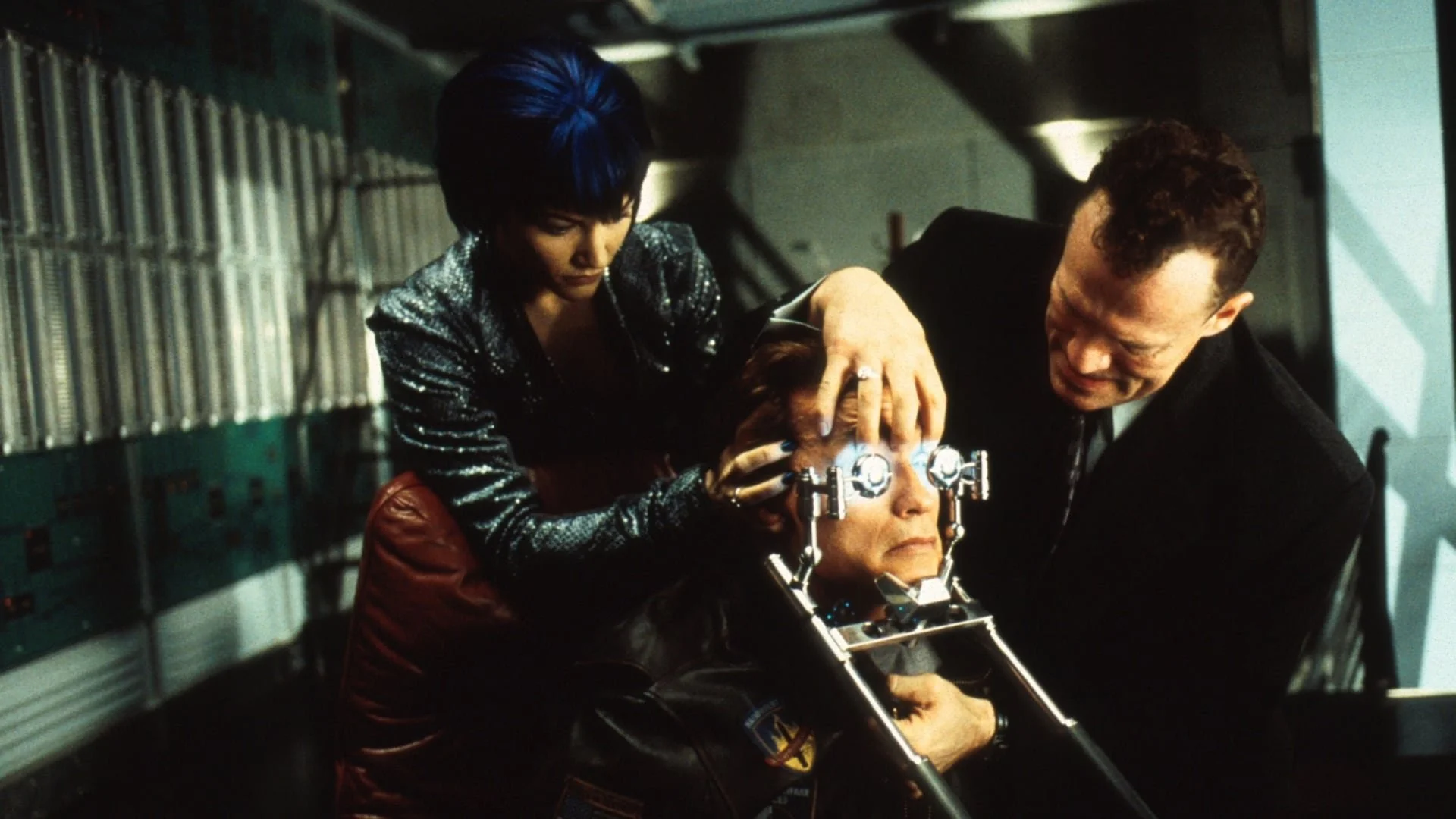

Coming out in November 2000, The 6th Day envisions a bizarre near future world where the XFL is the most popular sport in America, your fridge tells you when your milk is running out, and you can pick up a clone of your pet as easily as buying a toy on your way home from work. Oh, and Arnold Schwarzenegger is best friends with Michael Rapaport. I kid, but The 6th Day is a strange film for a generic action thriller, and one made stranger by its hit-and-miss predictions of the future. Although it is occasionally prescient about how America’s tech titans see death as the final frontier to conquer, it is also ugly and haphazardly directed in that way mainstream action films were at the turn of the millennium.
Made in the aftermath of Schwarzenegger’s turn as Mr. Freeze in Batman & Robin (1997), The 6th Day still featured Schwarzenegger at a time when he was one of the biggest stars on the planet. However, his appeal had started to dim with a series of duds, arguably starting with Junior (1994)—you know, the one where Schwarzenegger gets pregnant—and peaking with Batman & Robin. The 6th Day attempted to return Schwarzenegger to his sci-fi roots of the 1980s, but his hero, charter pilot Adam Gibson, is very much the family-friendly Schwarzenegger of the 1990s. He’s cheery, patient, a loving father and husband, and a good citizen. The 6th Day essentially imagines if the Schwarzenegger of Junior or Jingle All the Way (1996) was dropped into the plot of Total Recall (1990), as Schwarzenegger’s Adam finds himself cloned and in the middle of a corporate conspiracy.
Much of the appeal at the time was seeing two Schwarzeneggers on screen—the Adam who realizes he’s in the middle of this cloning conspiracy, and the unaware clone who has replaced him and goes about his idyllic life with wife and child. It’s as if we got Doug Quaid and Carl Hauser (Schwarzenegger’s two personalities from Total Recall) sharing the screen, instead of just a video message filling one in on the other. Much of Schwarzenegger’s 1990s filmography focused on playing these two sides of the Austrian star against each other. For instance, Kindergarten Cop (1990) drops the gritty Schwarzenegger of his 1980s era into a family-friendly comedy (to great success), while Jingle All the Way tries to have Schwarzenegger play against type and mine comedy (unsuccessfully) from the juxtaposition between expectation and presentation. You could argue this even started with his comic turn in Twins (1988) and is played most effectively in Terminator 2: Judgment Day (1991), which flips our expectations by having the T-800 the hero instead of the villain.
The 6th Day splits the difference and the affable, charismatic Schwarzenegger is successful in the lead, but he can’t keep the movie from falling apart due to the inconsistent worldbuilding and run-of-the-mill storytelling. The film’s science-fiction world is nowhere as compelling as the Mars of Total Recall. The film is most successful in its vision of the cloning conspiracy itself, which allows Tony Goldwyn’s sinister tech billionaire and Robert Duvall’s brilliant scientist to essentially become immortal, creating human clones that contain the same memories of their originals, so as to create an endlessly self-replicating chain of self that can cheat death. Aspects of the plot also seem to anticipate the transhumanist ambitions of Elon Musk and Peter Thiel.
However, in the minor details of worldbuilding, the film is truly hit or miss. For every future invention that proves prescient—Rapaport’s AI girlfriend has come to fruition in every way except the holographic projection—there’s another that is simply off or ungainly, like the semi-living doll that grows its own hair or the remote flying gloves that Adam uses for his charter business that look like the Nintendo Power Glove. In retrospect, it’s especially clarifying to compare The 6th Day with a movie like Minority Report (2002), which came out only two years later but is much more rigorous and credible in every detail of its near-future world.
To be fair, The 6th Day is primarily interested in being an action thriller, and it’s moderately successful at this. It’s fun to watch Schwarzenegger uncover the conspiracy run by Goldwyn and Duvall, and continuously fight their goons (Michael Rooker, Sarah Wynter, and Rodney Rowland), who are virtually impossible to kill since they have a supply of clones to replace them ad infinitum. There are car chases, gunfights in laboratories, and many twists (most of which are obvious from the jump).
While it has a star and some good ingredients, the film lacks visual gusto and coherence. Directed by Roger Spottiswoode, who made the Pierce Brosnan Bond movie Tomorrow Never Dies (1997) and embodies the generic action director of the late 1990s better than anymore, the film is overly enamoured of jittery stutter speeds during action sequences, inexplicable freeze frames and flash forwards, and fragmented editing that lacks a clear operating rhythm. For instance, as we watch Adam pilot a helicopter through a valley, the camera blends double-exposures and insert shots with wide angles of poor-CGI helicopters and sweeping vistas. The conventional framing and fragmented editing don’t match, making for an incoherent experience.
In retrospect, The 6th Day is useful at illustrating developments in action filmmaking that were inspired by the D-Day sequence of Saving Private Ryan (1998). Spottiswoode seems to be operating in a visual mode best exemplified by the films of Lee Tamahori (Die Another Day, The Edge): a blend of conventional action compositions and frenetic editing reminiscent of music videos. This approach seems to be a parallel action vocabulary for the shaky cam of director Paul Greengrass (The Bourne Supremacy): all of these directors were obviously inspired by Saving Private Ryan to create an emotionally overwhelming, credible sensory experience of combat. But the temporal confusion and jittery editing of Spottiswoode and Tamahori’s approach lost out to the rapid-fire pace and handheld camera of Greengrass’s.
Thus, The 6th Day also becomes a hallmark of a lost time and place, not only its uncanny 20th-century vision of the 21st-century, but also its style of action filmmaking, which has completely died out. It’s now just a novelty, as memorable for its slow-motion XFL opening as for any of its story or filmmaking.
4 out of 10
The 6th Day (2000, USA)
Directed by Roger Spottiswoode; written by Cormac and Marianne Wibberley; starring Arnold Schwarzenegger, Michael Rapaport, Tony Goldwyn, Michael Rooker, Sarah Wynter, Robert Duvall.
Read More Reviews
Alexander Ullom’s high-concept debut feature conjures an existential nightmare.