Review: The Wizard of the Kremlin (2025)
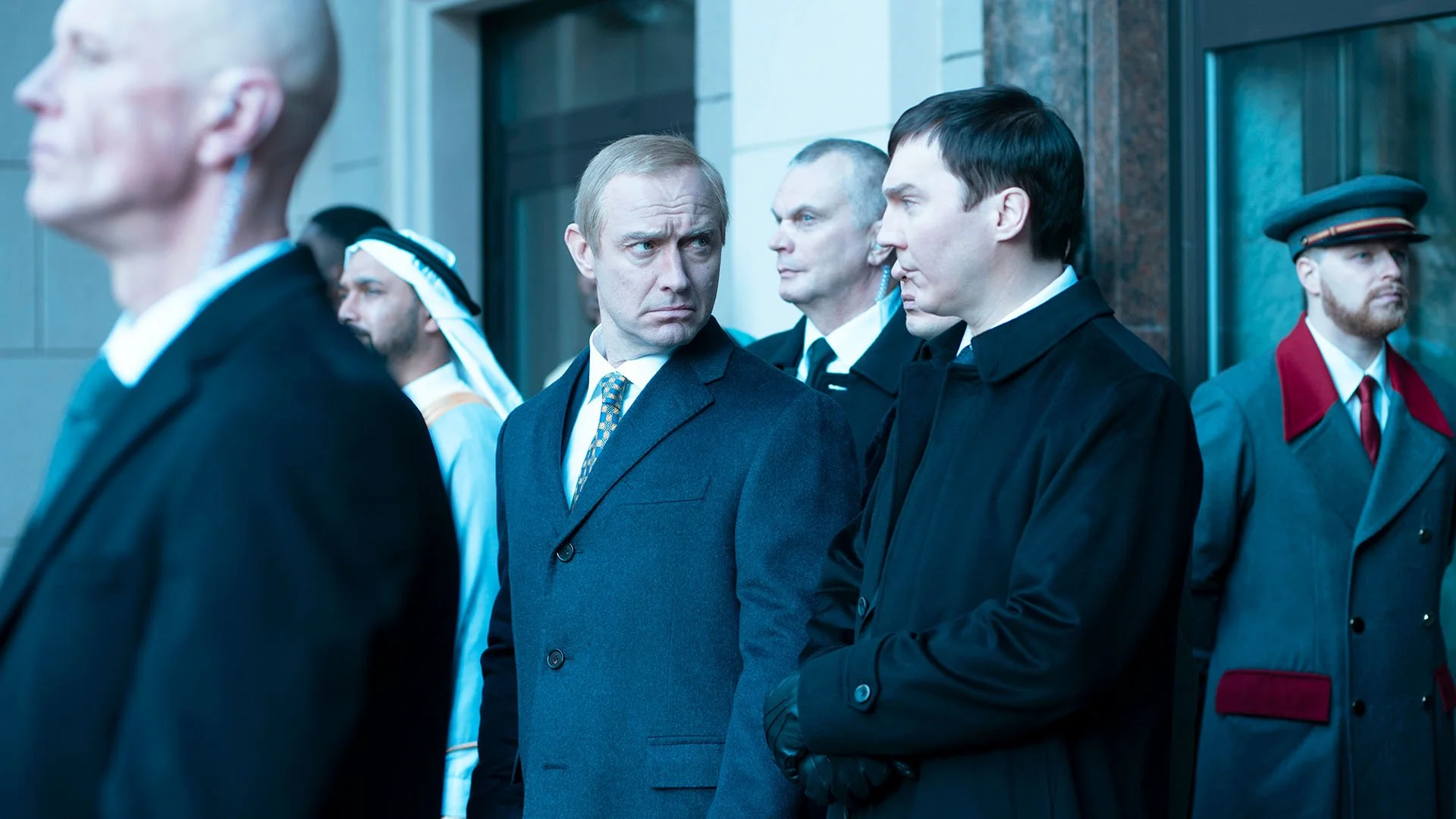

Olivier Assayas’s The Wizard of the Kremlin is a complex examination of seismic changes in Russian life—political, cultural, and economic—over the course of several decades. It’s also a biopic of an enigmatic political actor, Paul Dano’s Vadim Baranov, who is a fictionalized version of the real life Russian spin doctor Vladislav Surkov. In the film, Baranov, like Surkov in real life, is essential to the rise of Vladimir Putin (played by Jude Law) and his autocratic takeover of Russia. The film is much more successful as the former rather than the latter, largely because it’s tough to write an authentic portrait of a fictionalized cipher. But even despite that core issue, it remains a compelling work and a more rigorous, realistic portrait of Russia than you tend to find in most western media.
The Wizard of the Kremlin charts the rise and fall of Baranov, who we first meet as an ambitious artist who makes waves in theatre and then television during the post-Soviet, libertarian free-for-all that was 1990s Russia. Baranov transitions into politics when he becomes Vladimir Putin’s most trusted advisor during Putin’s ascendancy in the late 1990s. Early in the film, through the superfluous framing device following an American journalist (Jeffrey Wright) meeting with a now self-exiled Baranov at his wintery estate, we even hear that he’s the “new Rapustin”—evidently overlooking any of the sexual magnetism that was essential to Rapustin’s short-lived influence over the Kremlin. Baranov has sexual ambitions, mostly charted through his turbulent relationship with fellow artist Ksenia (Alicia Vikander), but hardly any magnetism. His ability to dominate Russian culture, then politics, is largely a result of his ability to direct interest away from himself and towards the figures in his orbit, crafting their mystique, from reality TV divas to the eventual president of Russia.
Dano plays into this externalization in his performance. As mannered an actor as they come, Dano is slow and deliberate in every line reading and movement as Baranov. His eyes betray the intense energy—the intelect—that fuels the man and the movement, but physically, he’s rigid, demure, even forgettable. At the same time, he’s ultra confident—or at least projects it even in moments of desperation, such as when he breaks off his relationship with Ksenia after finding out she’s sleeping with his friend (and future oligarch, Dmitri Sidorov, portrayed by Tom Sturridge).
Dano has a mixed reputation as an actor (Quentin Tarantino has some thoughts), but at his best, such as in Matt Reeves’ The Batman or Steven Spielberg’s The Fabelmans (both from 2022), he’s able to weaponize the internal/external dichotomy of his performance style—even to widely different ends. For instance, his Riddler from The Batman is a true cipher, expressing himself through violent riddles, externalizing the chaos of his mind even as he’s physically inconsequential, almost invisible. His father from The Fabelmans is stolid and sincere. He is inarticulate, perhaps even repressed, but strategically so as a means of providing stability to the chaotic family life around him. Dano’s portrayal of Baranov draws from both performances in how he plays his stolidity as both a mask for his chaotic political influence, but also a genuine expression of his ultimate aim: the need to provide an elusive stability to Russia by any means necessary.
Baranov finds the means of providing that stability when he meets Vladimir Putin, then head of the Russian security service, FSB, a straightforward, uncharismatic spymaster who is the man for the moment when the country is reeling in the wake of Boris Yeltsin’s incompetence (and physical decline). Once Baranov meets Putin, the film becomes a study in contrasts between the men. Putin is the supposedly straight-shooting doer—the man who makes the hard decisions to stabilize Russia, disempower the oligarchs, and restore the pride of the nation. His political popularity is entirely dependent on his authenticity—people believe he means what he says, and, thus, trust him with the fate of a nation preyed upon by every manner of opportunistic jackals. Conversely, Baranov is the supposed spin doctor with no true allegiance, an appetite for pageantry, and an unquenchable ambition. Over the course of the second half of the film, which covers everything from the Second Chechen War to the Sochi Olympics to the Crimean War (and conspicuously ending before the War in Ukraine) Assayas reveals the lie in Putin’s humble patriotism and unmasks the disguised patriotism in Baranov’s Machiavellian schemes.
The only problem: we never truly learn what motivates Baranov on a personal level. The film settles on depicting his quiet form of disaffected patriotism, but the journey there is scattershot, even contradictory. The ambiguities of the portrait are very literary—the film is based on a novel by Giuliano da Empoli, after all. However, when the character is essentially a one-to-one version of a real man—Vladislov Surkov—you struggle with parsing fact and fiction, real motivation from projected one, authentic expression from artistic license. Law’s Putin is much more rooted in fact—a man constantly disguising his rapacious intelligence and insatiable paranoia in false humility and pragmatism. But the portrait of Putin is also more conventional—Law is compelling in the role, but Baranov is undoubtedly the film’s focus.
If The Wizard of the Kremlin never resolves Baranov as a man, it does aptly convey his ideology, and thrillingly depicts modern Russian history with a vibrancy that’s entirely absent in most western films about Russia. Over the course of the film, we get a detailed depiction of the collapse of Sovietism, the takeover and chaos of the oligarchs, and the authoritarian rise of Putinism. We also get long and nuanced examinations of notions such as the power vertical. This political concept is Surkov’s (here, Baranov’s) main theory about the top-down federal chain of authority necessary to control Russia throughout history.
We also get a vibrant portrait of Russia—one with a sexual, cultural, and occasionally jovial pulse. Movies made in the West don’t show Russian as a place that is alive; Moscow might as well be fossilized, or frozen in ice, as far as Hollywood cares. Even the works of film and literature that westerners idolize (whether Andrei Tarkovsky or Fyodor Dostoevsky) are anything but contemporary. Hollywood’s dreary vision of Russia is summed up by the ubiquitous dull, blue-grey palette that lathers every frame of Russia as depicted in films such as the James Bond movie GoldenEye. Even works that examine Russia in the present day play into this dreary aesthetic approach—either by relying on the dismal, depressing archival footage of the post-Soviet transition or by depicting Moscow as a place of spies, shadows, and subterfuge, where even glamorous buildings are populated by miserable people who are not to be trusted.
Assayas might agree on the latter point about trust, but his film shows life and verve as well, which gets us much closer to Russia as it exists in the world and not simply in the minds of western filmmakers and journalists. The Wizard of the Kremlin is not a Hollywood film (it’s technically a French production), but it might be the only western film of note to resist blue-grey filters or Brutalist architectural vistas in its depiction of Russia. In the early scenes, Assayas takes us on a journey through punk houses and avant-garde theatres in post-Soviet Russia. He depicts a vitality in the blend of musical experimentation and sexual libertinism that accompanied the post-Soviet transition, even as he also shows the political fracture and economic collapse that powered the rise of the oligarchs. Later, when Assayas shows Putin relaxing at his vacation home in Sochi, the bright sun, green trees, and idyllic images of garden parties and water-skiing puncture a notion of the miserabilist vision of Russia. (There’s even a good joke about Putin pushing the summer haven Sochi as the site of the Winter Olympic games.)
The Wizard of the Kremlin is also identifiable as an Assayas film—not merely a work-for-hire from the celebrated French director who gave us Irma Vep and Clouds of Sils Maria. As in those movies, in The Wizard of the Kremlin, you’ll find Assayas’s fondness for pop music and for free-roaming camerawork, and even his occasionally skewed humour. Assayas’s canny use of montage helps him capture the scale of Russian history, while his attention-to-detail lets him blend real archival footage with falsified footage, inserting Law into archival clips (like Zelig or Forrest Gump), for instance, or recreating key moments in recent Russian history so they blend seamlessly into the world of his film.
As for his humour, you also get the cutting way his editing highlights a joke. This way that the editing creates the humour is most notable in a cut involving Sturridge’s Sidorov, one of the first oligarchs in modern Russia. In the first scene, Sidorov, sporting a leather jacket and sunglasses, pompously brags about his dubiously legal role as a kind of banker in the newly capitalist Russia while drinking at the bar with Baranov. Just as he finishes his drunken bragging, Assayas immediately cuts to Sidorov on television, sporting a neat suit and tie, being interviewed about his new official bank, preening for the camera with the sort of ruthless capitalist gusto learned from watching Wall Street and reading Forbes. It’s the sort of humour that captures a time and place, while also showcasing the editorial control of a filmmaker who knows how to assemble shots and cuts.
With Assayas at the helm, The Wizard of the Kremlin is frequently riveting and also rigorous in its examination of recent Russian history, even as it never resolves the cipher of its central character.
7 out of 10
The Wizard of the Kremlin (2025, France)
Directed by Olivier Assayas; written by Olivier Assayas and Emmanuel Carrère, based on the novel by Giuliano da Empoli; starring Paul Dano, Alicia Vikander, Tom Sturridge, Will Kean, Jeffrey Wright, Jude Law.