Review: The End of Oak Street (2026)
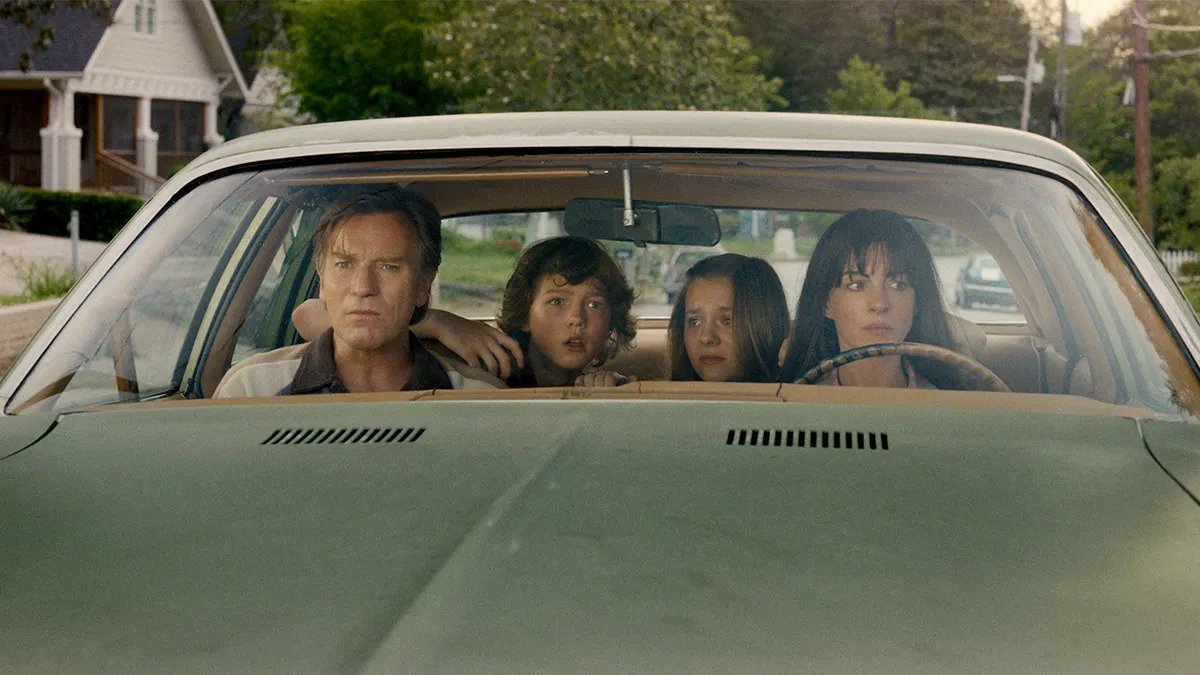

Children might love them and toys might make them seem cute, but living alongside dinosaurs would be horrifying. It’s hard to think of a film that conveys this more explicitly than David Robert Mitchell’s The End of Oak Street, which follows a family who mysteriously have their entire neighbourhood transported to the prehistoric era. No, not even the Jurassic Park franchise leans into the horror of dinosaurs as much—not even the Gothic horror-influenced entry in that franchise, Fallen Kingdom (2018). The Jurassic Park movies are ultimately in thrall to the wonder of dinosaurs existing alongside humans, no matter the violence and terror they can inflict. The End of Oak Street may take its inspiration from Steven Spielberg movies, particularly his 1980s run, but it’s rather more indebted to the nastier movies made by his production company Amblin Entertainment during that period, such as Gremlins (1984) and Poltergeist (1982).
Set in a Michigan suburb in 1982, the film opens with a neighbourhood barbeque that shows a seemingly idyllic community and introduces us to the Platt family: Denise (Anne Hathaway) and Greg (Ewan McGregor) and their teen children, Audrey (Maisy Stella) and Brian (Christian Convery). Right from the get-go, Mitchell punctures the sunny, idyllic vision of suburban life as Denise and Greg bicker about Greg letting Brian have his unruly dog Starbuck out for the barbeque as well as Greg ducking out early to work a side gig as a pizza delivery man. Turns out their marriage is on the rocks: Denise dreams of being a novelist and her first manuscript is all about a woman finally breaking free of her restrictive marriage—a clear personal fantasy, if there ever was one. For his part, Greg has secretly been laid off, swigs whisky when Denise is not looking, and refuses to engage with any of their marital problems.
Audrey, who’s a science nerd obsessed with Carl Sagan, and Brian, who’s a bit of a loser pining after Jeannette (Jordan Alexa Davis), the new girl on the block, both sense that their parents are having issues, but refuse to believe they could ever separate. Turns out the whole family is in denial about their circumstances. Well, life has a way of blowing up our little illusions, as happens one night when a massive thunderstorm mysteriously transports the entire neighbourhood millions of years back in time. When the family realizes that the lack of power and water is the least of their problems, as raptor-like predators and aerial pterosaurs start terrorizing the neighbourhood, they have to confront their issues once and for all: do they want to stay together or try to survive on their own?
The End of Oak Street has a classic set-up for such a family-driven creature feature, where the fantastical circumstance the family faces resolves their own interfamilial conflicts. It’s conventional, yes, but effective, especially as it clarifies each character’s motivations throughout the film. It also provides some genuine pathos in quieter moments between Denise and Greg, such as when Denise confronts Greg for smelling like whisky, castigating him for drinking at such a terrible moment. She completely undoes Greg’s retort, that he was shaken up and needed to settle, by telling him she knows it’s not this one time, but most times, and that it’s the sort of habit that becomes a genuine problem when she needs him focused and doing his best for the family. The early set-up also explains how Denise and Greg’s desperation genuinely fuels their often-impulsive actions in a quest to survive. If the status quo has doomed their family unit, then they’re willing to do anything to chart a way forward.
Once the neighbourhood is sent back in time, the film becomes a classic creature feature: the family has to navigate the neighbourhood in hopes of finding a way back to their own time, running into new dangers as bigger and scarier dinosaurs show up and set their sights on the family. There are lots of chases across manicured lawns, running up stairs, and hiding from creatures, big and small, who snap and claw at our heroes.
The filmmaking typically recalls Spielberg or producer J.J. Abrams more than David Robert Mitchell’s previous works, particularly his breakthrough It Follows (2015), but there are a few moments of genuine horror. Best of all is when a pale, giant snake, which we earlier glimpse cooling in an above-ground pool—a direct reference to It Follows, perhaps?—later silently slithers into the house, filling each corridor until its giant, man-sized head is ready to swallow one of our heroes gathering supplies in their room. The broad daylight, slow, silent approach of the monster recalls the inevitable horror of the spectre of It Follows—and gives extra willies for anyone who doesn’t like snakes, as I don’t.
Mitchell knows how to best craft these small moments of tension. He’s decent at the larger scale bursts of neighourhood rampages and collateral damage that happens with bigger dinos like the allosaurus and spinosaurus, but it’s in the icky, tense domestic situations where he shines. He doesn’t have the sweep of Spielberg or even the kinetic motion of his producer Abrams. Not every moment in the film sings, but it’s a decent approximation of the summer fun of the past, and more organic and lived-in than the synthetic approach of 1980s-obsessed properties like Stranger Things.
Mitchell also has that bitter edge that Spielberg typically lacks. For instance, there’s a cruel irony to starting the film with a sunny look at communal harmony since what follows shatters the illusion of such camaraderie in a suburban neighbourhood. Throughout all the family drama and creature feature chases, The End of Oak Street skewers suburban community dynamics, much like Joe Dante’s aforementioned Gremlins but especially The ‘Burbs (1989). When the chips are down, no one is out to protect their neighbours, rather hiding in their own homes—their supposed castles—and clinging onto any last vestiges of independence when the situation outside is out of control. A man’s home might be his castle, but when a spinosaurus barrels in through the front window, castle doctrine doesn’t help you survive. Mitchell even crafts a few gruesome sightgags, such as when a woman scolds the Platts for driving on her lawn only for a dino to bite her head off.
The image of a dino biting a woman’s head off sums up The End of Oak Street. It’s broad, entertaining, effective, nasty, a distillation of what big late summer movies were in the past and could be again.
7 out of 10
The End of Oak Street (2026, USA)
Written and directed by David Robert Mitchell; starring Anne Hathaway, Ewan McGregor, Maisy Stella, Christian Convery.
Read More Reviews
Matt Bettinelli-Olpin and Tyler Gillett’s action horror sequel is a mere reheat.