Halloween Horror Review: It Ends (2026)
Like a savvy blend of classic existentialist theatre and recent liminal horror, Alexander Ullom’s It Ends works its way into your psyche and conjures one of the most disorienting effects I’ve experienced from a movie in recent years. The last horror movie to leave me this queasy and panicked was 2023’s Red Rooms, but the better comp might be 2013’s little-seen-but-much-admired Coherence, which follows guests at a dinner party who accidentally stumble into endless alternate universes. It Ends might not be as tonally sly as James Ward Byrkit’s high-concept sci-fi thriller, but it presents a similar spin on a The Twilight Zone-esque plot along with in-depth, credible characterizations. Ullom’s film just dials down the jokes and dials up the nightmares to conjure a cinematic vision of infinity that makes you dizzy with dread.
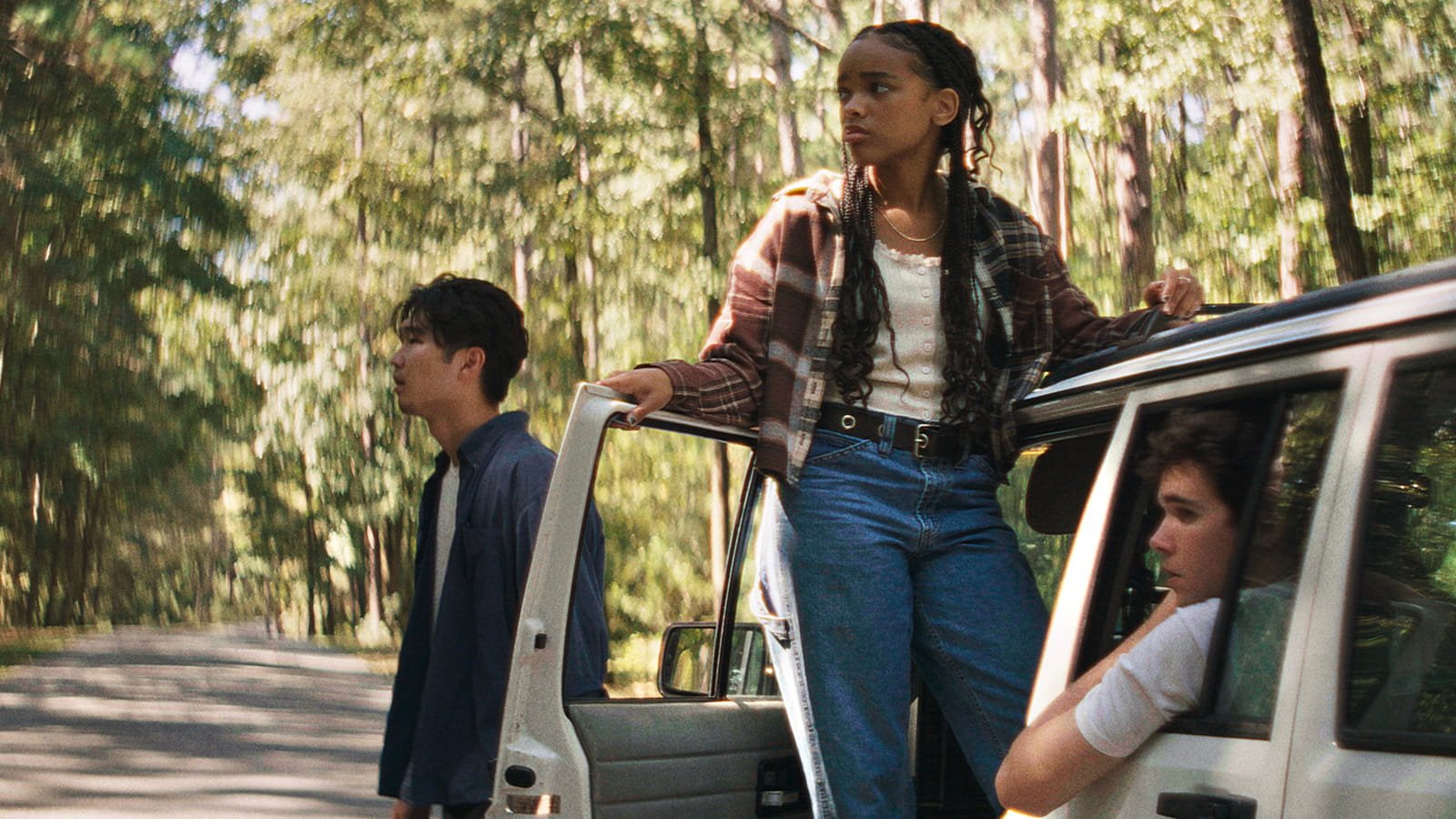
I mentioned the influence of existentialist theatre. Similar to a Jean-Paul Sartre or Samuel Beckett play, such as No Exit or Waiting for Godot, It Ends has a clear, minimalist premise with a small cast and restricted setting. Four recent grads, James (Phinehas Yoon), Day (Akira Jackson), Fisher (Noah Toth), and Tyler (Mitchell Cole), go for a drive to get food before James moves away for a job. But as they follow their GPS app onto a forest road, they never hit the turn they’re expecting. Tyler turns the car around to return the way they came, thinking they missed the turn, but they hit a wall of trees where the previous turn should have been. They’re stuck, it seems, on this forest road with no option but to go on and see what might exist down the line.
I also mentioned the influence of liminal horror, with its probing of spaces such Backrooms or Exit 8. However, if you’re expecting lore, exposition, or a deepening storyworld like you get in those films, you won’t get it with It Ends. Like the aforementioned existentialist writers, Ullom retains the minimalist approach throughout. Part of this is a result of the film’s ultra-low budget. It was shot for around $30,000 and ultimately cost $80,000 including post. Most of the scenes were shot in a warehouse with the characters in a Jeep against an LED wall (which Ullom could access as an alumnus of Florida State University). Exteriors were shot in a national park. But the final product is seamless. Furthermore, unlike so many movies with restricted settings (or plays for that matter), the film doesn’t seem restrictive at all. This is hugely a result of the character work and the strong, naturalistic performances by the unknown cast.
Taking inspiration from Linklater films, Ullom crafts the dialogue as casual yet specific banter between lifelong friends, which not only conveys the bonds these characters share, but also provides a credibility that does wonders for helping us experience the enormity of their peculiar situation. It helps that the dialogue is authentically odd, at points. For instance, the movie begins with the characters arguing over a thought experiment based on a meme depicting four collections of animals: which two would you want to protect you and which two would you want to fight? 10,000 rats, 50 hawks, 10 gorillas, 5 humans with guns? It’s a stupid, meaningless game, but they passionately argue about it as they weave in and out of long-standing disagreements, in-jokes, and references to their shared past. It doesn’t take long to establish the dynamic that not only are these real Gen Z people, but also they truly know each other such that they can waste their time arguing over a thought experiment rather than confronting the harder questions staring them in the face.
All four of the cast are excellent, but Phinehas Yoon as James is particularly impressive. James has the film’s core character arc, moving from a rational incredulity with their situation on the never-ending road to a philosophical acceptance of some supernatural meaning to the events to fanatical devotion to some future state that he desperately believes will resolve their issues. Yoon has a stoic face that hides a lot of emotion, but he conveys a lot with his posture, such that we can tell when his ramblings about potential meanings of what they're experiencing are likely masking a deep panic or when he’s genuinely trying to get an answer. James is the one, who as if hearing the viewer’s own conjecture, starts wondering whether they died and have gone to hell or purgatory. He asks the others whether they’ve done anything awful worth divine punishment, and the others think it’s a joke, but the longer the conversation goes on, the more they realize he’s being deathly serious.
Much of It Ends follows this kind of rhetorical approach: philosophical conversations conveyed in ways that are hyper-specific to these characters and their relationships. In an interview with Filmmaker magazine, Ullom references Linklater’s debut feature, Slacker, as a key influence, which makes a lot of sense. It Ends shares an interest in dorm room philosophy that delivers its higher concepts in a naturalistic way, which is similar to the approach to dialogue and theme in many Linklater films such as Slacker, Waking Life, and even his Philip K. Dick adaptation A Scanner Darkly.
It Ends also shares the disarming structure of many philosophical questions and how they’re discussed in these Linklater films. There’s an initial question or thought, casual banter, and then a gradual transition into serious interrogation and self-reflection. For It Ends, the characters are struck by this initial scenario, their disbelief in what’s confronting them turns to banter and then the striking realization that, no, this might all be real, they might actually be experiencing the impossible and they have to contend with that fact regardless of what they think about the situation.
So, unlike many horror films, It Ends succeeds not just for its concept but also its execution, mostly notably its commitment to the strange premise, its philosophical probing, and its believable characters. But did I mention the film is terrifying? There aren’t many conventional horror elements to the film, aside from a threat that resides in the woods and attacks them if they leave the car for too long. Ullom mines the tension of these moments of the characters watching over the woods, trying to distinguish movement amidst the towering trunks and dense shrubs. During these sequences, the camera pans over the forest and the movement of the camera captures the anxious energy of the characters. Eventually, it stops on a gap in the trees and you have to wait to see if something will reveal itself in the woods. The camera stopping is itself proof enough that some terror is about to arrive, so it gets our defences up.
Inside the car, he visually takes a page from David Robert Mitchell, director It Follows (the film’s title might be a homage to Mitchell’s film, as well as a statement about its own narrative), and utilizes 360-degree pans to amplify the tension between foreground and background action: the inter-personal things happening to the characters in the car in the foreground and the mysterious happening in the ditch and woods around them in the background. These sorts of decisions convey a confidence in visual storytelling as well as a masterful command of tone.
But it would all be for naught if the film didn’t have a conceptual rigour unheard of in most movies, even high-concept horror films. It Ends never breaks its own rules, largely because it so stringently refuses to explain them. As the characters drive down the road, they realize the car doesn’t run out of gas. They don’t grow hungry. They don’t get sleepy. But the road continues on. The odometer keeps moving up. Hauntingly, they pass an abandoned car with an odometer that’s hit 999,999. That single visual and the absence of the driver speaks volumes to the terror of this reality the characters have found themselves in.
It Ends is one of the few movies to truly conjure the terrifying experience of eternity, what it actually would be like to do the same thing, day in and day out, forever and always. There is a lot of metaphorical depth to mine here, from the idea of leaving the promise of adolescence into the doldrums of adulthood, to the fear of a generation entering the real world with no strong religious or philosophical belief systems to support themselves, but the film hardly needs these subtextual interpretations to work as an existential horror film. This is a bone-deep, sweat-inducing nightmare of what could await us in the void beyond our reality. Impressive work for any director: for a debut filmmaker, it’s staggering.
9 out of 10
It Ends (2025, USA)
Written and directed by Alexander Ullom; starring Phinehas Yoon, Akira Jackson, Noah Toth, Mitchell Cole.

Read More Reviews
Alexander Ullom’s high-concept debut feature conjures an existential nightmare.