Review: Rocky (1976)
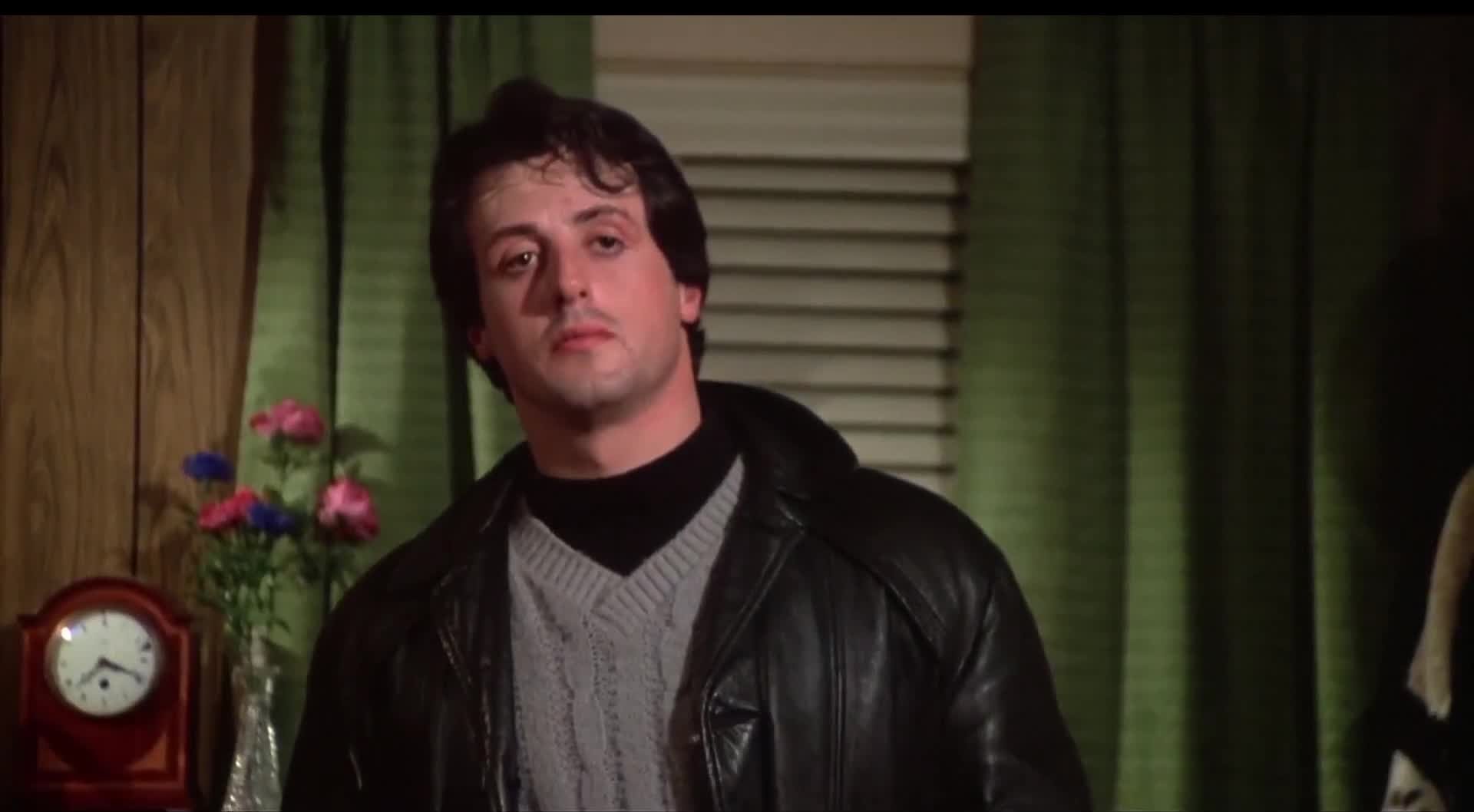

Rocky is a great movie—among the greatest sports movies and certainly the ultimate underdog sports movie. At the same time, it is sometimes diminished by the cinephile crowd as being mediocre, predictable, or at least not so great. One reason seems to be that Rocky won Best Picture at the 1977 Academy Awards, beating out several more acclaimed movies, namely Taxi Driver, Network, and All the President’s Men. The Academy’s choosing of the underdog movie with the happy ending over darker, more ambiguous, and more political works has been seen as an omen of the end of the New Hollywood Renaissance, which Star Wars, the next year, would only reinforce. There’s also the fact that Rocky was, and remains, a popular hit that has spawned a never-ending movie franchise with three distinct phases: there are the numbered sequels, Rocky II–V (1979–1990); the sixth film and early legacy sequel, Rocky Balboa (2006); and the three Creed spin-off movies of recent years (2015–2023), starring Michael B. Jordan. Can anything that has spawned this many retreads actually be of artistic value? Lastly, there’s the star, Sylvester Stallone, who, as much as he maintains a fan base, is also a punchline for others, a name used mockingly to signify populist action movies for meatheads.
To be clear, I think Stallone himself deserves far more credit than he often gets—for instance, he’s smarter, more artistic, and more thoughtful than many people think. For a segment of people out there, however, Stallone seems to have been cursed by misperceptions about his original hits (Rocky and 1982’s First Blood, the first Rambo movie) as well as his subsequent macho aesthetic. All that said, right now I want to focus on defending and praising the original Rocky and his work in it as both the screenwriter and star. I revisited Rocky this past year for its 50th anniversary (it notably came out the year of the American Bicentennial and this summer was America 250). I was pleased to rediscover that Rocky is a deeper and richer text than many remember.
For the few people out there, probably younger, who might not know, Rocky is about a down-on-his-luck prize fighter, Rocky Balboa (Sylvester Stallone), who gets the extraordinary opportunity to fight the Heavyweight Boxing Champion of the World, Apollo Creed (Carl Weathers). For America’s Bicentennial, Creed plans to have a big fight in Philadelphia, and when his original opponent has to bow out, Creed selects Rocky for the marketing novelty of fighting “The Italian Stallion,” which is Rocky’s nickname. To prepare for the big fight, Rocky trains with Mickey (Burgess Meredith). As he begins to turn his life around, Rocky also begins to date Adrian, the shy girl from the pet shop he frequents; Adrian is the sister of his loutish friend, Paulie (Burt Young).
Although Rocky tells a familiar story and is obviously a rousing crowd pleaser, two scenes emblematize the film’s substance and artistic aspirations. First, I was struck by a scene in Rocky’s terrible apartment when he looks at himself in the mirror for a length of time, and I couldn’t help but recall another character from 1976, Robert De Niro’s Travis Bickle from Taxi Driver, who also stares at himself in the mirror in a key scene. The former contemplates his life, pictures of his youth adorn the mirror, his hat resting on a knife stuck in the frame; the latter improvises and rehearses the new persona he is trying to adopt. Both scenes mark points in the protagonist’s transformation, but their journeys are in different directions: Rocky’s journey is one of ascent, Travis’s that of descent. In Rocky, the mirror scene also balances the tensions between Classical Hollywood economical storytelling and New Hollywood aesthetics and themes. While the information provided within the frame gives quite an overview of his life and the seemingly lost potential of his youth, the lingering nature of the shot accords with the New Hollywood desire to be unadorned, realistic, showing life as it (seemingly) is.
The second scene, a long single take of raw anguish, is even more New Hollywood. Rocky lashes out at Mickey, who has finally said he wants to be Rocky’s trainer, but who never gave him the time of day before. It’s one of those scenes that are a jumble of emotions and motivations and revealed past encounters—the kind of thing New Hollywood often did so well, and which seems hard to duplicate without feeling forced and fake in today’s artistic landscape.
Perhaps the first Rocky should actually be remembered not as a blow against, but rather another entry in, New Hollywood realism. As Peter Farrelly’s new movie, I Play Rocky, explores—and which features a brilliant remake of that memorable second scene—Stallone wrote the original screenplay himself and fought to play the starring role. Without taking away from John G. Avildsen’s work as the director, there is a distinctly auteurish aspect to Stallone’s hand in the movie. It is no surprise that he would become the creative force later propelling the franchise along. But there’s also the film’s aesthetic, which today exudes New Hollywood realism, as if the conventional sports tale were donning gritty realism like Rocky putting on his beat-up grey sweatsuit. The New Hollywood aesthetic is present throughout the movie, from the acting to the camerawork.
It’s also there in the story and the setting. As the film begins, Rocky is down on his luck and, frankly, his life looks grim. When I showed the movie to my boys this year, they were really struck by how terrible Rocky’s apartment is, and how rough his life looks. Rocky works as a collector for a loan shark down by the docks. Rocky’s world is working class and tough: meat packing, docks, hard city streets. Philadelphia looks so cold and hard. At the time, this was somewhat conventional for New Hollywood, but today it looks downright awful in comparison to the vague suburban everyhomes or urban townhouses in most movies today. The film’s willingness to have the hero work for criminals shows the complicated nature of characters in this period of American film. Rocky is also famously not bright—he’s well meaning and good natured but can be taken advantage of or make poor choices. This will become a tragic flaw in the second film, but this weakness is also a strength, especially in this first film. Rocky chooses to do a dumb thing—fight the Heavyweight Champion of the World, Apollo Creed—and it almost kills him. He overcomes through sheer perseverance and the willingness to take a beating.
The supporting characters have well-drawn personalities and they depict a segment of society that New Hollywood was drawn to: regular working class people with real flaws, even ugliness to them. Take Rocky’s pal, Paulie, who is a complete jerk, and who is incredibly cruel to his excruciatingly shy sister, Adrian. When Paulie essentially abuses Adrian in one scene, we see a rawness and nastiness to their domestic relations that is only played for exaggeration or terror today—rather than as a grim, unpleasant, but regular aspect of life.
Rocky’s persistence in courting Adrian is the main subplot. The bumbling nature of Rocky’s attempts perhaps cover over the conventional aspects of the courtship. Talia Shire gives the ultimate shy girl performance. We can see that she’s almost in pain when she has to speak to people. But of course she’s not the first attractive young lady in a movie who hides her beauty from men with glasses and her choice of outfits. We’ve seen this before, but it works. Likewise, their first date on the ice rink after closing is truly memorable—she can barely skate and Rocky is just sliding around on his shoes—but the special setting creates moments of authentic connection between them. That said, its cute novelty also covers how much of a “meet-cute” date it is.
While the rest of the cast is also strong, no one is better than Sly. His ticks and mannerisms, now so well known as to be cliches, are actually so good. At times, there’s a bit of a James Dean, turning and leaning away from looking people in the eyes. Stallone wrote the movie, but his performance gives those words life.
As a guy who functions as a collector on the docks for a gangster, there are also echoes of the great On the Waterfront (1954), in which Marlon Brando’s collector and one-time boxer laments to his brother, “I coulda been a contender.” Rocky is almost a movie conceived in reaction to that speech, about how a similar-type character just escapes being a “coulda been” and becomes “a contender” through a fairy tale event managed by the Heavyweight Champion of the World, who seeks even more fame and spotlight. (Famously, another great boxing movie, Raging Bull (1980), has De Niro’s Jake LaMotta repeat the monologue from On the Waterfront. There’s an interesting nexus of intertextuality among these boxing movies.)
In my view, it is Stallone’s script’s perfect linking of the personal and the sport that makes the film so powerful. These come together best in the training scenes as well as the film’s triumphant ending. The reason the Rocky training montage is the greatest of all time is not only that the music is great—Bill Conti’s score is justly famous—but also that it demonstrates a total reboot in Rocky’s life. Rocky doesn’t want to be a “bum” anymore. He wants to be somebody. Rocky’s journey taps into a raw desire inherent in all of us. We want to become better. We want our lives to have some meaning. The film’s raw optimism, never treacly or manufactured, works like a tonic.
The ending is brilliant, but it also embodies a degree of ambiguity of the New Hollywood era. The fight pays off in terms of a fight scene. The fight has a conventional arc to it, using a combination of rises and falls and breaks, montage and drawn out moments, but it is still effective. Avildsen’s fight compositions also seem unadorned; contrast them with Raging Bull, in which Scorsese uses unique audiovisual stylistic devices to convey the themes behind each fight. At the end, Rocky loses the fight, in what is essentially a toss up, but he knows he has won at turning his life around. A lesser film would have had him win outright. We cheer his loss to Creed because the fight itself and going distance is the real accomplishment. That is why he is so focused on Adrian: not only because he loves her but also because she symbolizes his renewal and victory in life.
All of this also works because of the film’s deft handling of the antagonist, Apollo Creed. It is essential that Creed is not a villain. Although he is full of himself and perhaps needs a humbling, he is also charismatic and likeable. Carl Weathers plays Creed with such gusto and momentum that we buy into his absurd idea for the Bicentennial Fight. The fact that Creed pitches the idea of fighting an underdog to his managers and promotional team helps pitch the absurd concept to the audience. We buy in because even within the storyworld it is a gimmick: a manufactured chance at the American Dream. Along with the New Hollywood aesthetic to the visuals and settings, this narrative distancing also helps refresh the boxing underdog story at the heart of the film.
So, is Rocky the greatest sports movie of all time? There are certainly other sports films that are great. In the best of these—such as Raging Bull (1980), Chariots of Fire (1981), or Field of Dreams (1989)—while the sport is integral—be it boxing, sprinting, or baseball—the narrative scope and its themes seem more expansive. The sport is essential but is also the means to tell a story, about a man or about a nation. Those three films I’ve mentioned are stranger, less conventional, and thus contain a greater range of significance and meanings than Rocky. It is easy to look at Martin Scorsese’s Raging Bull, with its classical music and experimental sound design and visuals, and say, “Now that’s not a boxing movie, that’s a work of art!” This isn’t to say that Rocky isn’t about more than just boxing, or that it lacks any art. Clearly, it is first and foremost about the man Rocky, who (as is joked in I Play Rocky) just happens to be a boxer. And clearly, the American Bicentennial that lies across the background of the entire movie gives the story of Rocky Balboa a larger significance, connecting his aspirations to those of the nation wanting to rebound during a famously fraught decade (the 1970s). But Rocky is also a simple story. It’s not trying to be complicated, experimental, or artistic. It’s trying to tell an inspiring story, and its all-in passion for the tale, and its simplicity, make it something essential.
Its success and lasting impact have also made Rocky the new origin point for the underdog sports tale. Anytime anyone makes another sports movie now about rising up and going the distance to achieve one’s goals, and thus transform and improve oneself, they’re remaking Rocky (just as many Rocky movies have remade the first Rocky). In other words, when we think of the sports genre, with its various conventions, Rocky is at the beating heart of it. And Rocky has more heart than just about any movie ever made.
10 out of 10
Directed by John G. Avildsen; written by Sylvester Stallone; starring Sylvester Stallone, Talia Shire, Burt Young, Carl Weathers, and Burgess Meredith.
Related Posts
Scott Beck and Bryan Woods’ horror thriller weaponizes Hugh Grant’s diabolical charm.