Halloween Horror Review: Heretic (2024)
There’s always been something diabolically charming about Hugh Grant. The stuttering Oxbridge accent. The disarming non-chalance. The wide, toothy smile. It’s mostly in his eyes, though, those watery blue eyes which always have a twinkle in them, betraying that sometimes he knows something you don’t.
Scott Beck and Bryan Woods’ psychological horror movie, Heretic, uses Grant’s diabolical charm for all its worth. It’s no wonder that Grant sports a massive pair of wire-rim glasses throughout the film, as if framing his eyes as the key to his charm, and his terror. The movie lives and dies on Grant’s performance, which is riveting. The rest of the movie is decent, too, if predictably falling apart in the home stretch like so many horror movies to come before it.
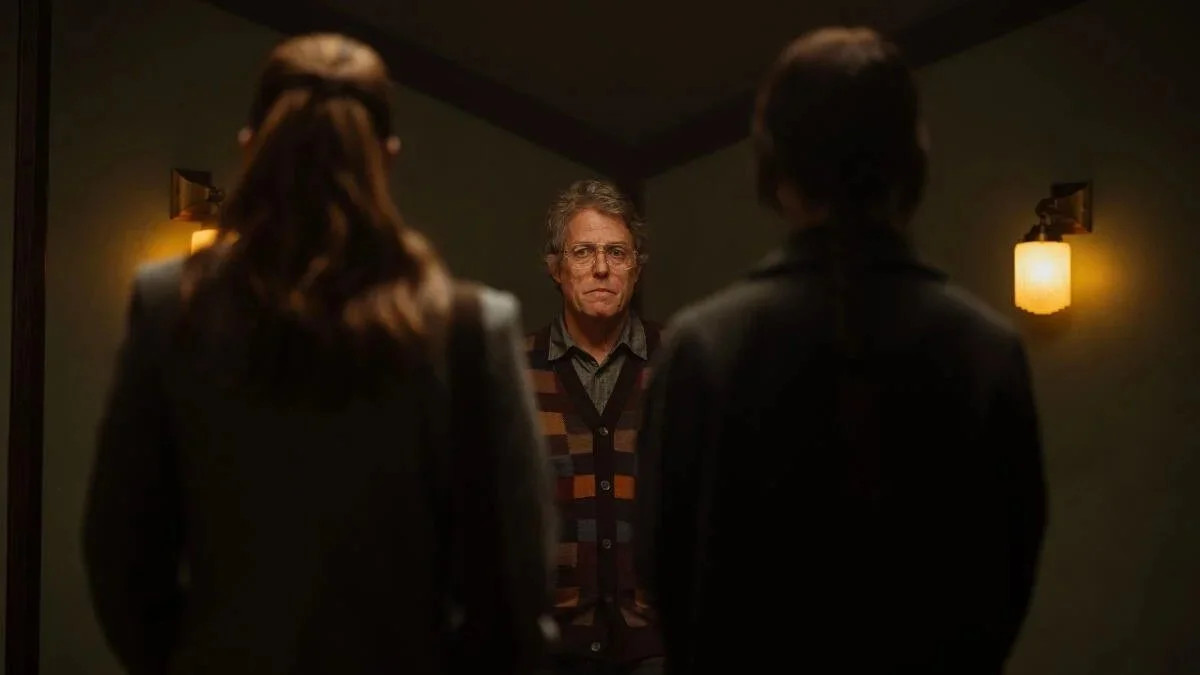
Grant plays Mr. Reed, an older gent with a large house in Boulder, Colorado with a deep interest in religion. He’s the final name on a list of potential converts for Sister Barnes (Sophie Thatcher) and Sister Paxton (Chloe East), two Mormon missionaries looking to win souls for the kingdom. Reed invites them in (assuring them his wife is in the other room, so they’re safe to be inside with a man), makes friendly small talk, and asks them some pointed questions about their faith. They light up at his interest in the Church of Latter Day Saints. but all is not right with Mr. Reed, as becomes quickly apparent. He has ulterior motives and begins testing the girls on why they believe what they believe—all in his disarming, charming, articulate manner, of course.
Turns out Mr. Reed is a psychopathic atheist who is going to test these women to get at what he believes is the root of all religious belief. His seemingly-earnest questions turn prodding and then aggressive, and soon enough, he’s making weaponized arguments about the links between Mithras, Horus, and Christ like he’s an avid reader of r/atheism or was hugely influenced by Sam Harris and Richard Dawkins in college. Reed’s arguments are purposefully limited (it doesn’t take much knowledge of the history of religion to poke holes in them), but it’s fun to watch Grant relish this argumentative material. During the film’s best sequence, Mr. Reed produces a copy of the boardgame Monopoly and proceeds to rant about ideation in religion by discussing how the game copied the earlier The Landlord’s Game and how Radiohead’s “Creep” stole the melody from The Hollies’ “The Air That I Breathe.” Grant’s polite, structured way of speaking helps the argument land, especially as it starts to dawn on these women that Mr. Reed likely has more surprises up his sleeve.
Most of Heretic strikes a nice balance between this escalating argument between Mr. Reed and the missionaries, and the escalating series of creepy coincidences that reveal more of Mr. Reed’s diabolical scheme. It effectively builds tension, and pays it off with some captivating sequences, such as the Monopoly scene mentioned above. The tension starts slowly with little incongruities: Mr. Reed says he has a blueberry pie baking in the oven, but then Sister Barnes sees that the candle he has burning is scented as blueberry pie. Mr. Reed gets the girls some refreshments, but happens to pour them glasses of soda, seemingly not realizing that Mormons don’t drink caffeine. We learn that Mr. Reed is deliberately provoking them to see how they will respond, and the women respond well, as they initially believe that they can still convert Mr. Reed. They’re also unfailingly polite—Mormons are famous for their positivity, their politeness, and their good manners. And Mr. Reed uses this to his advantage to extend the conversation and get them deeper into his house.
Beck and Woods, working with their cinematographer (and frequent Park Chan-wook collaborator) Chung Chung-hoon, do a good job of allowing the camera to amplify the cinematic elements of the house. Wide shots emphasize the wood trim, heavy doors leading to hidden parts of the house, and shadows cast by vintage light fixtures and heavy sconces. The environment is well designed, and the camera expands the space within the frame, while still keeping most of its focus on the characters’ faces with ample close-ups. You could never accuse the film of looking like a filmed play, like so many movies set in a single location.
Once the women make it to the central room in Mr. Reed’s house, where he has two doors leading deep into the mountain, one marked “Belief” and the other “Disbelief,” the cat’s out of the bag regarding his intentions, but the full nature of Mr. Reed’s plan is still unknown. The characters descend, he reveals more surprises, and the movie starts to riff on Barbarian (2022) and other recent movies weaponizing the mystery of “what’s in the basement.” That’s when things go sideways, like with so many horror movies. Coincidences pile up. Character actions grow questionable. The rhetoric and rigour of the early tension-building scenes are replaced by out-and-out sadism that’s hard to comprehend within the world of the movie as established earlier.
The movie eventually course-corrects with a grace-note ending, but like so many other promising horror movies, Heretic is structurally and narratively uneven. It’s so much easier to begin a scary story than end one, it seems. Unlike Grant’s performance, and Mr. Reeds’ earlier arguments, the film’s resolution lacks conviction. Luckily, Grant is there throughout, smiling, charming, deflecting, keeping us engaged and convinced even when his film cannot.
6 out of 10
Heretic (2024, USA)
Written and directed by Scott Beck and Bryan Woods; starring Hugh Grant, Sophie Thatcher, Chloe East, Topher Grace.

Read More Reviews

Matt Bettinelli-Olpin and Tyler Gillett’s action horror sequel is a mere reheat.