Review: Down the Road Again (2011)
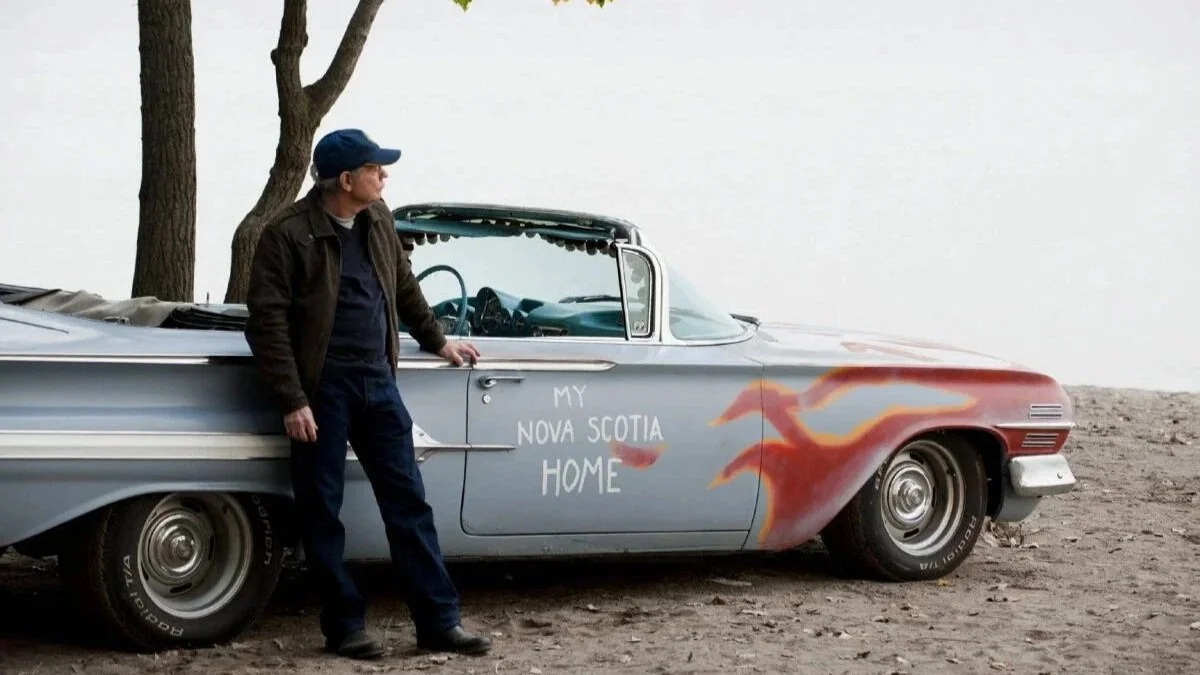

Down the Road Again is a well-meaning but misguided late sequel. Not every story needs resolution, nor does every character need closure, but when you get older, sometimes the desire for sentimental finality grows overwhelming. Evidently that is what happened with Donald Shebib, who revisited the characters of his landmark 1970 Canadian film, Goin’ Down the Road, 40 years later and decided to resolve all the unresolved tensions that made the original film a masterpiece.
The impulse is understandable. When he made Goin’ Down the Road, Shebib was 32-years old and evidently cynical about the world. When he made Down the Road Again in 2011, he was 73, and presumably looked at the world a lot differently. Down the Road Again represents the desire to rework, undo, and provide closure—all good things in themselves, but ill-fit for Pete and Joey, the brilliantly difficult characters of Goin’ Down the Road, who seem beset by economic, class, and personal issues they will never be able to overcome.
The last time we see Pete (Doug McGrath) and Joey (Paul Bradley) in the original film, they’re hitting the road once again, this time to flee Toronto, particularly Joey’s wife, Betty (Jayne Eastwood), and their unborn child, as well as their potential arrest and punishment for clobbering a grocery store clerk with a tire iron. In other words, it’s a dark, difficult ending, and one characteristic of movies of that era. When we catch up with Pete 40 years later in Down the Road Again, we learn he made it to Vancouver, but that he never did make much of a life for himself. Newly retired from his job as a mail carrier for Canada Post, Pete gets unwelcome news that Joey, who was also living in Vancouver, has died and has left him three letters. Pete honours his old bud by reading the letters and following their instructions to drive his ashes out to Cape Breton, Nova Scotia, where they grew up and their whole road journey began, and to make up with Betty in Toronto along the way.
Although it predates the run of legacy sequels popular in the mid 2010s, such as Star Wars: The Force Awakens (2015), Down the Road Again shares such films’ penchant to blend returning characters with new ones who are supposedly as interesting as our original heroes. In this case, it’s Joey and Betty’s daughter, Betty-Jo (Kathleen Robertson), who accompanies Pete for the ride to Cape Breton once he shows up in Toronto.
Betty-Jo is a female ne’er-do-well—out of work, constantly flaming out with men, rough, irascible. Over breakfast at a diner, Pete tells her she’s just like her old man—which the movie makes pains to spell out time and again. Except, Betty-Jo is not quite like Joey in Goin’ Down the Road. Rather, she’s like this movie’s revisionist version of Joey, a more mature man who we learn about through his letters (Paul Bradley died in 2003, so it was never possible to see Joey on screen once again). This epistolary Joey is contrite, repentant, and refreshingly clear-eyed about the world and his impact on it, unlike the younger man who seemed so unsure of his every decision in Goin’ Down the Road, making it possible in that film for Pete to bully him into abandoning his family and striking out for fortune once again. This posthumous Joey is a trickster with a heart of gold, rather than just a complex, loveable, yet difficult man with irreconcilable contradictions. Accordingly, Betty-Jo is a bit of a firecracker, but just the kind that an old man would come to love—a manic pixie surrogate daughter if there ever was one.
After bonding with inexplicable speed—Shebib shows off his television skills by resolving the conflict between Pete and Betty-Jo over the course of a few efficient road scenes together—the movie settles into Cape Breton, where it stagnates. For one, most of the conflict is resolved by then. Pete and Betty resolve their differences. Betty-Jo comes to look up to Pete like a father. Even Pete is apologetic to everyone, no longer the angry man with a dream of being something more but without the smarts or the luck to pull it off.
It doesn’t help that once Pete and Betty-Jo make it to Cape Breton, the movie shifts from being a road trip quest into twin romances—one between Betty-Jo and Matt (Anthony Lemke), the handsome young lawyer handling Joey’s estate, and the other between Pete and Annie (Tedde Moore), a mysterious old flame suffering from Alzheimer’s who happens to be Matt’s mom. It doesn’t take a genius to know that Annie is Pete’s long lost love, that Matt is Pete’s kid, and that in one fell swoop of genius, Joey, from beyond the grave, has managed to not only give Pete the family he never had, but also his daughter the surrogate father he never could be.
The narrative differences between the original and its late sequel are accompanied by changes in style. If you look at the trajectory of Donald Shebib’s career, from directing Goin’ Down the Road in 1970 to directing episodes of The Zack Files and Radio Free Roscoe in 2002 and 2003, you understand why Down the Road Again looks so different from Goin’ Down the Road. It trades in the independent filmmaking style of the late 1960s, full of unadorned performances, vérité camerawork, and tension so ripe and iconically Canadian that it seems to define the entire working class Canadian experience, to the conventional Canadian television filmmaking style of the 2000s, with clear arcs, quick conflict resolution, no rough edges, no questions left unanswered.
Shebib’s television approach is evident in every frame of Down the Road Again, which sets up and pays off every single dramatic tension that crosses its path. For the sequel to a classic of independent film, it also strangely presents a case of the shrinking world syndrome so characteristic of franchise late sequels, where the dramatic explanations end up shrinking the characters and their impacts on the world, as if all things can be explained by one wayward letter, one lost love, and one bad decision, rather than the cascading little decisions and reckless actions that spread out into a bad life like in Goin’ Down the Road.
While I think Shebib’s career turn towards television helps to explain this late sequel, I don’t mean to suggest that directing Canadian television is easy and doesn’t require intelligence and skill—it’s a harder job than most of us will ever know. It’s not like Donald Shebib became a bad filmmaker over the years—he undoubtedly knew more about filmmaking in 2011 than he did in 1970. But Goin’ Down the Road is not Canadian television material. It’s slippery and ambiguous and ugly. It presents a kind of messy, unresolved narrative that doesn’t lend itself to television, and it looks rough and raw, which visually complements the narrative.
In contrast, Down the Road Again is not ugly. In fact, it’s downright lovely in moments, if you can handle the high sentiment and gentle music that practically begs you to wistfully remember the past, much as Pete does throughout. Shebib even helps the viewer reminisce by constantly intercutting footage from Goin’ Down the Road.
While I’ve spent most of this review discussing Donald Shebib’s directorial decisions, it would be a mistake to overlook the other creative continuities with the original film film, especially the actor Doug McGrath, who plays Pete in both movies. McGrath is so compelling as Pete that he almost saves the film. It’s a pleasure to spend more time with this bitter old man and witness him softening, like so many old men do, because time is no longer on their side and their dreams have been left by the roadside like the people they’ve abandoned in the past. It’s also lovely to see the other performers from the original film, such as Jayne Eastwood as Betty and Cayle Chernin as her best friend Selina. Chernin was hiding terminal cancer during making the film, knowing it would be her last work, and she died a couple months after filming wrapped. In retrospect, her nakedly eager performance in the film speaks to a desire to return to an old role and give one last performance in a meaningful work. The way she looks at McGraw’s Pete with such wistful enthusiasm speaks volumes.
There are nice moments in Down the Road Again, almost all courtesy of the older performers who relish revisiting their roles and pour years of experience in life and film into their performances. But the story is too eager to resolve everything for these people and make them characters in two movies rather than just portraits of people living life. Down the Road Again shows Canadian life as it’s imagined to be on the silver screen. Goin’ Down the Road shows Canadian life as it is, or was.
5 out of 10
Down the Road Again (2011, Canada)
Written and directed by Donald Shebib; starring Doug McGrath, Kathleen Robertson, Anthony Lemke, Jayne Eastwood, Cayle Chernin, Tedde Moore.
Read More Reviews
The History of Concrete is like a feature-length version of an episode of How To with John Wilson.