Sacrifice and the Ending of Spider-Man 2 (2004)

The title of Spider-Man: Brand New Day claims to be a fresh start for the superhero, but the core issues Peter Park faces in what was the summer’s biggest movie are hardly brand new. Of course, this isn’t surprising, given the serial nature of most superhero movies, especially those of the Marvel Cinematic Universe, as well as their status as adaptations. With the immense financial success of Brand New Day, and with the general praise for the film’s emotional resonance, however, it’s worth remembering that Peter Parker also struggled with his Spider-Man identity over two decades ago in Spider-Man 2 (2004), the second entry in Sam Raimi’s original Spider-Man trilogy featuring Tobey Maguire. Brand New Day gives us the opportunity to remember the achievements of Raimi’s films, especially Spider-Man 2.
Even before Christopher Nolan brought a new seriousness to the superhero genre with his Dark Knight Trilogy, Spider-Man 2 was being hailed as an artistic achievement by critics such as Roger Ebert, who, in June 2004, called it “the best superhero movie since the modern genre was launched with Superman (1978).” Raimi’s second Spider-Man film was written by veteran screenwriter Alvin Sargent—who won two Academy Awards for Best Adapted Screenplay, for Julia (1977) and Ordinary People (1980)—and was based on a story developed by Alfred Gough, Miles Millar, and acclaimed novelist Michael Chabon. In my view, Spider-Man 2 remains one of the best superhero films of all time, not just because of its great action scenes, deft comedic moments, and compelling tragic villain in Doctor Octopus (Alfred Molina), but especially because of the care and attention it gives to the development of Peter’s character and his relationship with the love of his life, Mary Jane Watson (played by Kirsten Dunst).
Peter Parker is famously a nerd, and Raimi’s trilogy, with Maguire in the lead role, leans into Peter’s meekness and social awkwardness in regular life. He’s a lovable dork. Even when wearing the mask of Spider-Man, Maguire can be heroic but rarely cool. Since his creation, Peter Parker has typically been conceived by different storytellers as “just a kid,” someone just like the young people reading the comic books and watching the TV shows and movies. In other words, Spider-Man/Peter Parker’s alignment with his target audience has always been assumed. (As Aren has explored in his recent essay on Brand New Day, the new film does a good job at presenting us with a Gen Z Spider-Man/Peter Parker.) The audience's connection to Peter (and not just admiration for the superhero) gives a soap opera appeal to Spider-Man stories, in that we care about the everyday challenges of Peter, which seem to make his heroic achievements as Spider-Man all the more satisfying. Raimi’s Spider-Man trilogy, especially the second film, is built around this audience identification. We get many scenes relating Peter’s challenges and misfortunes—his slumping grades at college, or his crappy apartment and difficulties paying rent. Even in the movie’s first scene, before we see any super-powered heroics, we see Peter as a pizza delivery boy who must deliver some pizzas on time or be fired.
From the get-go, Spider-Man 2 is conceived as an identity crisis for the dual-natured protagonist, who feels like he must choose between being Peter Parker or Spider-Man, between being normal and happy or fulfilling his great responsibility as a super-powered crime fighter. The voice over narration at the beginning of the film sets up this duality. Maguire talks to the audience over an image of Mary Jane, which is slowly revealed to be the budding actress’s face on a billboard advertisement:
Mary Jane Watson. Oh boy, if she only knew how I felt about her. But she can never know. I made a choice once to live a life of responsibility, a life she can never be a part of. Who am I? I’m Spider-Man, given a job to do. And I’m Peter Parker, and I too have a job.”
As the narrative develops, the film keeps asking, “But who is Spider-Man? And who is Peter Parker? Can they co-exist?”
As the sequel begins, Peter is bearing the weight of the famous dictum told to him by Uncle Ben (Cliff Robertson) and repeated in Peter’s voice over during the powerful ending of 2002’s Spider-Man. That first film starts with “Who am I? You’re sure you wanna know?” It ends with an answer: “Whatever life holds in store for me, I will never forget these words: with great power comes great responsibility. This is my gift, my curse. Who am I? I’m Spider-Man.” Even though he feels cursed, the film concludes with a resolution of his identity. In order to go even deeper into the character, the second film must work to trouble that identity.
At one point in Spider-Man 2, Peter will give up being Spider-Man, echoing the famous “Spider-Man No More” single issue of The Amazing Spider-Man comics. Raimi includes a shot that explicitly resembles a panel in that comic, showing Peter walking away in the background from his Spider-Man costume, which has been dumped in a garbage can in an alleyway in the foreground. As the story plays out, it resolves Peter’s identity crisis, but not through a rejection of either identity. Resolution also doesn’t come simply through learning that the different parts of oneself must work together, which seems to be the lesson in Brand New Day: you must find harmony with the seeming contradictions of oneself. Rather, In Spider-Man 2, Peter learns that, yes, each side shapes the other and can healthily co-exist, but only if one will carry the burden and pay the cost. The film also asserts that Peter’s particular human weaknesses keep him grounded and humble, and distinct from the hubris of the film’s tragic hero/villain, Doc Ock, who comes to think the good of his goals allows him to justify any means to achieve them. Spider-Man learns that his attachments as Peter aren’t simply liabilities; rather, they will fuel his ability to sacrifice for the greater good. In other words, Peter’s attachments are Spider-Man’s. They are two halves of his whole person, not competing personalities.
The corollary, which the film explores, is that those in close relationship to Peter Parker/Spider-Man will also have to sacrifice for him. But he can be truthful about his identity only if others are willing to voluntarily take on the cost. This dynamic is primarily explored through Peter’s relationship with the girl-next-door, Mary Jane Watson, played by Kirsten Dunst.
After recently rewatching the sequel, I noticed that Raimi’s movies afford more depth to the ostensible “romantic interest,” Mary Jane, than seems to me commonly assumed. There’s some truth when Peter in voice over says at the start of the first movie that his story is all about a girl. Likewise, as I already noted, the second film begins with an image of MJ’s face on a billboard. The story of these movies, and of Spider-Man 2 in particular, is in some sense about Mary Jane, and her character development becomes more profound in the second film. I admit that many today might say that the film, because it doesn’t create an action-oriented heroic role for MJ, or doesn’t conceive her as a highly intelligent, strongly political nerd who rivals Peter’s intelligence (like Zendaya’s MJ does), that the film isn’t interested in the character. But heroic endurance and active patience are longstanding forms of heroism (as I’ve argued previously about Disney’s live action Cinderella), even if our culture largely ignores them. Indeed, this series on occasion emphasizes Peter’s heroism when he chooses not to act, because he knows he is too powerful, which is contrasted with his ill-motivated outbursts at bullies (or failure to act when he should have).
Back to Dunst’s Mary Jane. She has a lot of screen time, including scenes that don’t involve Peter Parker. Her central crisis is whether she would be happier not involved with Peter and his alter ego, Spider-Man. Given that, in this second movie, she is engaged to a world-famous astronaut and has a budding acting career off-Broadway, the choice isn’t really between a boring regular life and Spider-Man. The choice is over the degree to which she will want to sacrifice herself for her romantic partner. I imagine that living with an astronaut would have its own set of challenges, but Spider-Man will always have to choose the greater good over her, in order to fulfill the responsibilities bestowed upon him. What the film nicely recognizes is that that’s something Peter can’t just throw on her. Mary Jane has to freely choose it.
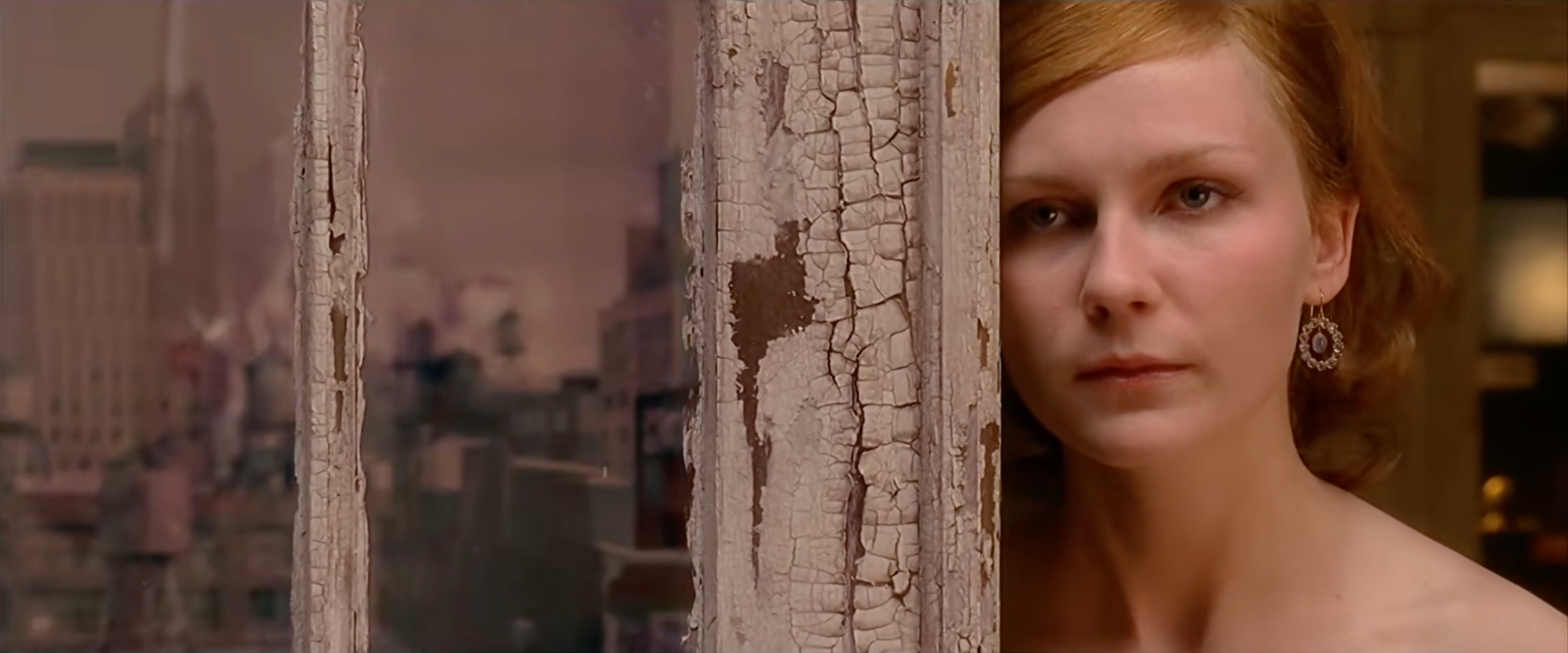
All of this comes together visually in the final scene of Spider-Man 2. The final shot of the film is of Mary Jane, leaning against the apartment window frame, looking with Dunst’s sad eyes at Spider-Man, who is off chasing after criminals. His dynamic heroics are contrasted with Dunst’s static composition. With the ending, Raimi sets Spider-Man’s resolved identity crisis alongside the seeds of Mary Jane’s, which will become a central theme in the third film: what sort of life and success and achievement can Mary Jane expect or, indeed, achieve as the partner and ( perhaps eventually) wife of Spider-Man/Peter Parker? Is all this fair for MJ?
Raimi could have easily just ended Spider-Man 2 like the first film, with another bravura display of Spider-Man’s web-slinging acrobatics as he swung off into the sunset, or posed for the camera. The runaway bride showing up and saying her famous catch phrase, “Go get ‘em, Tiger,” is enough to bring some closure to the conflicts of their relationship, and to deliver satisfaction to the audience. But her proud call to action for her love is contrasted with the lingering sadness in her eyes as she watches Peter swing away in the final shot.
Is it the realization, within Mary Jane, that her sacrifice enables Spider-Man’s full heroism for the city? Without her, he has been troubled and not performing. He had lost his powers. With her, he is now full of gusto. But what does she get? Her final dialogue with Peter describes their being together as the reconciliation of two halves, two half-people coming together as one. The romantic language mirrors the resolution of identity between Peter’s two halves, Peter Parker and Spider-Man. But amidst their final displays of love and discussion of wholeness through that love, is an act of self-sacrifice on the part of Mary Jane—a willing choice to give away security and many parts of her life by knowing Spider-Man’s identity and still choosing Peter.
In my mind, I couldn’t help but compare the sacrifice in the ending of Spider-Man 2 with the famous sacrifice-laden ending of another second entry in a great superhero trilogy: the ending of Nolan’s The Dark Knight (2008). At that film’s end, Batman assumes the crimes of Harvey Dent/Two-Face and is hunted by the police so that District Attorney Dent can become the symbol of normal human heroism that Gotham City needs. These themes are made explicit through Commissioner Gordan’s stirring final speech to his son about why Batman is doing all this, even though he didn’t do anything wrong. Nolan’s film portrays Batman as a necessary scapegoat for the community to move on; it’s also the price he and others have to pay for erecting the noble lie of Harvey being a white knight. As I’ve written before, Nolan’s Dark Knight is a Christ-like figure, giving his life, becoming the criminal, hated and hunted, for the good of others.
In Spider-Man 2, Peter must sacrifice his ambitions for a normal life, but that’s not the main focus. In fact, by the third film’s start, everything is going quite well for Peter. Unlike the ending of the first movie, in which Peter feels he must set aside his love for Mary Jane to assume his great responsibilities, at the end of Spider-Man 2, the deepest sacrifice is Mary Jane’s. She will have to take on an unfair burden in order for the hero to help the greater city. This small touch adds nuance to the otherwise straightforward (yet deep) themes of the film.
Raimi’s choice to add a measure of ambiguity at the end of Spider-Man 2 also recalls another famous ending of a movie—but not a superhero movie. I’m talking about The Graduate. Before you scratch your head and stop reading this essay, let me explain.
At the end of Mike Nichols’ The Graduate (1967), one of the most famous movies that Baby Boomers like Raimi grew up with, Dustin Hoffman’s Ben Braddock breaks up the wedding of Katharine Ross’ Elaine Robinson and they run off from the church together, with Elaine still in her bridal dress. They board a bus and sit down at the back, looking euphoric, but then the camera lingers on them and they both begin to look uncertain. What comes next after such a romantic, yet destructive, moment?
Spider-Man 2 also has a bride run away from her wedding in her bridal gown. We see Mary Jane running and smiling in joy through the square outside the cathedral where the groom has been left standing at the altar. She shows up at Peter’s door, seemingly ready to go and start her life with the right man. But we don’t get their wedding next. In fact, what does Peter do? He leaves her to save the day. He swings off empowered once again. She looks longing after him, yes, with love and affection, but also uncertainty and concern. Peter’s settled identity crisis is leading to MJ’s, one of the subjects of the next film.
Now for one more movie connection. Raimi famously added the song “Raindrops Keep Fallin’ on My Head” (written by Burt Bacharach and Hal David, and played by B.J. Thomas) to a montage in the Peter Parker plot, when he has decided to just live as Peter. This was a left field musical choice for a superhero movie in 2004. The song is originally from another famous late 1960s movie, Butch Cassidy and the Sundance Kid (1969), directed by George Roy Hill. That movie also stars Katharine Ross, who in fact is the girl in the original montage using that song. I don’t know if these connections were conscious to Raimi when he made these artistic choices, but the result is the younger Boomer Raimi injecting a bit of New Hollywood ambiguity into the final frame of his second Spider-Man movie.
I am convinced that these small artistic touches, which add subtlety and nuance to the characters and their relationships, are what ultimately set Spider-Man 2 a level higher than most superhero movies, and make it one to be remembered.
Spider-Man 2 (2004, USA)
Directed by Sam Raimi; screenplay by Alvin Sargent, based on a story by Alfred Gough, Miles Millar, and Michael Chabon; starring Tobey Maguire, Kirsten Dunst, and Alfred Molina.
RELATED POSTS
Scott Beck and Bryan Woods’ horror thriller weaponizes Hugh Grant’s diabolical charm.