Review: RoboCop (1987)
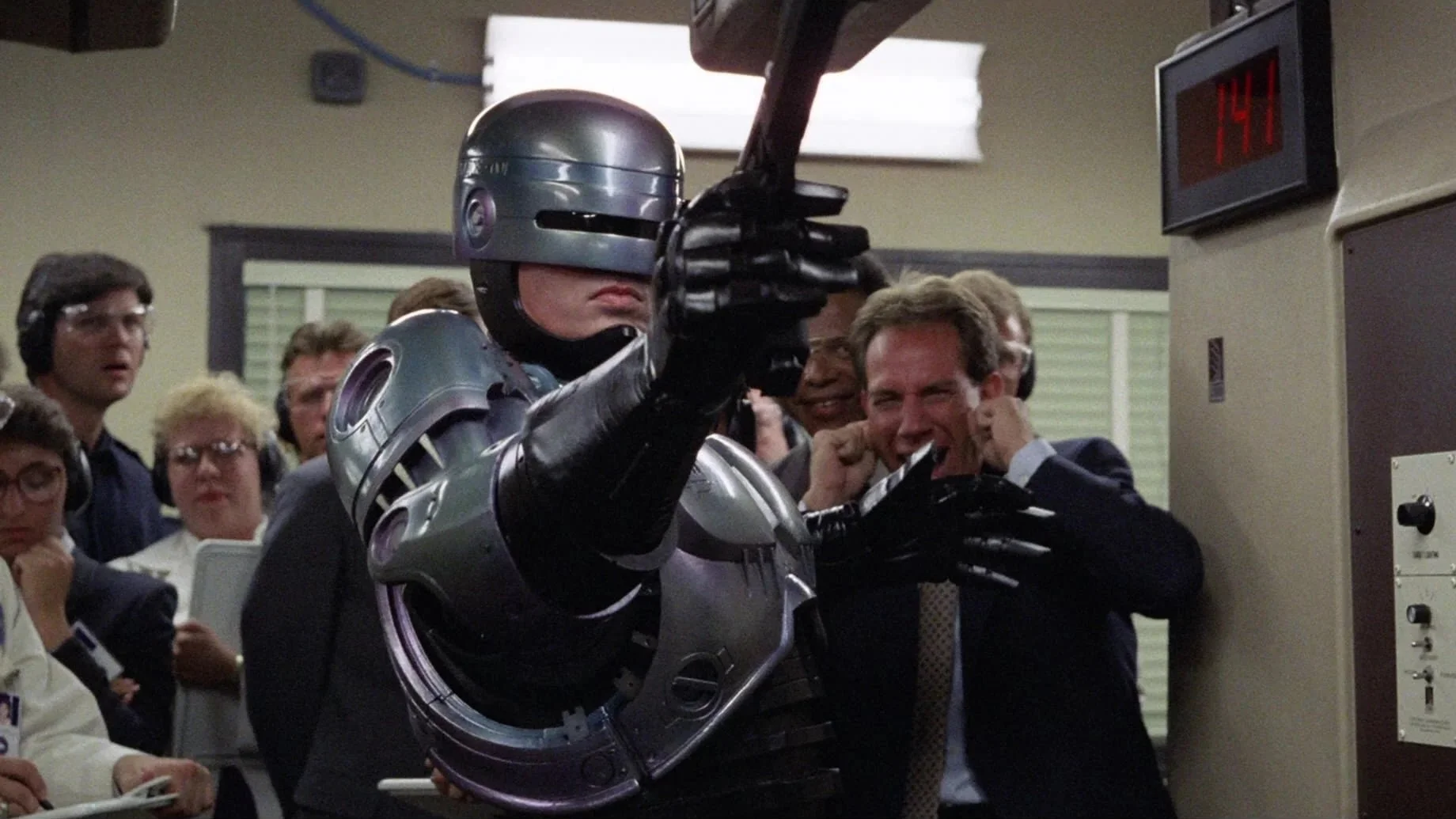

Despite its reputation among critics and my friends, I didn’t have the clearest or most favourable memory of Paul Verhoeven’s 1987 sci-fi satire, RoboCop. I had definitely seen the film (in whole or part) during high school, and what I remembered most was the over-the-top violence and the special effects, particularly the RoboCop suit and the ED-209 law enforcement robots. I was either too young or too distracted to really get the satire of American culture that the film puts forth. But rewatching the film in the year 2026, in an age when corporate greed, social decay, and the role of AI are central concerns, the film’s reputation, if anything, might be understated. Additionally, few films as successfully capture the feel of a 1980s grim and gritty “mature” comic book, especially resembling in aspects the British series 2000 AD and the character of Judge Dredd. From the plot and characters to the costumes and set design, RoboCop is thoroughly indebted to the science fiction and superhero comics of the time, such as Frank Miller’s The Dark Knight Returns (1986), despite the film not being directly based on a comic book. Revisiting RoboCop confirmed my memory of its bloody violence and slick design, but I was surprised to discover how biting the satire is, and how incredibly poignant and moving certain moments can be.
Perhaps it shouldn’t have surprised me that I liked RoboCop so much more upon this viewing. I’ve gotten over the fact that Verhoeven’s films can be ugly and garish at times. I’ve grown to appreciate his blending of camp and violence, such as in 1990’s Total Recall starring Arnold Schwarzenegger. I’ve even learned to appreciate the astuteness of Verhoeven’s once lambasted Showgirls. I think his 2006 Dutch World War II film, Black Book is underrated. The first Verhoeven film I really liked was his adaptation of Robert Heinlein’s Starship Troopers in 1997, a film that Anton and I saw inadvertently with our dad and uncle in our early teens (we wanted to see the film, our dad was a fan of the novel, but the theatre had accidentally labelled it PG and it was not clear before the screening that it was a hard-R rating until the film opens with a scene of Federation troops being ripped apart by bugs). It makes sense that RoboCop screenwriter Edward Neumeier also wrote Starship Troopers, which RoboCop most closely resembles in its gratuitously funny violence and camp tone, down to the use of television news anchors and advertisements that play a similar role to the propaganda PSAs and newsreels in the later film, forwarding the experience as immersive and placing the films themselves into the contexts of life in contemporaneous America.
RoboCop is famously set in a near future Detroit, where deindustrialization and privatization have led to skyrocketing crime rates and financial collapse. The city has turned over control of the Detroit Police Department to Omni Consumer Products (OCP), who are keen on testing their new law enforcement robots on the local population. The OCP executives are comic book villain versions of 1980s corporate executives, venal and greedy. From the start the film makes clear that this won’t be a simple “cops and robbers’ set up, but rather that there are villains in both the police department and OCP as well.
One early scene has senior president of OCP, Dick Jones (Ronny Cox) introduce a new autonomous killing machine, the ED-209, to the board of directors and CEO (the “Old Man,” played by Daniel O'Herlihy). Jones believes the ED-209 can become a hot military item after a trial run on the streets of Detroit, but the demonstration goes awry when the robot opens fire on the hapless executive helping with the demonstration, riddling his body with bullets and a spray of carnage that goes so far beyond any reasonable limit that it enters the realm of absurdist comedy. The use of squibs to generate bloody viscera is over the top, but there’s something about the physicality of the filmmaking that is both shocking and impressive by today’s standards, which often rely on CGI blood and gore that lacks “visceral” impact in the true sense of the word.
After the failed demonstration, a junior executive, Bob Morton (Miguel Ferrer) sees the opportunity to push his alternative project: RoboCop. From here, the film switches focus for a stretch to introduce a new police officer assigned to the dangerous Metro West precinct, Alex Murphy (Peter Weller). Murphy is a good cop and family man. One day, while out on assignment with his new partner, Anne Lewis (Nancy Allen), he is brutally killed in the line of duty by the vicious Clarence Boddicker (Kurtwood Smith) and his gang who terrorize the city (for those who know Smith only from the sitcom, That 70s Show, it’s quite entertaining to see “Red” as a monstrous villain). After the Boddicker gang escape, the OCP saves Murphy’s body to utilize in their RoboCop experiment, since his employment contract has made his body the company’s property. Saving his horribly mangled body after a gunshot through the brain seems impossible, but saving “Murphy” isn’t really the point.
The following scene where Bob Morton and his team go through the process that will turn the man, Alex Murphy, into RoboCop is one of the best and most memorable in the film. It’s shot in a chaotic and unique visual style. We get various jump cuts in time, often framed from Murphy’s point of view as he drifts in and out of consciousness. Needles are injected into what remains of his corpse and it becomes clear that brain death isn’t a major concern in the process. His body is essentially being treated like a piece of meat to be used for a horrible science experiment. It’s nightmarish and dehumanizing, and the editing and composition suggest the disassociation that Murphy experiences as his sense of identity is stripped away. At one point, well into the process, they note that they were able to save one of his arms, but Morton tells them to just get rid of it and make both arms into metal and chrome.
The whole sequence is one of the moments in the film where it isn’t just satirizing corporate greed or 1980s tough-on-crime policies, but raising broader philosophical questions about the nature of life and death in a world where virtual or cybernetic “survival” is a goal of many scientists and researchers. Murphy himself is never considered as a person with any worth, only as a biological system to be used. Would he be better off dead? Is he dead? Is the entity “RoboCop” in continuity with the man, Alex Murphy, who after the process has had his memory of his prior life stripped, aside from his ability as a police officer?
RoboCop is introduced as a law enforcement entity stripped to three core directives: serve the public trust, protect the innocent, and uphold the law (a fourth hidden directive is alluded to, but not mentioned at this point). He is assigned back to Metro West and begins a one man war on crime, stopping armed robberies, rapes, and all kinds of general mayhem with brutal efficiency. But despite Morton’s insistence that “Murphy” is gone, there are hints that lingering aspects of his past are still clinging to this new entity. During hardware maintenance, he has a nightmarish dream of his past. When he encounters his former partner Lewis, she recognizes him, in part from the cowboy-style gun holstering he performs, something that Murphy did to impress his son.
Eventually RoboCop encounters the Boddicker gang, and captures one member, Emil Antonowksy (Paul McCrane), who recognizes him from their earlier encounters with Murphy. In response to seeing RoboCop, Antonwsky remarks “We killed you!,” and we get RoboCop’s famous retort: “Dead or alive, you’re coming with me.” But the encounter prompts RoboCop to dig into the criminal’s history, such as his involvement in the killing of Murphy. RoboCop then proceeds to use the database to find more information about Murphy. He even visits his old abandoned house he once lived in, his wife and son having left after his “death.” It’s one of the film's other most poignant moments, as RoboCop struggles to understand his own relationship with his past. What connection remains between who he is now and the man he was?
Eventually, it is revealed that the Boddicker gang is working directly with Jones, the evil senior president of OCP. Boddicker and his gang then kill Morton, as Jones’s goal remains to destroy RoboCop so he can go ahead with his ED-209 project. RoboCop is badly damaged in a fight with the police who have been turned against him by Jones. His partner Lewis saves him and takes him to an abandoned factory to repair himself. The film’s final act unfolds in classic genre fashion, where the heroes are cut loose from formal authority and must work alone to reveal the corporate criminal conspiracy and defeat the villains and restore some kind of order. We get treated to plenty of scenes of RoboCop facing down with the ED-209, and then a final showdown with the Boddicker gang in a “cocaine factory” as Detroit descends into violent chaos due to RoboCop’s absence and the co-option of police force.
It’s a wild ride, consistently entertaining and rooted in police and science fiction genre conventions. As I mentioned, many of the film's most memorable moments are the over-the-top scenes of violence. In one of the film’s most outrageous moments, Antonowsky, released thanks to the collaboration of Jones and Boddicker, is bathed in a wash of toxic waste which causes him to mutate into a disgusting, agonized wretch, with his skin drooping and ragged. During the fight and car chase, Boddicker runs him over, causing his destabilized body to explode into a shower of liquified remains. It’s gross, but comical. Verhoeven rightly understood that the way to make the satire stick was to escalate the violence beyond reality, and it does make the whole thing more funny than horrifying, even if it’s nasty.
Verhoeven’s handling of the violence points to the film’s overall success, as RoboCop is fairly remarkable for the line it walks between its generic, satirical, and social commentary. As a genre piece, it’s comic book violence and 80s-style action is top notch. It’s not quite the level of the original Terminator, but those two films are probably the closest we’ll ever get to seeing one of those 1980s Frank Miller comics on screen. It’s fitting then that when Verhoeven and Neumeier declined to work on the sequel, Miller himself was brought in to write the screenplay for the much less dynamic or interesting RoboCop 2. Its genre interest goes beyond its non-stop action, posing science fiction questions around cybernetic life and the nature of identity. Satirically it takes aim—literally—at the privatization and corporate policies of the Reagan-era, as well as the way that television shapes our understanding of political and social issues. It’s satire then naturally lends itself to social commentary, suggesting that militarization of police may not be a good way to solve the problem of crime communities face, rather that it only leads to escalation of criminal violence. It’s an expert blend of all these elements.
It seems I’m not the only filmgoer who has misremembered RoboCop as an overly macho and violent piece of 80s nostalgia. Many fans focus on the violence and the power of the film’s design and the film has long been successful as a staple of comic-con. Walk into any comic book or collectibles shop and you’ll see they're always putting out new figures and toys that play to these interests. Instead, what I found upon this rewatch, is that like other films from the era, including the original Rambo and the aforementioned Terminator, RoboCop is much more thoughtful and interesting, raising challenging questions and criticizing the political and social conditions of their era.
The commodification of these films from the period into toys and sequels that were much more cartoonish or less-interesting shows how our cultural memory forgets the critiques and deeper meanings these mass-entertainments often contained. I mentioned I had rewatched the film to a friend of mine and remarked upon how I had found the film’s social commentary and even existential musings much more compelling than I had remembered. I noted that things that seemed so outlandish at the time, like corporate militarized policing, cyborgs and artificial intelligence, and human beings exploited for profit, have moved from the realm of science fantasy to reality in the years since. My friend agreed and suggested to me that the meanings of these films have often been culturally repressed, because otherwise we would have to confront that we were warned about the trajectory Western culture was on but ignored it. It continues to this day in films like Avatar, which are treated purely as genre entertainment with any cultural critique often dismissed. I think there’s a great deal of truth to my friend’s idea. It’s not about elevating these films in lieu of other art and forgetting that they are still entertainment. But it does mean that these artifacts of the past are often much more interesting than cultural memory suggests. I’m glad I rewatched RoboCop and rescued it from my hazy, stereotypical memory of the film and realized it for the bracing, entertaining satire that it is.
9 out of 10
RoboCop (USA, 1987)
Directed by Paul Verhoeven; written by Edward Neumeier & Michael Miner; starring Peter Weller, Nancy Allen, Dan O’Herlihy, Ronny Cox, Kurtwood Smith, Miguel Ferrer, Ray Wise, Paul McCrane.
Related Posts

A fun pirate parody, a smart adaptation, and one of the best Muppet movies.