Review: Backrooms (2026)
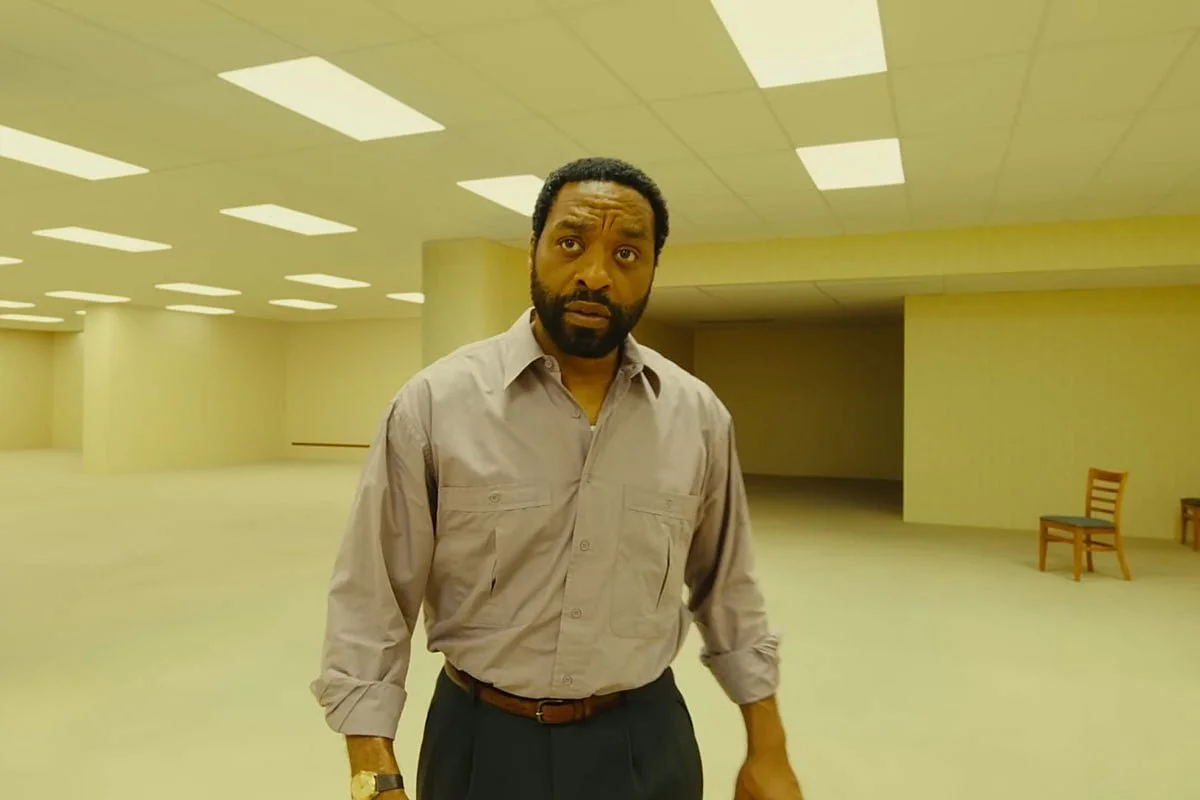

Backrooms is, on the whole, a remarkable work for a film directed by a nineteen-year-old, Kane Parsons, creator of the viral webseries of the same name. In the series and the film, people find themselves in a strange liminal space of pale yellow walls and fluorescent lighting that seems to go on forever. It’s strong imagery that taps into a number of cultural anxieties, which partially explains the popularity of the original concept and the success of this film. Although it's easy to damn a film with faint praise, it’s perhaps inevitable for a film like this which combines aspects that are excellent with those that are lacking (or maybe too much, as I’ll try to explain). Overall, Backrooms is intriguing and well-done, and I’ll be very interested to see where both Parsons and this series go next.
Backrooms is based on the “creepypasta” spawned a number of years ago building off a photo someone posted of a strange, empty room with yellow carpet and walls, windowless and with an odd orientation. The term “creepypasta” is the webspeak for the kinds of community-driven stories and urban legends that are generated on these webforums, often of a horror or conspiracy genre. In 2022, then 16 year old Kane Parsons posted a short film, “The Backrooms (Found Footage),” on his YouTube channel, Kane Pixels. The film appears to be shot on a SD camcorder and is shown from the point of view of a filmmaker who stumbles into a strange extradimensional space, expanding the original “Backrooms” idea into a short film. He wanders in this seemingly empty, windowless and endless series of rooms seeking an exit and trying to find someone who can help him. In the course of his wandering, he glimpses a strange creature that pursues him until he eventually passes out of the “backrooms” and the camera falls from the sky. Parsons created the series using a mix of sets and 3D Blender animation, but its low-def footage is highly effective and evocative.
The short was followed by a whole series which in snippets expanded the mythology of people exploring this extradimensional space. It ties into the popularity in online culture of so-called “liminal spaces,” those transitive or generic spaces of architecture in our culture that take on an especially strange affect when empty and quiet. Think abandoned shopping malls, generic office buildings, warehouses, and hallways. These are the places that our modern society creates, but often as an afterthought.
I mention “liminal spaces,” because you hear this term all the time in relation to the film and it’s almost impossible to discuss the impact of Backrooms without reference to it. The concept has slowly gained currency in contemporary discourse, and other recent science fiction and horror films and tv shows are indebted to it. The most obvious contemporary examples are the “Upside Down” from Stranger Things, which gestures to it, but even more so is the popular Apple TV show, Severance. In fact, series creator Dan Erickson has admitted that Parsons' early Backrooms shorts were an influence. I’d say the fantastic Canadian indie horror Skinamarink is another example, mining the concept’s associations with timelessness and lack of outside references, as well as maze-like shifting architecture. I don’t think it’s an accident that both Skinamarink and Backrooms originated during Covid-lockdown culture. The sense that time has stopped and that the outside world has ceased to exist, combined with the sight of normally populated spaces devoid of people are key to the creepy aesthetic, but also might explain the emotional pull of these works. But you could also say that it goes back to something like The Shining; what is the empty Overlook Hotel than a massive liminal space, especially once you start considering the strange, seemingly impossible architecture and temporal shifting that goes on inside it? Or maybe the reference is the non-Euclidean geometry of Lovecraftian nightmares? Either way, the Backrooms themselves are the star of the film. There’s a reason that the young YouTuber was approached by a number of studios to turn the shorts into a feature film.
The film opens with a similar sequence to the original “Backrooms (Found Footage)” short, as in the early 1990s a person with an SD camcorder explores the Backrooms, is pursued by a barely seen entity, and seemingly killed. The film then switches to following Clark (Chiwetel Ejiofor), a divorced alcoholic who runs a failing furniture store in northern California with two employees, Kat (Lukita Maxwell) and Bobby (Finn Bennett). Clark visits a therapist, Mary (Renate Reinsve) to help him process his divorce, and it is revealed he has begun living in his furniture store and drinking again.
One evening while investigating the strange electrical fluctuations he notices in the store, Clark finds his way into the Backrooms through a wall in the store’s basement. He explores a fair bit of the space, finds some of the gear from the film’s opening, but retreats when he hears and catches glimpses of something terrifying in the otherwise empty stretches of rooms. He tells his therapist, who doesn’t believe him, and then recruits his employees into helping him explore the strange expanse of the Backrooms. While they try to lower him into another level of the Backrooms, Bobby is grabbed by an unseen entity and Kat and Clark each subsequently follow to try to find him. When Mary receives a message on her answering machine from Clark saying he won’t be coming back, she goes to his store and finds her way into the Backrooms as well, where she searches for Clark and finds herself facing down more than just the empty expanse of the strange space.
The film is at its most effective in the stretches when characters are cautiously exploring the strange extradimensional space of the Backrooms. It’s truly a creepy and nightmarish space. It captures the feeling of being trapped, but also being alone in the face of something bigger than you initially can imagine. While I mentioned that Parsons’ used a mix of 3D renders and sets in the original shorts, for the film they created over 30,000 square feet of sets, which were apparently so large that some of the crew got lost in them! It gives the Backrooms themselves a tactile and realistic feel that few films of this kind achieve. Parsons knows how to use a camera to build suspense, limiting the viewer’s perspective and using a mix of buzzing, fluorescent lighting and shadows to emphasize the setting. However, it's in the first person, point of view sequences that the film has the most tension and generates its best scares.
One of the reasons that Backrooms seems to have generated so much enthusiasm with audiences is mostly through how evocative it is. Like the idea of creepypasta and other online subcultures, it generates strong interest through audience participation with references and the way the liminal space acts as a kind of thematic canvas for people to paint all kinds of interests on top of, even if it doesn't always do much with them itself.
For instance, one late sequence (repeating a similar sequence from the original short) gestures to the truly immense and vast size of the Backrooms. It’s possible that this extradimensional space is as big or larger than you can possibly imagine. I was reminded of the descriptions of the titular library in Jorge Luis Borges’ “Library of Babel,” and the fact that infinite space allows for anything to be present or possible, if one has enough time to search and explore.
The film also, in a way that is seemingly de rigour these days, delves into topics of therapy and trauma, both through Clark’s and Mary’s pasts and how it treats memories as material for the content of the extradimensional space. Characters attempt to describe the Backrooms as resembling a “faulty misremembered copy” of things from our day-to-day reality, whether office buildings or houses, distorted and warped through the copying and over-writing of memory and time. It lends the film a veneer of seriousness that I’m not sure was necessary. Additionally, the film reveals in snippets that a strange company, Async, has been monitoring the Backrooms since discovering them. It’s a bit of “lore” that is key in the YouTube shorts, but I’m not sure it adds anything to the film. Both the presence of a strange company and the explicit evocations of trauma play well with audiences today, but I preferred the film when it played to the strength of the central concept alone.
So many films today have great central concepts but muddle or fail to stick the landing with plot developments. Backrooms has confident filmmaking, good performances (though both Ejiofor and Reinsve’s American accents didn’t always convince me), but ultimately lost me a bit in the last half hour, especially after the identity of the strange entity pursuing them is revealed.
Regardless of what I consider to be a flawed ending, the film clearly has struck a nerve with audiences. A part of me wishes the late great British cultural critic Mark Fisher could have seen this film. To me it exemplifies not only the “liminal space” and possibilities of “creepypasta” storytelling, but Fisher’s notion of “hauntology,” which for him described the way that contemporary artforms use temporal disjunction and the persistence of the past to try to generate the sense of lost futures we experience today; in other words, the future didn’t end up being something totally new but a remix and revisiting of elements of our past. It’s a kind of strange inverted nostalgia. I think Backrooms setting in the 1990s is important. The future which eventually arrived has foreclosed certain imaginative possibilities, since modern technology like mobile phones and the Internet would make the plot less plausible, and so young artists reach back for something that they never really experienced themselves. Most critics are talking about this movie as the filmmaking of the future, but, like so much of our art today, it’s rooted solidly in the past.
Backrooms is worth your time. It’s evocative and genuinely creepy, generating good tension and bringing the concept from the web series successfully to the big screen. Some of the developments of the film seem to me to be more about setting up the possibility for mining future instalments out of the success of this one. It seems even the most grassroots, outsider art is only a hair away from being turned into a franchise. But Kane Parsons shows genuine talent, even if the origins and popularity of the Backrooms concept itself is bigger than him. I’m curious to see what he’ll do next, but in the meantime, I’m glad he was able to take those of us who don’t spend our time on YouTube into this strange world.
7 out of 10
Backrooms (2026, USA)
Directed by Kane Parsons; written by Will Soodik, based on “Backrooms” by Kane Parsons; starring Chiwetel Ejiofor, Renate Reinsve, Finn Bennett, Lukita Maxwell, Mark Duplass.
Related Posts
Alexander Ullom’s high-concept debut feature conjures an existential nightmare.