Review: Exit 8 (2025)
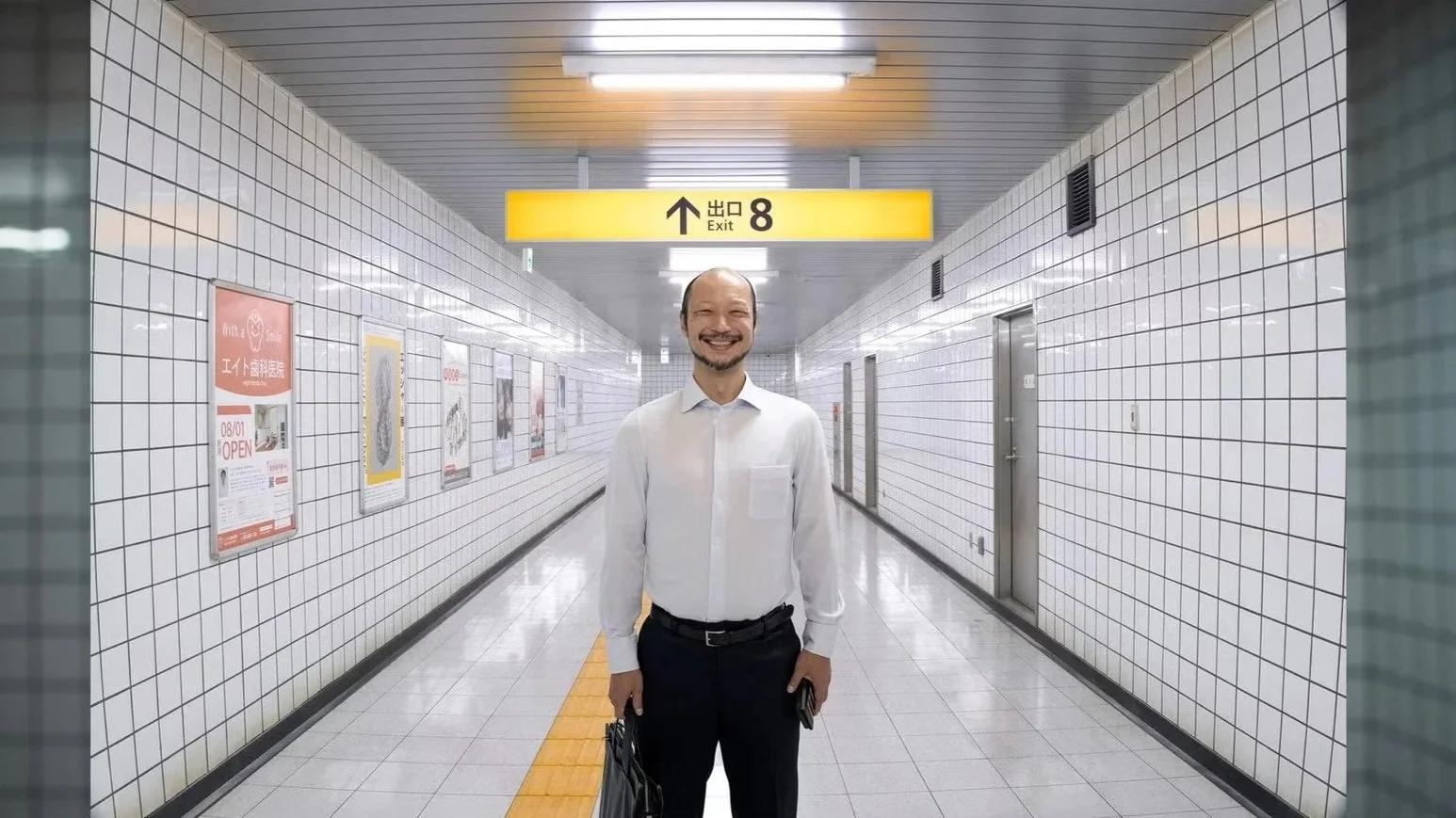

Genki Kawamura’s Exit 8 is a clever little horror thriller about a man trapped in the endless loop of a subway corridor. It captures the anxiety of the modern world that fuels so much horror filmmaking in 2026, whether the anxious protagonist of Obsession or the anxiety-inducing liminal space of Backrooms. It also has a more seamless visual and narrative presentation than is typical in low-budget horror movies. Unfortunately, its emotional engine is built entirely on spare parts, but let’s not overlook just how impressive its visual craft is, from the fluid camerawork to the clockwork pacing to (most critically) the production design of its central setting. Overall, Exit 8 is an effective mindbinder that engages you throughout its runtime, which is vital as it’s a repetitive work by nature.
Exit 8 follows a man (Kazanari Ninomiya) who gets stuck in a subway corridor while commuting home one night. The hallway seems nondescript—a typically whitewashed subway hall with fluorescent lighting, promotional posters, and a fellow commuter (Yamato Kochi) walking in the opposite direction. But when the man turns the corner past some lockers and a photobooth, he finds himself back where he started at the beginning of the hall. The corridor is a loop—a mobius strip, essentially, where its beginning is its ending. Eventually the man finds a poster that suggests some rules for the scenario: he must pass through the hallway. If he notices an anomaly—something that isn’t supposed to be there—he must turn back. If he doesn’t notice an anomaly, he should continue on. If he does everything right, he’ll make it to “Exit 8,” where, presumably, he will exit the loop and re-enter the real world. But it’s not so easy to notice anomalies, especially when you have no baseline to compare things against.
Exit 8 is also one of the few movies that actually feels like a video game—and I mean that as a compliment. To be clear, it is based on a video game—an indie puzzle game from 2023—so perhaps its success is a matter of translating the core appeal of the game to the screen. It might also be that Kawamura understands that puzzles need to have clear rules and a seamless presentation to have the necessary impact on the viewer. His film includes the necessary strategy and trial-and-error in its narrative. Kawamura also forces us into close alignment with the protagonist, such that he might as well be our onscreen avatar like a video game character. The man tries to solve the puzzle. We want to help him, watching with an eagle eye as he tries to catch every anomaly (a misplaced doorknob, an upside-down sign, or a misstep from the fellow commuter) and adjust to the shifting circumstances of the film. He either succeeds and moves onto the next identical iteration of the corridor—marked with signs 0, 1, 2, etc., leading to 8—or fails and starts again, more agitated and anxious than before. If you’ve ever been stuck in a parking garage or underground tunnel structure and worried you’d never get out, you can sympathize with the anxiety of the situation.
It’s fun to watch the man go through the constant trial and error to figure out how to escape from the subway. That said, Kawamura also understands that such a predictable and repetitive narrative structure cannot fuel an entire feature film runtime. (These sorts of plots always work best in hour-long television format, whether The Twilight Zone or Star Trek, since they can maintain the narrative focus.) So Kawamura introduces a few interesting pivots along the way, including shifting perspectives and the addition of a lost boy (Naru Asanuma) in the hallway, who may or may not be an anomaly himself.
Exit 8 rewards obsessive viewers who like paying attention to detail on screen, so if you like pouring over the frame trying to find what’s off, you’re in for a treat. For the character, it’s about doing the same without having a panic attack, since every loop makes it seem like there’s no way out. Will he keep trying? Will he give up? The movie adds some rote emotional motivation for the man so that we can see the metaphorical weight of his predicament. You see, on his way home he received a voicemail from an ex-girlfriend telling him she’s pregnant and he’s going to be a father. He’s not sure whether he wants to commit, but doesn’t want to be a bad person, so he’s paralyzed with indecision—an anxious response familiar to young people (and which seems to be common in popular horror movies these days). The loop becomes a metaphor for his decision paralysis: if he can commit, will he break the loop? This is a touch too tidy way of explaining the emotional storytelling at work, but it’s close, especially as the lost boy becomes a critical part of the storytelling. That said, the whole world is dealing with fertility issues, and countries like Japan more than most, so children are something of a precious commodity these days. It’s not cliché to say that the decision to have a child and be a father is genuinely profound, and the sort of thing you can hang a character's motivation on.
But you don’t watch Exit 8 to find out whether this man will rise to the occasion—regardless of how cliched this element of the film is or is not. Rather, you watch it for the remarkable production design and fluid camerawork, which creates a creepy on-screen world that is both discombobulating and seamless—and all for a budget of under $2 million.
It’s not common to get lost in the production design of a movie, but Exit 8 is all about getting lost in a particular space, and in many ways, the space itself is the star of the work. It’s one of several liminal horror movies released in North America in 2026—Backrooms being the other major work—but unlike its American counterpart, it’s a tidy, closed system. Fittingly, the film consists of long, unbroken takes that follow the man through the hall and back into the same corridor. Subtle cuts hide the seams and allow the team to pull off the endless loop, but it’s seamless in presentation, and effective in trapping us within the space with the man.
Does it grow tiring to spend 90 minutes in this corridor? Kawamura throws enough curveballs to avoid narrative stasis, but when the film veers too much into horror territory (with some unconvincing CGI to boot), the experience does strain under the weight of it all. Luckily, Kawamura pulls off a clever ending that fits with the whole presentation. In 2026, many movies and TV shows make you feel like you’re watching the same scene play out on repeat. At least this one does so purposefully and with a technical precision that conjures some genuine anxiety and dread.
7 out of 10
Exit 8 (2025, Japan)
Directed by Genki Kawamura; written by Kentaro Hirase and Genki Kawamura, based on The Exit 8 by Kotake Create; starring Kazunari Ninomiya, Yamato Kochi, Naru Asanuma, Kotone Hanase, Nana Komatsu.
Read More Reviews

Alexander Ullom’s high-concept debut feature conjures an existential nightmare.