Review: Disclosure Day (2026)

Steven Spielberg’s Disclosure Day is an old man’s movie. It’s also an uneven work of science fiction by a master filmmaker who is firmly in his “late style” phase. In North America in 2026, “an old man” usually means “a baby boomer,” and the film, in many respects, presents the worldview of your typical liberal boomer, with its outdated understanding of media (TV news is an essential good) and its predictable values and assessment of the main problems facing our world (we need more empathy to prevent World War III).
In some ways, Disclosure Day feels out of step with the actual disclosures about Unidentified Aerial Phenomena (or UAPs, what we once called UFOs) going on right now, while in other ways it exhibits our culture’s renewed interests in the strange, the wondrous, the occult, the spiritual, and the religious (see Exhibit A: the dominance of horror in today’s cinema). None of this is automatically a bad thing, and I’m not using “boomer” strictly as a pejorative, but too little about Disclosure Day is surprising or new, which is a let down when the movie’s very title promises big revelations and a big event.
(While I’ll try to avoid spoilers of a specific nature, if you don’t want to know anything about what the revelations or events are, read no further.)
What is the “Disclosure Day” of the title? Obviously, the film—based on an original story by Spielberg, which is a rarity in his career, and written by Spielberg’s frequent collaborator, David Koepp—taps into real-world debates and disclosures about what the US government knows, or does not know, about UAPs and extra-terrestrial life forms. In the movie, a young cyber-security expert, Daniel Kellner (Josh O’Connor), who works for a secret non-governmental organization (called the Wardex Corporation), steals secret evidence in the desire to instigate “total disclosure” on the subject to the whole world. In many ways, he plays like Edward Snowden for UAP. While the title might set up the expectation that the story will be about the disclosure and then what comes next—think of a movie akin to Arrival (2016), exploring how humanity would actually deal with the revelation that aliens are real—the actual movie functions more as an argument for disclosure. In other words, “Disclosure Day” is Kellner’s goal in the narrative, and not the precipitating event. The plot is mostly a series of chases to make that disclosure happen. Many of the chase sequences are brilliant, but the climax does not fully deliver and the film ends abruptly.
Much of my disappointment stems, however, from the fact Disclosure Day is not just any movie by any old male filmmaker. It’s a film by Steven Spielberg! Given both his genius for filmmaking and his prior successes in the alien encounter genre, Spielberg’s brand sets up very high expectations for the film. I’ll note that most of the movie posters I’ve seen simply say “Spielberg” above the title, where typically we would see the starring actors' names. At the same time, Spielberg’s personality, style, and interests make many aspects of the film more understandable. The film is best understood within the context not of current events, cultural trends, psyops, and conspiracy theories, but of Spielberg’s own career. This is why the film does not offer a new take on the subject, but rather is the summation of a whole career’s ideas and stories about human encounters with beings from beyond our world.
In the years after Jaws (1975), the movie that launched the summer blockbuster, Spielberg was Hollywood’s wunderkind, and in his early years he gave us two great movies about aliens: 1977’s Close Encounters of the Third Kind (which he wrote) and 1982’s E.T. the Extra-Terrestrial. While both films explore the terrifying potential of such encounters, they are ultimately hopeful about extra-terrestrial life. They are real and they are benevolent. Mid-career, Spielberg took on the godfather of alien invasion stories with War of the Worlds (2005), and he threw scary, powerful, and wise extra-dimensional beings into his fourth Indiana Jones movie, Indiana Jones and the Kingdom of the Crystal Skull (2008). (See our newsletter, “A Guide to Spielberg and Aliens,” for more commentary on those films.) Interestingly, Koepp, who had worked with Spielberg on the Jurassic Park movies in the 1990s, wrote the screenplays for both War of the Worlds and Kingdom of the Crystal Skull. It’s been decades now since Spielberg was operating in the genre, and so Disclosure Day also marks his first movie about aliens from his late career, and a return to working with Koepp.
Spielberg’s career pivots into its late stage somewhere around Lincoln (2012), and it is very noticeable by Bridge of Spies (2015), a movie at turns agile and creaky that I really do like, but which contains scenes that are the product of an older man wanting to share his thoughts on an important subject. Like Bridge of Spies, Disclosure Day doesn’t lack energy. It’s that the energy comes in fits and starts, while other sections seem plodding, overly plain in their message, or overwrought in their themes. Many of the speeches by lauded actor Colman Domingo (who plays Hugo, a shadowy manager working to help disclose the secrets) are cringy because they sound like thematic monologues being spoken on the stage, rather than actual human conversation on deep matters.
That said, the movie starts with electricity, throwing the viewer into the ring of a pro wrestling match—literally—as a POV camera is kicked and thrown about by the unnamed wrestlers. It’s a visceral, figurative start, signalling that this is one of those thrillers where we are thrown into the mix of things and will have to catch up as we go along. In this respect, Koepp’s screenplay is crafted along the lines of a Dan Brown novel (like The Da Vinci Code); notably, Koepp has adapted two Dan Brown novels to the screen, Angels & Demons (2009) and Inferno (2016). As in Dan Brown, there is a MacGuffin, or two actually: data drives containing archival secrets as well as a strange wand-like object of uncertain power. Kellner the whistleblower has stolen these objects, and Colin Firth’s capable, intelligent, overreaching villain, Noah Scanlon, the head of Wardex, works to recover them, along with his pack of agents dressed in black. All of this is very familiar, whether from Men in Black, The X-Files, or scores of spy thrillers. As in a Dan Brown novel, we follow the heroes, and then we follow the villains, and back and forth, as each scene leads to the next challenge, escape, and chase. And as with Dan Brown, there’s a Gnostic assumption beneath everything, that the truth is found in secret knowledge.
Eve Hewson (Bono’s daughter, who appeared in Bridge of Spies as well) plays Jane, Daniel’s girlfriend who gets caught up in things. She is also an ex-nun, which allows the screenplay to comment on aliens and religion, a theme explored in both clever and clumsy ways throughout the film. (It also takes the film quite a while to catch up with anyone who has read C. S. Lewis’s Space Trilogy, which has no problems reconciling Christianity with the idea that God made other sentient creations, but that is beside the point for now.)
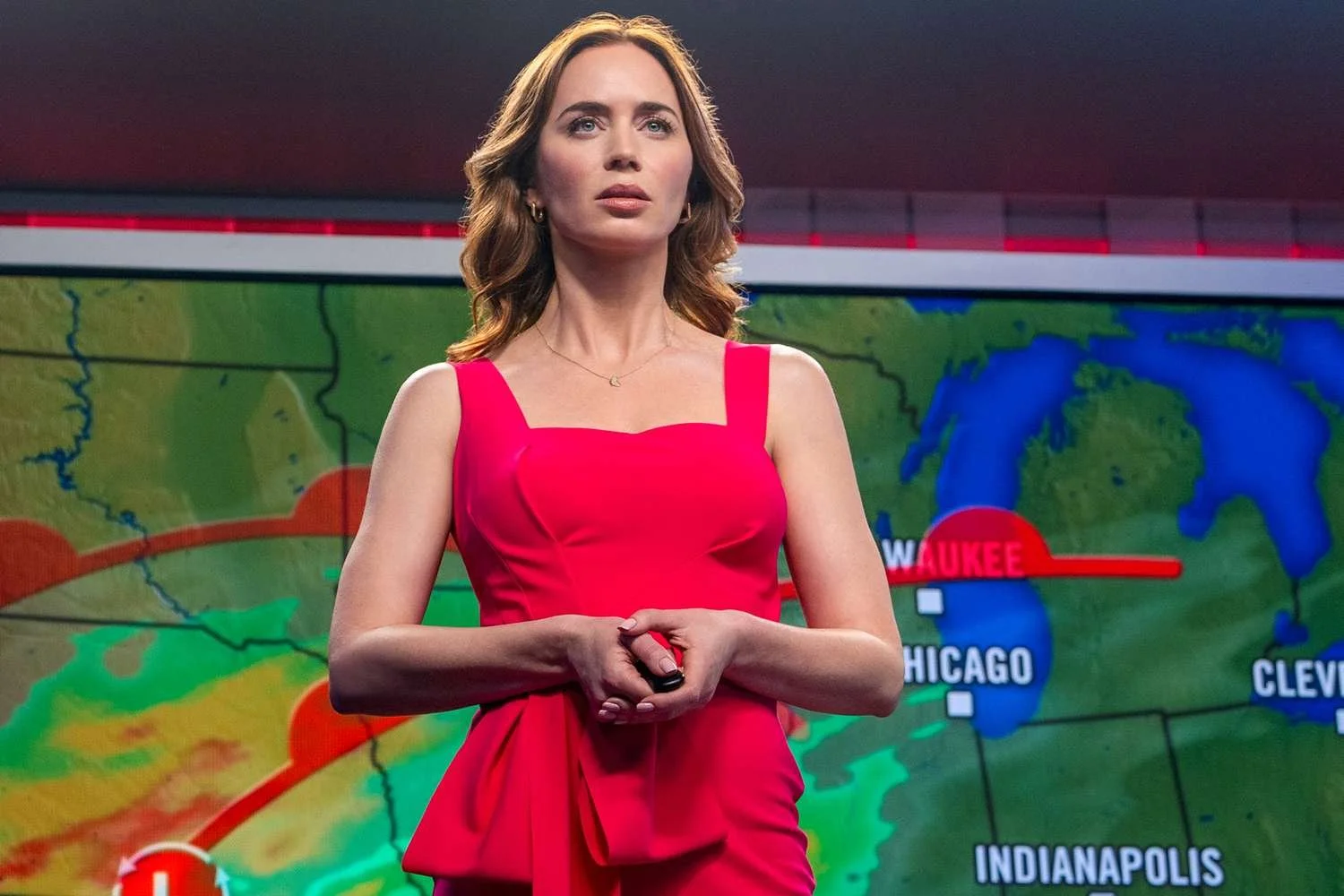
The other main character, who provides a third storyline that will interconnect with the others, is Emily Blunt’s Margaret Fairchild, a TV meteorologist from Kansas City (which will allow the District of Columbia characters and activities to “go home” to Kansas, a la The Wizard of Oz). Blunt’s storyline is initially the most intriguing, as she finds herself speaking seemingly unintelligible noises on live TV and in other human languages to her boyfriend (Wyatt Russell) after a strange encounter with a cardinal (yes, the bird). Margaret, who has repressed memories from her childhood, also begins to discover she has a telepathic power for empathy, being able to read the thoughts of others and immediately connect with their lived realities on a personal level.
As I alluded to earlier, there’s often too much time in the scenes between the chases. Like late-style Scorsese, late-style Spielberg seems to no longer care about trimming his movies to a two-hour run time, which was typical of most of his earlier blockbusters. If everything that happens in, say, Indiana Jones and the Kingdom of the Crystal Skull can happen in 122 minutes, I don’t see why we need 145 minutes here.
Spielberg still dazzles us with some amazing action sequences. The assured flow of Spielberg’s virtuoso shot constructions and movements (once again working with Janusz Kaminski) makes it all look so easy. Rays of white light will shine out from behind figures. Shots weave in and around vehicles as they are parked or as they drive, recalling long takes Spielberg pioneered in War of the Worlds, when the camera moves in and around the family van as they flee disaster. One sequence in Disclosure Day involving an approach to a farm house on foot and then by car is brilliant, as is a sequence with a car and a train. Scenes like these remind us that Spielberg is a master—executing complexity that seems simple because it is so elegant.
By now, you’ll get my point that there are ups and downs in Disclosure Day. However, what is most memorable—or haunting—are the moments when Spielberg throws in breadcrumbs that reveal a lifetime’s journey in the cinema—references, motifs, preoccupations, associations. The strangest example—a scene I’ve been picking over and can’t quite figure out since I saw the movie—comes when Margaret reenacts a moment from her childhood in order to recover the repressed memory. The young Margaret sings a tune (what she calls “her song”) which is in fact the final song in Walt Disney’s Snow White, “Some Day My Prince Will Come.” The strange manifestations of woodland animals present—a deer, a fox, a cardinal, etc.—recall the empathetic connection the Disney princess often has with animals, but it strikes even deeper than nostalgia for classic movies. Just as Richard Dreyfuss’ Roy in Close Encounters has a fondness for Pinocchio that his family doesn’t share (he wants to take his kids to the movie), and just as Roy seeks transcendent meaning amid his mundane, chaotic life, Spielberg seems to get that Disney’s classics, although often dismissed as mere cartoons, contain some of the most potent visions of transcendence in our modern culture. There is none more famous than the ending of Snow White, with the vision of the Prince’s castle, a Heavenly City in the sunset sky. Deeper still, the Snow White connections tie the whole modern-day phenomena of UAPs and alien abductions to fairy tales—to the stories we once told children, often fantastical, to make sense of the world and to teach them how to operate in it. Disclosure Day is by no means an un-thought-through movie, even if it grates at times, feels tired at others, frustrates at others.
I’m also left with lingering concerns about aspects of the whole conception of these benevolent extra-terrestrials, if we are to judge them based on their actions and not just their stated aspirations. Hugo can say what he wants, but why is the young Margaret taken to “Hansel and Gretel’s house” (with its sinister connotations)? Why do they abduct children against their will, traumatizing them for the rest of their lives? Should we understand them to be like the ancient Greek gods, superior beings, but not always good, who think they can do what they like with mere humans? Or like the strange actions of God at times in the Old Testament, operating beyond human understanding? But how do these matters align with the film’s assertion that they have built their understanding of the universe on empathy? I find aspects of the film’s abduction sequence disturbing (and I would recommend Jonathan Pageau’s analysis of the symbolism of the scene, even if I don’t entirely agree with it).
As in Spielberg’s Close Encounters, it seems this movie’s impetus is to have our longing for transcendence—we want to believe, we want to connect—overshadow any hesitations about what has gone on earlier with the aliens. But Disclosure Day, even more than Close Encounters, seems to emphasize the goodness of the aliens. There’s something here that really taps into Spielberg’s career-long interests. Aliens. Fairy Tales. Disney. Transcendence. Movies. It’s all here.
But what does it all mean? We are not alone. We need empathy.
Okay, but what else does it mean besides these platitudes? That remains undisclosed to me, after a single viewing. Even though I have very mixed feelings about this movie, it might be worth a second watch. It’s a Spielberg movie, after all.
5 out of 10
Disclosure Day (2026, USA)
Directed by Steven Spielberg; screenplay by David Koepp, based on a story by Steven Spielberg; starring Emily Blunt, Josh O’Connor, Colin Firth, Eve Hewson, Wyatt Russell, and Colman Domingo.
RELATED POSTS

Matt Bettinelli-Olpin and Tyler Gillett’s action horror sequel is a mere reheat.