Review: Young Mothers (2025)
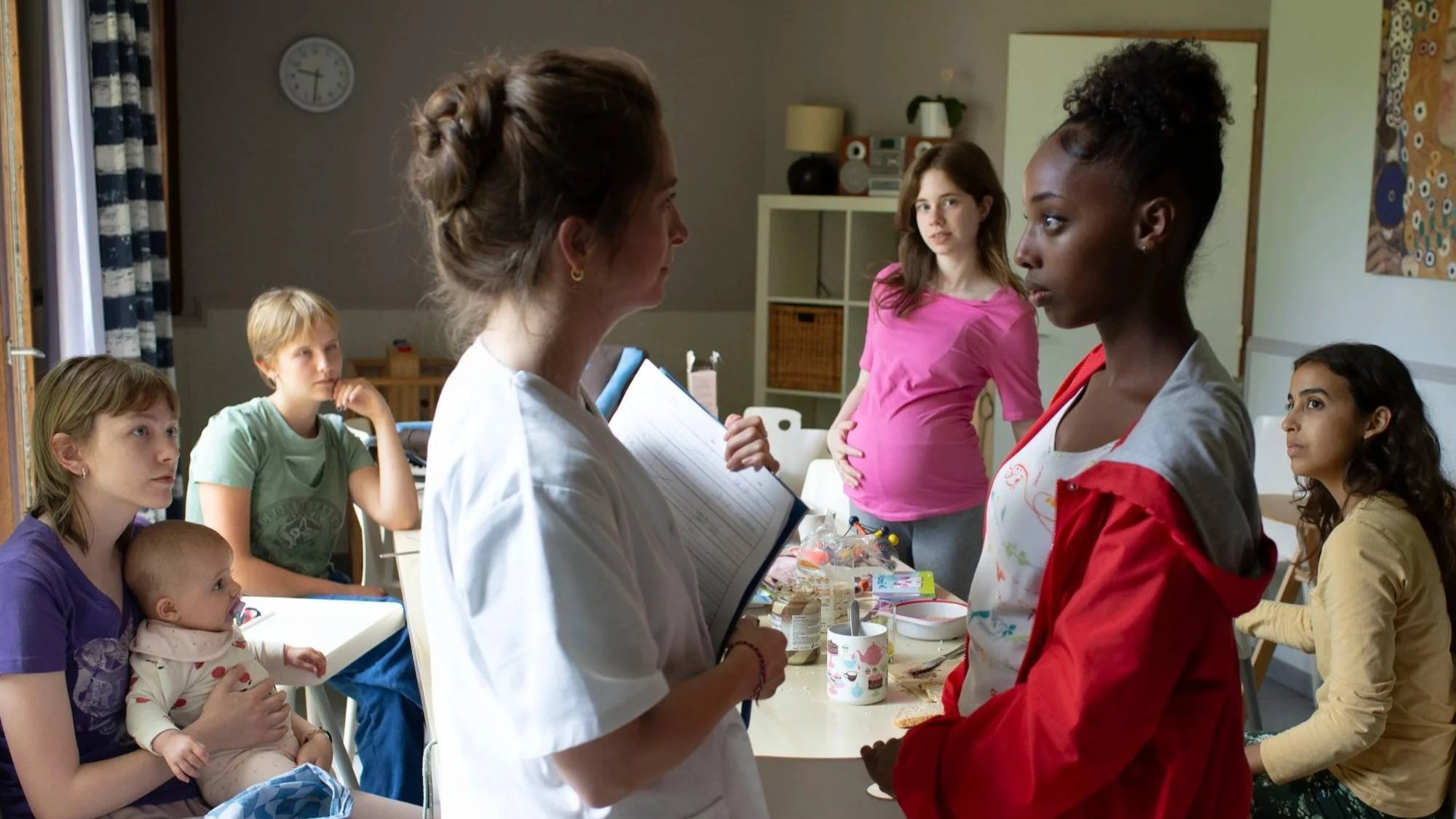

If you have a young child, as I do, or melt at the sight of babies aching for affection, then it’s likely that Jean-Pierre and Luc Dardenne’s Young Mothers will wreck you. The latest social realist drama from the Palme d’Or winning Belgian filmmakers, Young Mothers is unsentimental, uncalculated, and unassuming. There’s no real plot, per se, but simply a series of vignettes from the lives of four very young mothers living in a group home in modern-day Belgium. It’s gentle, sweet, but unflinching, the sort of drama that shames more adorned, melodramatic films.
Like so many Dardenne protagonists, the young mothers of their new film are dealing with a variety of mental, emotional, and economic challenges. There’s Perla (Lucie Laruelle), who has kicked her drinking habit but struggles to accept her duties as a mom when her boyfriend (and the baby’s father) gets out of juvenile detention and proceeds to shun her and the baby. There’s Jessica (Babette Verbeek), who is pregnant when we first meet her, and who desperately wants to be a good mom but is fixated on her abandonment by her own mother, Morgane (India Hair). There’s Julie (Elsa Houben), who is a recovering drug addict who has left the streets behind as she embraces being a mom alongside her supportive boyfriend. And then there’s Ariane (Janaïna Halloy Fokan), who has a little girl she wants to put up for adoption to the horror of her own abusive mother, Nathalie (Christelle Cornil), who desperately wants the child Ariane won’t keep her for herself.
These young women—and I do mean young, as several of the characters are in their mid-teens—deal with a variety of conflicts that would be at home in a typical melodrama, but Young Mothers is anything but melodramatic. Take the scenes where Jessica tracks down Morgane, despite the latter’s desire to be anywhere else but around her daughter. Jessica yells and Morgane callously avoids, but the camera hangs back, simply watching, not judging, nor amplifying the disagreement with close-ups and emotional framing. Rather than keeping us at a distance from the material, the unadorned approach evaporates the distance between us and the characters, making us feel like we’re bystanders on the street who’ve become accidental witnesses to a familial breakdown. We’re not only present, but we feel morally implicated by our proximity, as if now that we know about their problems, we’re obliged to help try to resolve them. If you’ve seen any Dardenne films before, you’ll know that the unaffected nature of the presentation heightens the emotional impact as we’re overwhelmed by the humanity of the people we watch on screen. Simply put, we forget we’re watching a movie.
There are many scenes like this where we’re subtly, magnetically, pulled into the orbit of these young women and become silent witnesses to some of their most vulnerable moments. The scenes with Ariane are particularly distressing and absorbing. She has a happy, healthy baby and is fairly competent taking care of her, especially as her mom, Nathalie, pitches in. But she’s only 15 and does not see herself as being a capable mother, no matter how much practice she gets. Her mother rails against this, thinking it’s the caretakers at the state home pressuring her into giving up the child, and begs for Ariane to keep the girl or at least give it to her to raise as her own daughter. But that’s the last thing Ariane wants and each protestation by her mother makes her want to create even more distance between her and her daughter, lest she transform into the kind of domineering, vindictive woman who emotionally torments her the way her mother does. Contrasting Ariane’s feelings with those of her baby, who watches her with such gooey-eyed affection, cooing her lovely little noises, only makes it more heartbreaking that Ariane feels she cannot reciprocate the love lest she hurt the child in the process. Also, Nathalie is no simple villain. She nakedly, desperately, pathetically pleads for the girl, but also slaps her daughter at the drop of a hat. The wild vacillations between pitiful and pitiless are heartbreaking, but absolutely credible.
Young Mothers is full of moments that are emotionally vulnerable, perceptive, subtly joyful or crushing. It breaks your heart, then makes you want to be a better person.
9 out of 10
Young Mothers (2025, Belgium/France)
Written and directed by Jean-Pierre and Luc Dardenne; starring Lucie Laruelle, Babette Verbeek, Elsa Houben, Janaïna Halloy Fokan, Samia Hilmi, Jef Jacobs, Günter Duret, Christelle Cornil, India Hair.
Read More Reviews
Send Help is Sam Raimi’s effective if lax tropical riff on Misery.