Why Obsession (2025) Is Not Reinventing Horror

Maybe I’m just a millennial who doesn’t get it anymore, or I’ve watched too many horror movies. Whatever the case, I thought that Curry Barker’s Obsession was merely good and hardly as scary or provocative as the average Letterboxd user will have you think it is. It’s an effective late-night horror thriller. I understand that it’s always dangerous to judge a movie by its reputation, and we critics can sometimes run the risk of reviewing the discourse, not the movie. However, with a movie phenomenon that’s outduelling Star Wars at the box office and making people think that YouTube is a viable pathway for Hollywood success (along with Backrooms), it’s hard to separate the movie from the hype. And Obsession doesn’t live up to the hype.
That said, Obsession clearly strikes a chord. Its assortment of grossout gags, jumpscares, and awkward laughs play well to packed late-night theatres. The film’s themes about relationships, consent, and anxiety are perfectly pitched to Generation Z, who are famously hesitant about relationships, sex, and putting themselves out there (while ironically living almost entirely online). The fact that the concept is mindblowing for its target audience is also fitting, given that Gen Z is typically ignorant of the past. I guess young people these days have never seen the Monkey’s Paw episode of The Simpsons that apparently inspired the film—let alone W. W. Jacobs’ short story that inspired the episode and the entire concept.
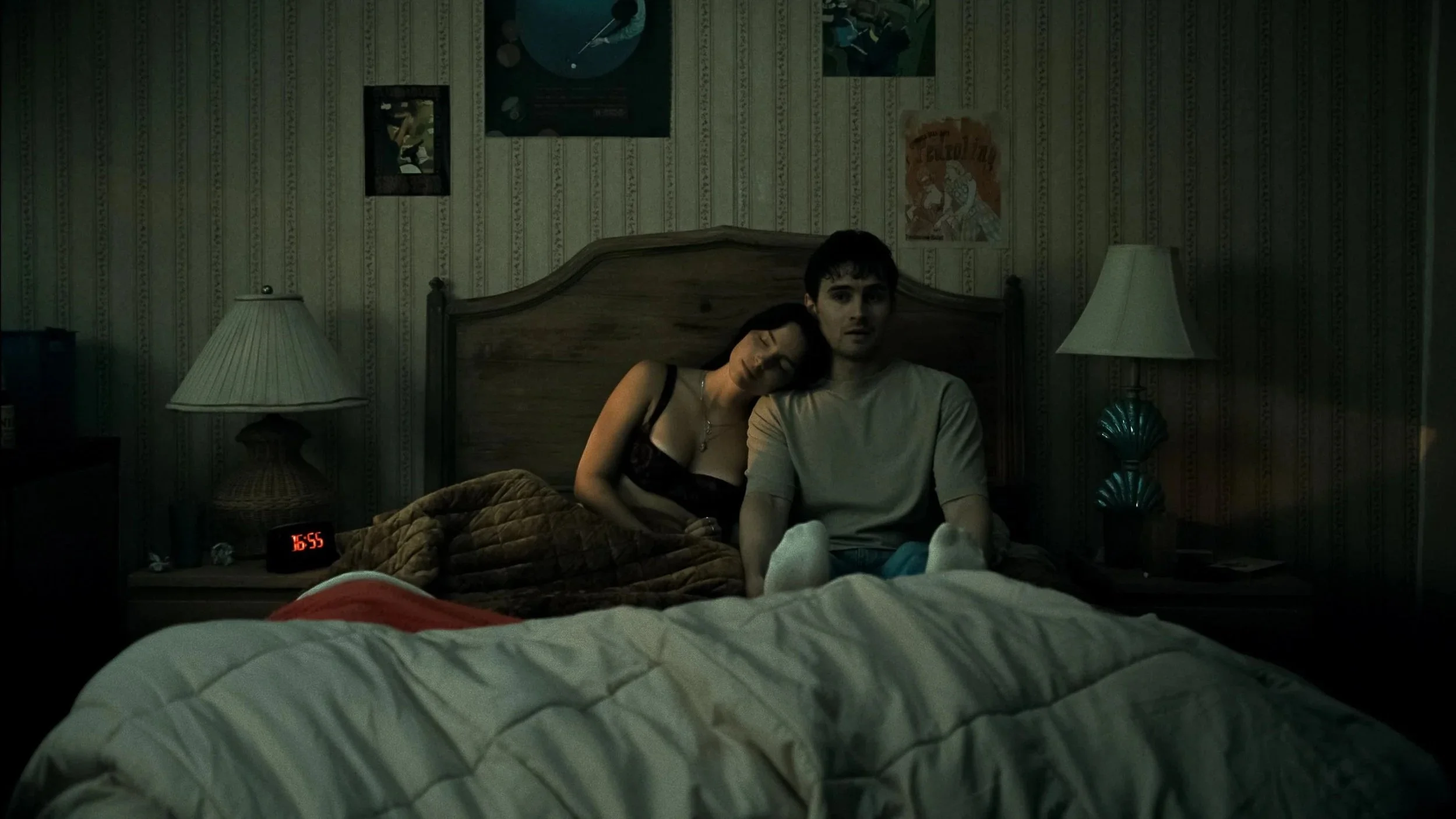
If you’re familiar with the concept of the Monkey’s Paw, you’ll understand the general concept of Obsession. Michael Johnston’s Baron “Bear” Bailey has a crush on his buddy/coworker Nikki Freeman, played by Inde Navarrette. On a night out together with friends, he plans to tell her his feelings, but he chickens out. Dejected, he uses the directions of a charm, a “One Wish Willow,” which he bought for Nikki but was scared to give her. The charm is supposed to grant a single wish, so Bear wishes that Nikki would love him more than anyone on earth. Fantastically, he gets his wish—along with all its unintended consequences.
From the moment that Bear uses the One Wish Willow, Obsession charts an escalation of awkward and insane relationship moments between him and Nikki, which progress from cringeworthy to horrifying. First we get Nikki being overly clingy—a bit too much, but mostly cute. Then we get her making Bear a monument to his dead cat, which dies in the opening scene—kind of creepy, but well meaning. But then we get her peeing on the carpet because she stands at her door all night waiting to see Bear the following day—very creepy and gross—as well as more nasty, violent, and alarming behaviour that I don’t want to spoil for those who haven’t seen the film.
Many of these moments are played for laughs as well as scares. The mixture between the two seems to be the modus operandi of popular horror movies in 2026. Jordan Peele pioneered this approach with Get Out in 2017 and Zach Cregger turned it into the genre standard with Barbarian in 2022 and especially Weapons in 2025. Both comedy and horror puncture unease with laughs or scares, so it makes sense that horror comedy is an effective blend for audience members who are perpetually anxious. Obsession goes one step further and has its protagonist embody that anxiety.
When we first meet Bear in the opening scene, he’s a nervous, inarticulate mess. In a diner, Bear pours out his affection for Nikki, telling her how he’s always felt about her. We watch this young man earnestly and painfully pour out his feelings only for a cutaway to reveal that Bear is not actually talking to Nikki but a waitress that his buddy, Ian (Cooper Tomlinson), has talked into playing the role of Nikki for a moment. Ian mocks Bear for being so awkward, essentially warning him that if he ever expresses himself like that to Nikki, he’s doomed. Bear isn’t confident, but doesn’t get any more confident from there.
So when Nikki comes under the spell of the One Wish Willow, Bear finally finds himself in control for the first time in his life. He doesn’t do anything to undo the spell. He’s too caught up in the fantasy coming true. You could read this as Curry Barker exploring Bear’s latent misogyny or skewering incel tendencies in young men, but Bear’s actions are ultimately a result of his anxiety, which connects to the anxiety of Gen Z as a whole. Bear is terrified of connection, but desperately yearns for it on his own terms. So when he finally gets the impossibility of connection with control, he’s thrilled.
Of course, control is unhealthy for any relationship, and this new relationship with the spellbound Nikki is anything but healthy. As Nikki starts freaking out others, acting more erratically, even violently, Bear realizes he’s in trouble, but he has decision paralysis. He’s overcome by his own feelings of inadequacy and the fear that he’ll never have control again. Ultimately, Bear is doomed.
Barker is tapping into a potent theme here, so kudos for his script having some weight to it, even if it’s most interested in provocation moment-to-moment. Johnston is capable in the role of Bear, oscillating well between anxiety, earnestness, and disbelief. Inde Navarrette is more impressive in some ways, as she’s tasked with the burden of playing huge moments with total commitment. Sometimes she has to wear a stupid, painful grimace for way too long in a scene. Other times, she embarrasses herself in ways both big and small. It takes selflessness to throw yourself into such a role and there’s a reason she’s getting all the praise and attention from critics and audiences. But her yang wouldn’t work without Bear’s yin; the wacko antics wouldn’t be effective if they weren’t paired with Bear’s internalized discomfort.
If it’s true that Obsession is a potent exploration of Gen Z anxiety, why aren’t I more impressed? It largely has to do with craft. Obsession is formally repetitive. Its best aspect is its tone. Barker deftly balances the horror and the humour throughout, alternating all the way through to the film’s particularly nasty ending. Like other good horror filmmakers, he plays to expectations, zigging when audiences expect the movie to zag, or holding discomfort until the viewer is bagging for a scare to break the unease. But in terms of shot construction, lighting, and blocking, he’s got nothing new to bring to the equation.
It’s important to note the film’s miniscule budget: $750,000. You shouldn’t expect M. Night Shyamalan-level craft with such a budget. And Barker does mimic the muted colours, earthy brown palette, and hazy backgrounds of contemporary horror, perhaps best exemplified by Ari Aster’s Hereditary (2018). He often places Nikki in the hazy negative space of a room or backlights her to hide her face so she’s draped in shadow and you’re unsure of what she’s going to do, putting us on edge as the viewer.
But the shot composition is overly-reliant on centre-framing, as if the movie is being composed entirely for social media users who are going to crop the frame for clips. When every shot seems to have its focus dead-centre, there’s no variation or visual discovery scene-to-scene. Your eye doesn’t move through the frame. It just sits and passively takes in the action. The visual momentum becomes stagnant.
There’s also virtually no blocking to think of in the film. Movement is conveyed through edits, not in-camera movement. This is common for low-budget features as shot/reverse-shot constructions hide the limitations of the set. It’s by no means fatal, but does betray a hermetically sealed world, one where the logic breaks down the further we get into the film.
Most of these shortcomings are familiar to many (perhaps even most) horror movies. Horror movies are often low budget. Horror movies are often referential, even formulaic, in terms of style and their approach to scaring the viewer (did I mention that Obsession uses jumpscares as its main scare tactic?). The logic often breaks down, especially as you turn into the third act, when the weight of a fantastical scenario becomes too heavy for the screenwriters to carry through to the end.
All of this is to say Obsession is not a breakthrough in horror filmmaking, but rather a representative work of horror filmmaking in 2026. It’s most remarkable for its astounding commercial success against its miniscule budget, and for its director successfully translating YouTube horror filmmaking to the big screen. But it’s rather ordinary, effective, and efficient as a film—just what you’d expect from a Monkey’s Paw movie, if you know what the Monkey’s Paw is in the first place.
Obsession (2025, USA)
Written and directed by Curry Barker; starring Michael Johnston, Inde Navarrette, Cooper Tomlinson, Megan Lawless, Andy Richter.
Read More Articles
Lance Oppenheim’s Primetime offers a fascinating portrait of Chris Hansen’s complex moral and professional motivations.