Review: Violent Saturday (1955)
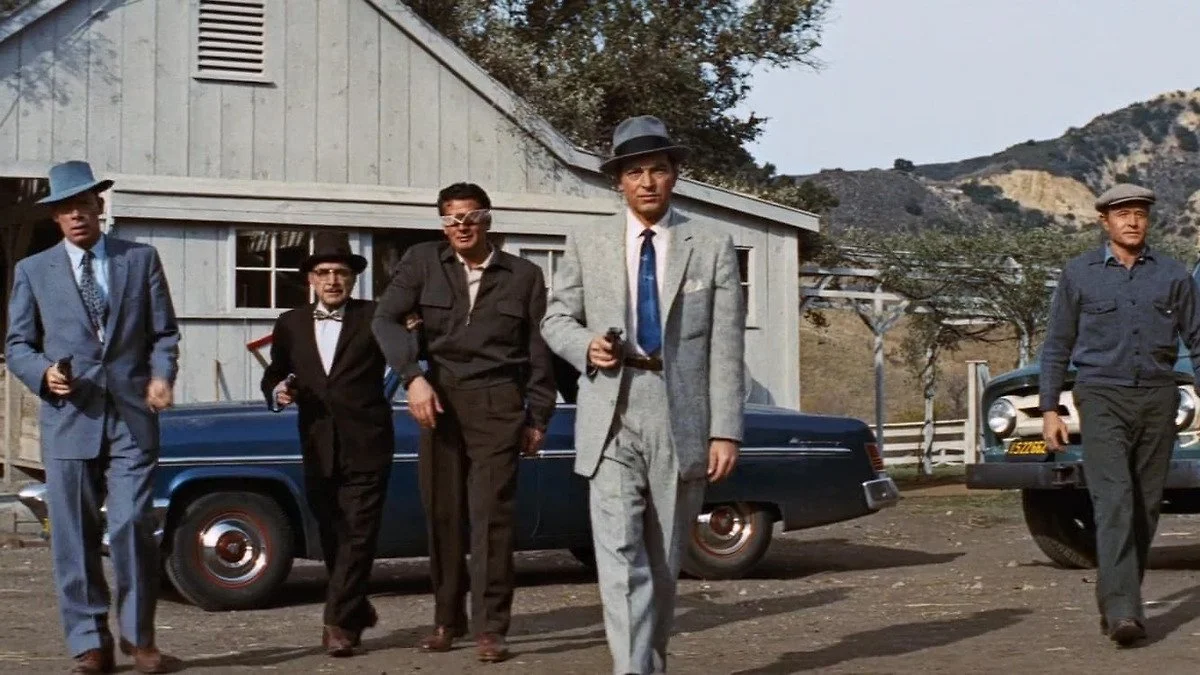

One of the joys of watching old, mostly-forgotten B-movies is being surprised. You’re surprised at the craft of a 90-minute picture made for less than $1 million. You’re surprised by big actors early in their careers showing glimpses of the appeal that would make them famous. You’re even surprised by the unconventional roles established stars would take. You get all of these in Richard Fleischer’s Violent Sunday, an effective crime picture about a bank robbery on a nondescript Saturday in a small Arizona town.
In many ways, the plot recalls the hyperlink pictures of the early 2000s, such as Crash (2005) or Babel (2006), where we get vignettes of the lives of various people in this town who will all be pulled together by a central violent incident. We get the local father, Shelley (Victor Mature), trying to convince his son he’s not a coward, since he didn’t fight in World War II. We get his business partner, Boyd (Richard Egan), who drinks himself into a stupor to distract from his wife’s (Margaret Hayes) affair and contemplates his own affair with an attractive nurse, Linda (Virginia). We get the timid manager of the bank, Harry (Tommy Noonan), who has a crush on Linda. We get the Amish patriarch, Stadt (Ernest Borgnine), living on the farm outside town and maintaining his traditional lifestyle.
All these individuals have their own anxieties and issues, motivated by a desire for stability, pride, and safety. For the first half of the film, we learn about their lives and watch them interact with each other, working through their troubles, be they familial, sexual, or cultural. There’s nothing groundbreaking about the drama presented here, but it does set up a clear and comprehensive reality for three robbers to puncture when they enter town one Saturday intent on robbing the local bank.
The robbers are played by Stephen McNally, J. Carrol Naish, and Lee Marvin. McNally’s Harper is confident and handsome. He presents as a travelling salesman when he checks into the local hotel and is the kind of man to build a rapport with the staff. Naish’s Chapman is bookish and quiet. Although we learn he’s one of the crooks shortly after meeting him, it still registers as a surprise after his gentle encounter with the Amish family on the train. And then there’s Marvin’s Dill, a Benzedrine addict and the most violent of the three—the sort of man who screams “loose cannon.”
While many of these stars have faded from the public consciousness over the years, there’s novelty in watching Mature, Borgnine, and Marvin, in particular. Marvin gives us the glimpse of future greatness. Dill is a small part, but from the moment we meet him, huffing from his inhaler as a kind of psychosomatic tic while waiting on the train, we know this man’s one to watch. It’s important to note Violent Saturday comes early in Marvin’s career. He had previously broken onto the screen with notable roles as villains in Fritz Lang’s The Big Heat and László Benedek’s The Wild One (both in 1953), but he wasn’t the star of The Dirty Dozen or Point Blank yet (both 1967) and so his violent physicality and snarling intensity breaks through the staid conventions of 1950s performances.
Mature, best known for playing Doc Holliday in John Ford’s My Darling Clementine (1946), offers probably the least revelatory performance of the well-known stars, but it’s still interesting to watch his Shelley navigate the expectations of manhood in the post-war world. A heart-to-heart with his son reveals a wounded vulnerability and pleading desire for affirmation that isn’t usual in leading roles of the time.
And then there’s Ernest Borgnine’s Amish farmer (it’s fun to note this performance comes in the same year that Borgnine won Best Actor for Marty). How realistic it is to have an Amish family living on the outskirts of an Arizona mining town is neither here nor there—the sheer novelty of watching him play the pacifist pushed to the brink shows just how fun it is to watch stars of the past take risks.
Violent Saturday is not exceptional in its drama, but it’s compelling. It’s also notable as an early CinemaScope picture, and director Richard Fleischer (best known for later films such as 1973’s Soylent Green) delights in the expanded frame. Although the film lacks the visual dynamism of a picture by Alfred Hitchcock, for instance, it’s still startling to see how much visual information is packed into every frame. Violent Saturday is not a film that believes in negative space. The deep focus and packed frame lets us observe the lived-in details of this small town.
Everything leads to the climax, which is shockingly violent, first at the bank and then leading to the Amish farm where the reluctant heroes are forced to confront the brutal robbers. Like in a picture such as The Big Heat, the violence in Violent Saturday explodes the expectations of a 1950s film. Characters don’t hesitate in brutalizing others. Marvin’s Dill, in particular, delights in killing and hurting, even women and children.
The whole effect is a solid B-picture, surprising in its violence, sturdy in its craft, novel for the performances of its luminary stars. It’s still a B-picture, through and through, more functional than exceptional, but there’s a sturdiness here that is almost entirely absent from contemporary 21st-century Hollywood cinema.
7 out of 10
Violent Saturday (1955, USA)
Directed by Richard Fleisher; written by Sydney Boehm, based on the novel by William L. Heath; starring Victor Mature, Richard Egan, Stephen McNally, Virginia Leith, Tommy Noonan, Lee Marvin, J. Carrol Naish, Sylvia Sidney, Ernest Borgnine.
Read More Reviews
Alexander Ullom’s high-concept debut feature conjures an existential nightmare.