The Guilt of War Fuels Christopher Nolan's The Odyssey (2026)
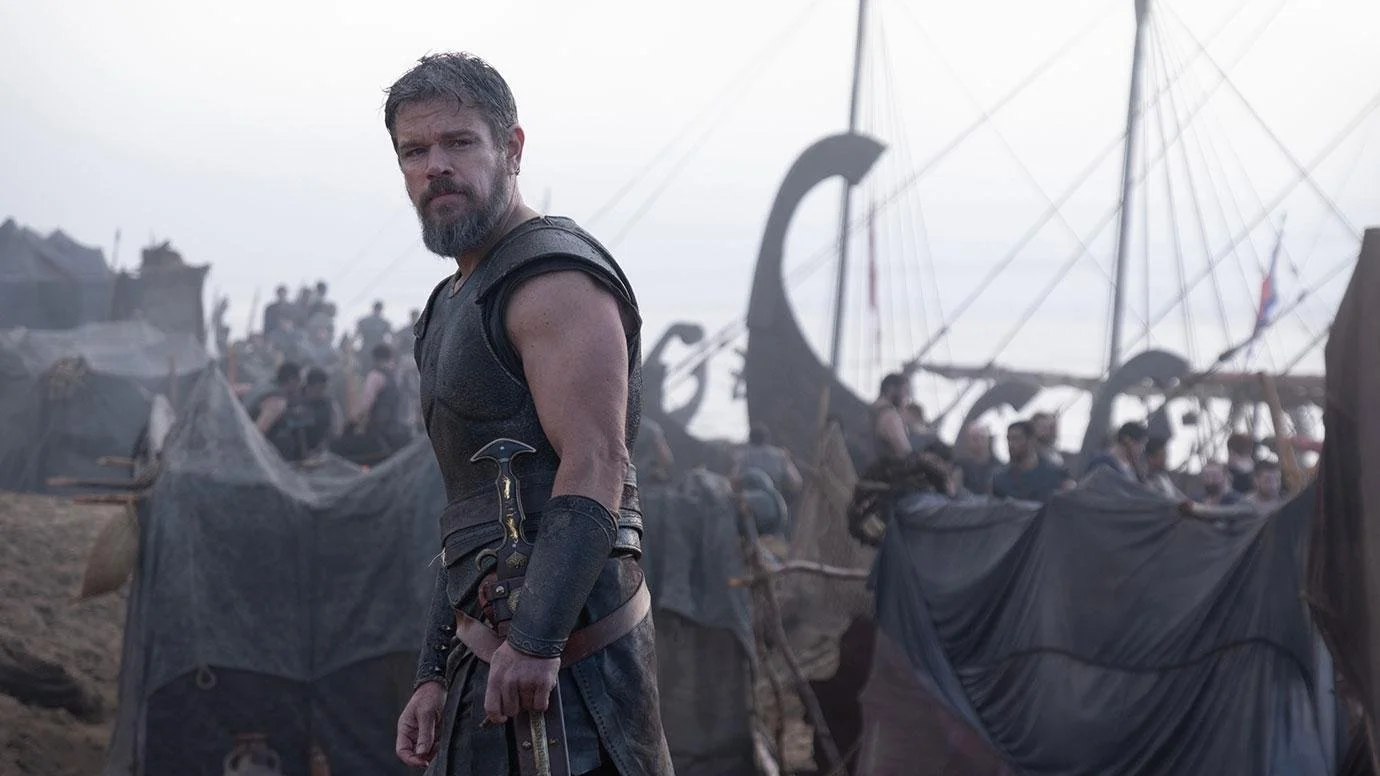

Guilt dominates the films of Christopher Nolan. Guilt over failing to save others fuels Batman’s mission to defend the citizens of Gotham, in a way he never could defend his parents, in Nolan’s The Dark Knight trilogy. Guilt over sacrificing yourself at the expense of family and friends, whether done selfishly in service of ego as with the magicians of The Prestige or selflessly in service of humanity as with the explorers of Interstellar, is at the thematic heart of those two films. Over the past decade, Nolan has zeroed in on the guilt over war, whether the guilt of the survivor (Dunkirk or Tenet) or the guilt of the victor (Oppenheimer). So it should come as no surprise that Nolan’s adaptation of The Odyssey is also a film consumed by guilt—of actions taken, of actions not taken, for good and for ill.
You could even argue that since 2017 Nolan has channeled this fascination with guilt into a series of anti-war pictures. Dunkirk is one of the very few war movies that escapes the charge that all war pictures are pro-war pictures. Tenet might be more of a mind-bending sci-fi thriller than a war film, but its narrative is powered by a secret group of actors fighting to undo the wars of the future—heroes literally moving backwards and forwards in time to prevent war from consuming the entire world. It might be ironic, even hypocritical, that The Odyssey continues this anti-war bent as it has the most rousing war scenes of all Nolan’s works, but it is a film with a damning vision of the costs of victory.
In adapting Homer’s Odyssey, Nolan has remained largely faithful to the ancient Greek bard, but he has also imbued the film with a haunting, bone deep guilt for the actions taken in service of victory in war—so much so that it seems a spiritual sequel to his Best Picture-winning Oppenheimer. Both films are about men who end wars, and in a way, end worlds.
Based on ancient source material that is so enduringly mythic, it continues to pervade even our proudly illiterate culture, The Odyssey traces the long voyage home of Greek king Odysseus (Matt Damon) from the Trojan War—a war he himself ends through the deception of the Trojan Horse, in which the Greek soldiers penetrate the impenetrable walls of Troy and sack the glorious city. Even people with zero knowledge of the classical world will have some basic expectations of The Odyssey—the Cyclops, the Sirens, the Trojan Horse—and they are presented with all these elements here, as Nolan follows the source material rather closely even as his thematic preoccupations are distinctly, obviously, modern in a way Homer’s work is not. It’s also distinctly a Nolan film from its very first frames of a fire-lit hall and a sun-bleached beach.
It should come as no surprise to you that, being a Christopher Nolan movie, The Odyssey does not have a linear narrative. The film begins in the halls of the palace on Ithaca, Odysseus’s island kingdom, flashes back to the beaches of Troy, then jumps back and forth as it splits its narrative focus between Odysseus’s son Telemachus (Tom Holland) searching for word of his father and Odysseus on the island of the sea nymph Calypso (Charlize Theron) remembering what happened to him and his men after leaving Troy. Much of the flashback structure is borrowed from the source material as Homer relates most of Odysseus’s voyage and the fall of Troy through stories told by characters in the text. For instance, we never witness the sack of Troy in the present tense in Homer’s work. But Nolan amplifies the temporal shifts, highlighting the ways that past events, particularly Troy, haunt the characters. He uses certain images, most notably the Trojan Horse, as these mammoth symbols of what has been lost in war.
Unlike Dunkirk or The Prestige, The Odyssey does not play with time to capture the dilation of war or play a trick on the audience. Rather, it’s more like Oppenheimer or Memento, with Nolan using the nonlinear narrative to capture the act of remembering and crucially show how guilt fuels action. For a portion of the story, Odysseus is like Leonard from Memento, eternally trapped in the present, eating the lotus flowers of Calypso to forget the past and live in a blissful, unaware fog where he can escape the guilt of his past decisions. Unlike Leonard, Odysseus does not flee from the past eternally—he never transforms a fabricated past into fact, like Leonard does at the climax of Memento when he writes a lie onto one of his polaroids. But he is tempted to remain ignorant. Eventually, under the behest of the goddess Athena (Zendaya), he does leave the fog of fantasy and return to the clear shores of his home. To return home, however, he must strap himself onto a meagre raft and give himself up to the sea and the judgments of the gods. Only by embracing his fate, accepting his past actions and the accompanying guilt, can he find his way home, rediscover himself, restore his kingdom, and, perhaps, save his soul.
Core to Nolan’s presentation of The Odyssey is the idea of remembering the past for what it is. Odysseus’s wife Penelope (Anne Hathaway) must hold onto the memory of her husband as he was and cling to the kingdom as it should be rather than the state it has devolved into, as suitors flood her palace intent on replacing Odysseus as her husband and the island’s king. Telemachus must discover the sort of man his father actually was by venturing to meet King Menelaus of Sparta (Jon Bernthal) but also by listening to his mother and his father’s old loyal servant, Eumaeus (Jon Leguizamo), who impart the lessons of fatherhood that his father never could. Even the leader of the cruel suitors, Antinous (Robert Pattinson), must come to terms with paying a poor boy to take his place in Troy.
Odysseus himself must remember what happened to his men on his voyage home and, crucially, remember the reality of the Trojan War: that it was tragedy, not triumph. In legend, the Trojan War is presented as the Greeks’, and particularly Agamemnon’s (Benny Safdie), great triumph. But, as Nolan’s film clearly illustrates, none of the victors reap the glories of its aftermath. It takes all of them years to get home and even the ones who get home relatively unscathed, such as Menelaus, have to live with the fact that the conflict was started due to their domestic failures—in his case, his wife, Helen (Lupita Nyong’o), fleeing with Paris to Troy. Others, such as Agamemnon, return to what they think is glory, but actually betrayal, as they have to pay for the sins of their past decisions, as Agamemon’s wife (and Helen’s sister), Clymenestra, kills him in retaliation for sacrificing their daughter to the gods to gain favourable winds when sailing to war.
As the mastermind behind the Trojan Horse, Odysseus needs to confront the consequence of his actions—like Oppenheimer confronting his creation of the atomic bomb. To make memory and guilt central to his tale of Homer’s legend, Nolan has to change some elements of the original myth. For instance, Nolan blends together some books—the island of the Lotus-Eaters is combined with Calypso’s island so that Odysseus is the one tempted by the lotus flower—while excising other elements altogether—we do not get Princess Nausicaa and the Phaeacians, for instance. Elements that are not so prominently discussed in the poem—for instance, the Trojan War is constantly referenced, but actual description is mostly restricted to Menelaus’s speech to Telemachus in Sparta—have greater prominence. They have to, since the Greeks of ancient times who would have heard Homer’s poem were so familiar with details of the Trojan War, through other songs and legends, including Homer’s Iliad, that they didn’t need the details fleshed out.
But Nolan needs to flesh out these details and hone in on the brutality of the war to make the film’s points strike home. The film takes pains to reference Zeus’s Law over and over again—the command that you should accept a stranger into your home and offer them food and safety, lest they be a vengeful god in disguise. It cannot rely on implicit inference, as the original hearers of the poem would have had. Nolan is an effective filmmaker, but he’s also often a rather blunt one, too, and he hammers home the concept that breaking this law undoes the world of ancient Greece. The Achaeans might have won the war with Odysseus’s trickery, but the Trojan Horse itself is a betrayal of the law that bound their world together. By winning the war, Odysseus destroys his world in the process, completely reshaping the rules that bind all human interaction.
It’s why Nolan uses his nonlinear presentation to continually return to the night of Troy’s fall. First, we get Trojan soldiers finding the horse on the beach and killing the soldier, Sinon (Elliot Page), unknowingly tricking them into believing it’s an offering to Athena. This sequence cuts off as Penelope interrupts the telling in her hall. She doesn’t want to listen to the story of Odysseus as she knows the reality is much crueler and less glorious.
We return to Troy when Telemachus visits Menelaus and the Spartan king tells him the story of the Trojan Horse and what it was like to be inside the horse and sack Troy. Flashing back to the past, we watch the Greek soldiers hiding inside the horse, withstanding blows from Trojan soldiers testing the horse to see if anything is inside, and then secretly escaping it to open the gates of Troy and allow Agamemnon’s army to sack the city. This version is a tense race against time—the Greek team inside the horse are essentially the small band of men on a mission you find in many war movies, ultimately succeeding against all odds. The sequence shows a triumph of cleverness and bravery.
If that were the final time we see the Trojan Horse, the film’s lessons would go unlearned. But we return to this sequence once Odysseus has finally returned to Ithaca and, disguised as a beggar, tells Penelope the story of the fall of Troy. As Odysseus discusses the true cost of the war, we see Odysseus and Menelaus open the gates to allow Agamemnon’s soldiers into the city, where they proceed to rape or murder every Trojan they meet. We follow Odysseus through the city as towers topple, fires blare, and the outnumbered Trojans fall to the blades of the Greeks. It’s a bravura sequence, but for all the grandeur of the practical effects and the pounding score from Ludwig Göransson, Nolan undercuts the majesty by foregrounding the brutal murders of civilians. It culminates in the sack of the Temple of Athena, where the Trojan Horse was brought as an ostensible offering, the murder of the temple priestess (played by Zendaya in a cunning dual role), and the toppling of the statue of the goddess.
Throughout the film, people that Odysseus and Telemachus meet speak warily of the Sea Peoples who are coming to overthrow their civilization. These Sea Peoples do not respect Zeus’s Law and do not extend hospitality to strangers. This omen of armageddon haunts the people of ancient Greece as a future time of tribulation, but as Odysseus reveals to Penelope during this climactic speech, the Greeks themselves are the Sea Peoples. By using the Trojan Horse to conquer Troy, they betrayed Zeus’s Law, and became the very monsters doomed to end their civilization.
By facing his own guilt, and admitting his role in breaking the laws of the gods, Odysseus admits that they ended the world. In the final moments, as Nolan weaves in elements of Alfred, Lord Tennyson’s poem “Ulysses,” which imagines the king of Ithaca sailing into the West after returning from Troy, Odysseus mentions a coming collapse of the age. Nolan is hinting at the Bronze Age Collapse, which completely devastated the Mediterranean world and set people back into a dark age before the time of Homer and those other orators telling these ancient legends. It might seem like a minor note, but by introducing this future collapse and making it a consequence of the actions of Odysseus and the fall of Troy, Nolan draws a straight line from the victory of war to civilizational destruction.
In this way, the Trojan Horse becomes to Odysseus as the atom bomb is to J. Robert Oppenheimer: the tool of victory becomes the cause of self-destruction. The grace note is that this is not the final end of the world, but the end of a world—unlike the haunting suggestion at the end of Oppenheimer that atom bombs will prove the final period at the end of the sentence of human life on the planet. Civilization will fall with the Bronze Age Collapse, but there will be songs of Odysseus and Penelope, and if people hear the songs, if they remember their lessons, if they remember who we were and what we can be, then they can respect Zeus’s Law and avoid repeating the mistakes of the past.
For Christopher Nolan, The Odyssey becomes a story we tell to remember the cost of war and to return to our rightful home of peace. The guilt-ridden message might not be Homer’s original intention, but we’d do well to remember the name of the 24th and final book in Homer’s poem: “Peace.” Whether through the act of gods or the act of man’s remembrance, the return to peace is the only return worth celebrating.
The Odyssey (2026, USA/UK)
Directed by Christopher Nolan; written by Christopher Nolan, based on Homer’s poem; starring Matt Damon, Tom Holland, Anne Hathaway, Robert Pattinson, Lupita Nyong’o, Samantha Morton, John Leguizamo, Zendaya, Charlize Theron, Jon Berthnal, Himesh Patel, Bill Irwin, Elliot Page, Benny Safdie.
Read More Reviews

Matt Bettinelli-Olpin and Tyler Gillett’s action horror sequel is a mere reheat.