Review: Toy Story 5 (2026)
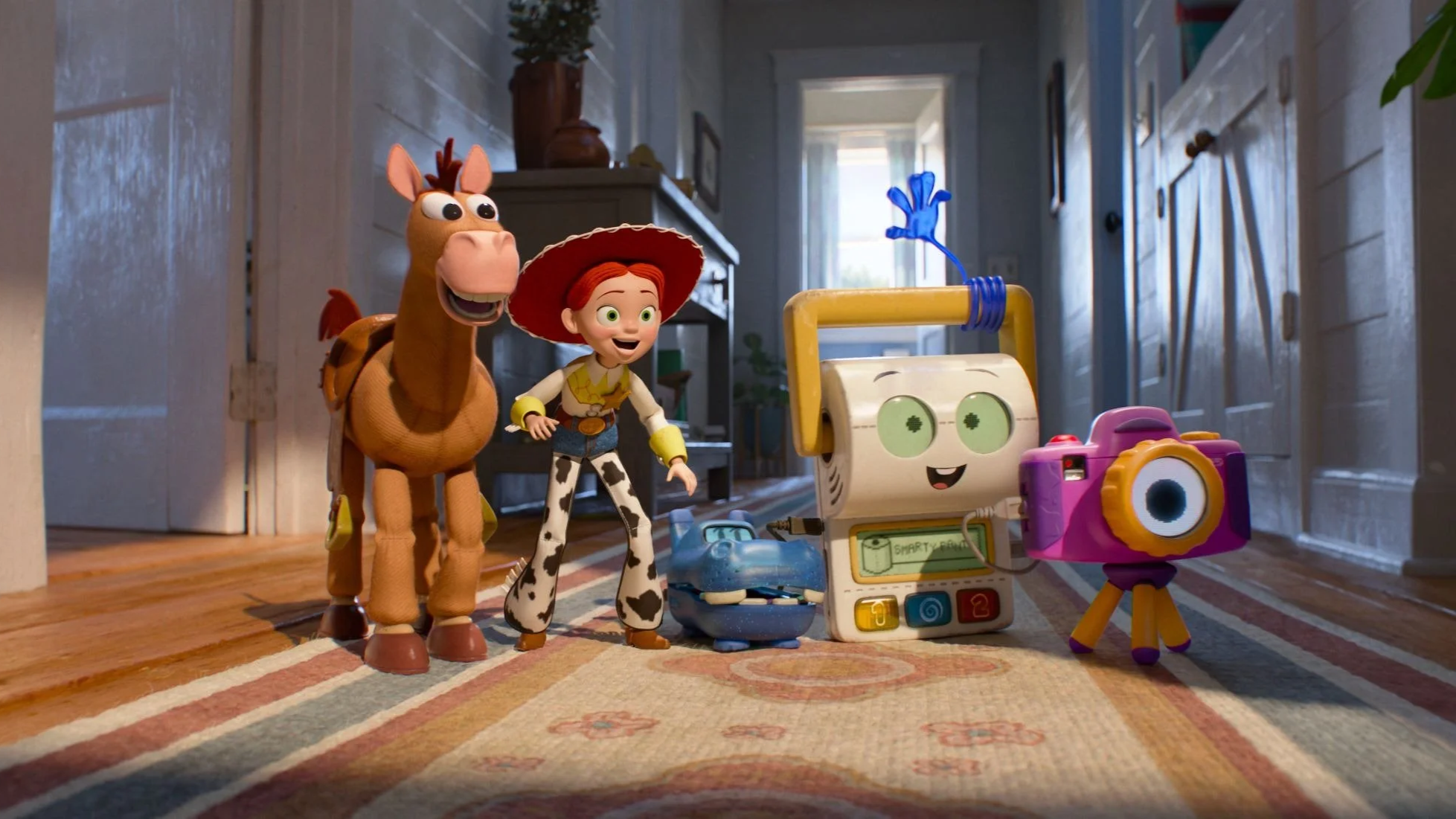
If it wasn’t clear before, Toy Story 5 makes it crystal: these movies are now made for adults. To be precise, they’re made for millennials, who have grown up along with the franchise: children during the first two films, young adults for the third, and now adults with kids of their own for the fourth and fifth films. (I can only imagine that when millennials are octogenarians, there will be a Toy Story 8 waiting for them.) So it makes sense, then, that the plot and themes of Toy Story 5 are focused on how technology has taken over children’s lives. Children do not worry about whether they are getting too much screentime. Parents do. And Toy Story 5 thoroughly explores this parental anxiety with Pixar’s patented mix of insight, sentiment, and emotional manipulation.
Directed by Andrew Stanton, best known for his Pixar films Finding Nemo (2003) and WALL-E (2008), Toy Story 5 stands out from its predecessors in two key ways (aside from the prominence of smartphones and tablets in the storyworld). The first is the sidelining of Woody (Tom Hanks) and Buzz Lightyear (Tim Allen)—long overdue, especially after a fourth film that was more interested in toys as individuals than the functions they serve for their owners. In this fifth film, Woody and Buzz are merely supporting characters to Jessie (Joan Cusack), the cowgirl introduced in Toy Story 2 (2000) and the chosen sheriff for Bonnie (Scarlett Spears), the little girl at this and the previous film’s centre. It’s fitting that after several movies where Woody and Buzz get older, they’re finally too old to hold centre stage, not that Jessie is a spring chicken herself. But, thankfully, Toy Story 5 avoids being an encore nostalgia tour for Hanks and Allen. Woody and Buzz are there to help, but the film doesn’t bend the narrative towards them, and is all the better for it.
The second way this Toy Story entry stands out is in the intense focus on Bonnie. In the first three Toy Story movies, Andy (Woody and Buzz’s owner) mostly exists on the periphery, more deity than demonstrable personality for us to care about. Toy Story 3 injects some personality into Andy as he gives Woody, Buzz, and the rest of the gang to Bonnie, embracing his new adulthood at the same time that he ignites the imagination of a young girl with his passing of the torch. In Toy Story 4, Bonnie takes the place of Andy—the beloved of the toys, but hardly a character that the filmmakers are interested in. Toy Story 5 changes this because its preoccupation with tech and screentime for children makes her essential to the film’s narrative and themes.
The film revolves around the panic that seizes the toys when Bonnie’s parents get her a Lilypad (Greta Lee), a children’s tablet with internet games and chatrooms for her to bond with other kids. Bonnie is a weird kid, we learn, someone who doesn’t make friends easily and who lives in her head when so many other children live online.
In two blunt but effective sequences early in the film, we see the devastating impacts of screens on children. In the first, we see Bonnie attempt to bond with the twins living across the street only to scare them off with some weird jokes about her toys. She flees inside and dejectedly asks her parents why no one wants to be friends with her. It’s the kind of comment that breaks the hearts of any parents watching, as it does Bonnie’s parents, who panic and desperately try to think of a means of getting her connected to her friends, landing on the Lilypad as the best course of action. As this scene demonstrates, Toy Story 5 is invested in Bonnie as a character in a way no previous Toy Story film has invested in its children.
In the second, we see the toys’ point of view soon after Bonnie gets her Lilypad and is absorbed in its digital world. The toys gaze out the window and the digital camera pans over the homes of all the neighbours, where every open window reveals an adult or child enveloped by their screens, living alienated, isolated lives in the mainframe rather than interacting with anyone else. It’s a lonely, depressing vision of life in the present.
Pixar might be a shadow of its former self, but it’s still capable of these sorts of effective, if manipulative, moments in its films, where it synthesizes its themes with strong emotional hooks. No viewer with any skepticism of the insidious power of smartphones will be able to watch such a shot and stay stoic—it cuts right to the core of our new, isolated, sad world for humans, especially children.
For much of its runtime, as Jessie desperately tries to get Bonnie to connect with a friend without resorting to tech, and Woody and Buzz try to support her by deflecting the machinations of Lilypad, Toy Story 5 makes a persuasive argument that the analog world, with its cowboy dolls and spaceman toys, is a genuine improvement over the digital, even if it’s hopelessly outmatched in 2026. It even makes an effective villain in Lilypad, who thinks that her means of connecting Bonnie to others is so much more efficient and effective than the childish play of Jessie and company.
At its core, the film synthesizes the use of screens with the childhood desire to be more than a kid—to seem adult. Which is true to a point, as play is tied to imagination and innocence—it’s no accident that when kids hit adolescence, they often stop playing with toys. However, this perspective elides the addictive qualities of tech, and the fact that the whole system is rigged to make us all dopamine addicts, endlessly scrolling, streaming, and clicking until our every economic decision becomes connected to getting another digital fix. Tech doesn’t just coincide with our loss of innocence; it transforms us into addicts. Ultimately, Toy Story 5 ignores that there are a new set of problems at play beyond what impacted children during the advent of radio, television, and the PC.
Toy Story 5 might be made for adults, but it’s still beholden to the clear and conventional Pixar structure which demands emotional catharsis, so Lilypad’s machinations must be blunted, the dangers of tech must be muted, and the characters allowed to succeed with a compromise, not a conquest. No, her parents don’t get rid of her Lilypad in the end. Much like myself, who hates smartphones but wrote some of this review on one, the film is not willing to go all the way and banish tech. It lives in that mushy middle.
And that’s fine. We cannot expect a radical approach from a kids film in 2026, even if it’s more made for the parents than the kids. But the film’s resolution does undo so much of its thematic interest and resolve in the most obvious manner possible—which was not always the case with Pixar movies.
Toy Story 5 starts promising and plays well throughout. It’s affecting—a return visit to the home of Jessie’s first owner, Emily, is especially devastating, especially as it recalls the heartbreaking sequence from Toy Story 2. It’s also gorgeously animated. For all its shortcomings in recent years, Pixar continues to advance its animation capabilities to the point where a throwaway shot of Jessie against a whitewashed dresser is captivating for the texture and detail Pixar has animated, down to the several coats of paint, complete with drip lines, on the drawer. (I understand the irony of the movie itself being a sparkling example of the possibilities of technological advancement.)
These are capable craftspeople. Toy Story 5 is an appealing film. It’s just too bad that it chickens out in pursuing its thematic interests to the fullest. Ultimately, it favours comfort and surety when its initial concerns promise anything but.
7 out of 10
Toy Story 5 (2026, USA)
Directed by Andrew Stanton; written by Andrew Stanton and Kenna Harris, based on a story by Andrew Stanton; starring Tom Hanks, Tim Allen, Joan Cusack, Conan O’Brien, Scarlett Spears, Greta Lee, Shelby Rabara, Mykal-Michelle Harris, Craig Robinson.

Read More Reviews

Matt Bettinelli-Olpin and Tyler Gillett’s action horror sequel is a mere reheat.