Hot Docs 2026: INDIVISUM: Legacies Adrift
It might not be the conventional take on documentaries, but I believe that whether a documentary succeeds or fails often comes down to the footage, not the subject matter. Interesting subject matter is important, but even a documentary with a fascinating subject can fail if the material could be better presented in an article or book. Thus, the onus falls on a documentary filmmaker to provide the cinematic exploration that justifies their film’s own existence. In essence, they need to answer the question: Why tell this story as a documentary movie? Thus, a film like INDIVISUM: Legacies Adrift, from emerging Canadian filmmaker Katia Café-Fébrissy, has an interesting subject matter—about fractious inheritance laws in her native Gaudaloupe—but lacks footage to support its investigation. It’s a movie with a thesis and a clear structure, but little content to pad out its scant 75-minute runtime.
Part introspective personal essay, part investigation of colonial inheritance laws in the French-controlled Caribbean territory of Guadaloupe, INDIVISUM takes its title from the legal notion of “indivision,” which is when a property is jointly owned by multiple people rather than divided into shares or clear divisions of ownership. Over the course of generations, such a practice leads to inevitable conflicts as more heirs get added to ownership without any clarity on how decisions are made or how properties are dealt with. Eventually, you have dozens of people who jointly own a property and completely disagree on how to dispose of it, leading to huge family disputes and properties that exist in legal limbo.
Café-Fébrissy explores this legal situation as she returns to the island to talk to family and starts to discover more and more vacant properties across the island of Guadeloupe that have been left empty due to indivision. Frustrated at being unable to come to a compromise with their joint owners, many people simply abandon the properties since the terms of legal occupancy or upkeep are unclear. In the most straightforward expositional moment in the film, a representative of the Guadeloupe Departmental Archives explains how old French colonial laws continue to impact family inheritance in a territory where title deeds and notarized wills are not common, leading to families fighting about land and inheritance becoming an arduous process bogged down in endless, incomprehensible documentation.
Café-Fébrissy sheds light on this practice and argues its colonial legacy continues to undermine the territory and its people. The argument is compelling, especially when you realize that many people don’t have deeds or draft succession plans because of the egregious legal costs of those processes. Guadeloupe’s legal situation is also complicated because, as an overseas territory still a part of the French Republic, French laws require legal paperwork and processes to be the same in Guadeloupe as they are in France, rather than scaled down to the economic realities of a poor Caribbean island.
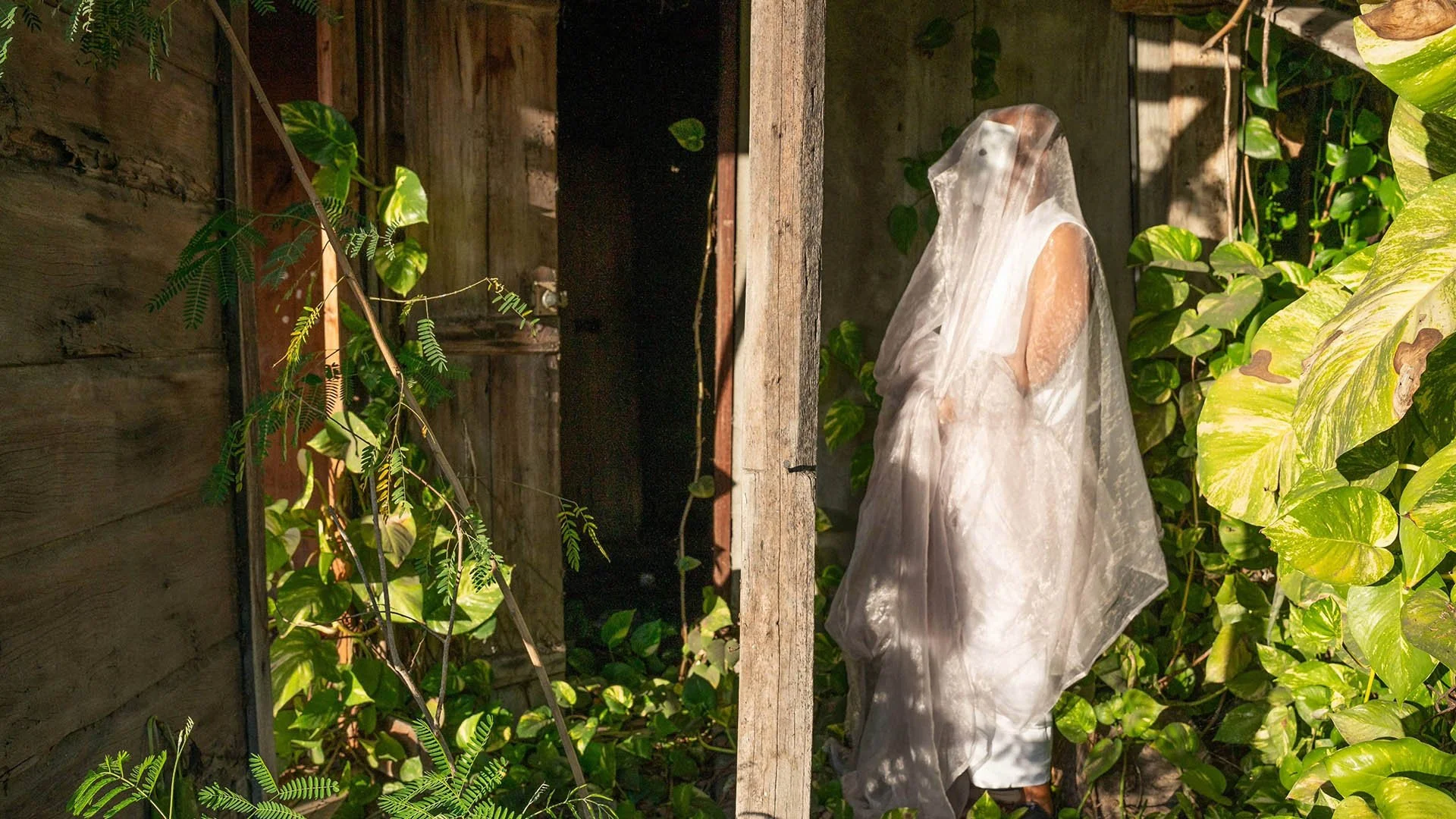
Café-Fébrissy recounts her own family struggles with indivision and interviews four anonymous women who give their own tales of indivision leading to familial breakdown. I appreciate her artistic flourishes, often creating striking tableaux of women in white masks and shrouds standing in front of old properties left decrepit by the legal limbo of indivision. We never see the faces of the women she interviews. They are only shot in these white costumes, while we hear their interviews overtop of B-roll of the island’s jungles and empty lots as well as these artistic flourishes. She also layers her own narration onto the footage, making the entire film an introspective journey as well as an interrogation of a legal practice that is crippling her homeland. Through her artistic framing, she presents the movie as a journey through an underworld, where these women are ghosts haunting the properties that tore their families apart.
There’s artistry here, but it’s also compensating for a crucial lack at the film’s centre: we never see any of the actual familial disputes we hear endlessly about. This is why I say that a documentary’s presentation will always be its most crucial element, even above that of its subject matter. We learn about indivision with INDIVISUM: Legacies Adrift. We enjoy a window in Café-Fébrissy’s mind and her own emotional journey back to Guadeloupe. But we don’t ever get footage that could communicate the film’s thesis in a visceral manner; the footage doesn’t do the talking. We never see a family going through indivision in the moment or people arguing over legal disputes. We don’t see a family undergoing this breakdown in real time—only select members of families discussing it after the fact. Thus, Café-Fébrissy has to compensate with her own story, her repeated thesis, her artistic flourishes since she’s ultimately lacking the vital cinematic urgency that would animate, and clarify, the whole.
5 out of 10
INDIVISUM: Legacies Adrift (2026, Canada)
Directed by Katia Café-Fébrissy.
Read More Reviews

Matt Bettinelli-Olpin and Tyler Gillett’s action horror sequel is a mere reheat.