Review: The Fall Guy (2024)
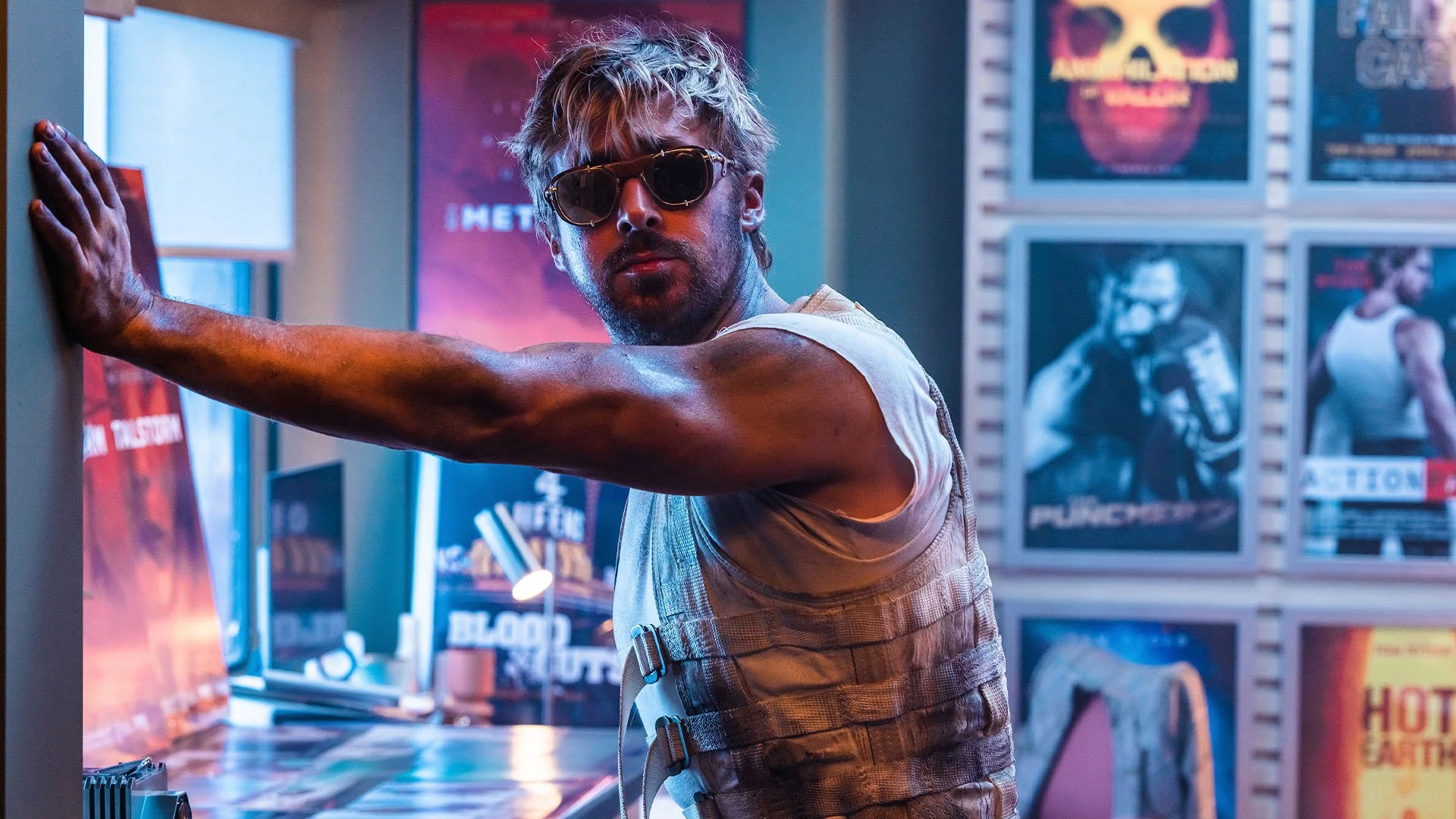

The Fall Guy is fun until it’s not. David Leitch’s 2024 ode to stunt performers and throwback to Hollywood action romance works best when it’s in Shane Black-lite mode, letting Ryan Gosling do his charming doofus shtick and making fun of big-budget Hollywood productions in the process. It’s also appealing as the rare big-budget picture with a romance at the centre that isn’t explicitly targeted at romance audiences—the on-screen banter between Gosling and Emily Blunt is not playing to the same people obsessed with Colleen Hoover novels, for instance. But like many of Leitch’s films, such as Atomic Blonde (2017) and to a lesser extent Bullet Train (2022), The Fall Guy is repetitive and literal-minded to a fault. By the end of its runtime, I was mostly bored, even if Gosling and Blunt did their best to provide the fun.
But before digging into where The Fall Guy botches its landing, let’s start with what works. Ryan Gosling is a bonafide movie star and Barbie (2023), for all its limitations, was a great showcase for how charming he is in mainstream movies. In his first movie after Barbie, Gosling carries much of that same Kenergy into The Fall Guy as Colt, a well-meaning but somewhat dense stunt double for a big time Hollywood movie star, Tom Ryder (Aaron Taylor-Johnson). When he injures his spine on a stunt, he leaves the industry, much to the chagrin of his on-set girlfriend, Jody (Emily Blunt), a camera operator who wants to become a director. He ghosts her and withdraws from the world, until over a year later, he gets an invite to come to Australia to be a stuntman on Jody’s breakthrough picture. He thinks she sent the invite, but they actually want him there to find Tom, who has disappeared into the Sydney underworld, leaving behind a trail of drugs. So Colt’s goal becomes two-fold: find Tom and win back Jody, doing one to make possible the other, saving her picture to reignite their relationship in the process.
It’s a decent set-up: there’s a mystery hook (where’s the star?), a running clock (the production will shutter if they can’t get their star back), and personal stakes (a happy tomorrow with the girl of his dreams). And for a while, it’s fun. Watching Gosling sleuthing around Tom’s absurd Sydney penthouse is entertaining, as is an entire action sequence where he goes to a club masquerading as a star himself and takes out an entire crew of drug dealers with champagne bottles and other available items. Leitch, himself a former stuntman for Brad Pitt among other stars, relishes every opportunity to showcase stuntwork. So we get Gosling (and his stunt double, Justin Eaton) crashing into tables, getting smashed by bottles, dodging katana blades, and generally showcasing every which way to get pummelled on film. It’s amusing at this point in the film (later, not so much, but we’ll get to that in a bit).
It’s also fun to watch Blunt and Gosling spare on screen, playing up the classic romantic comedy approach of acting really upset with each other, talking around double meanings, and generally letting the character friction fuel the on-screen chemistry. When Jody first realizes Colt is on set, she embarrasses him by talking about their relationship through the half-hearted guise of talking about the characters in the movie she’s directing. Speaking over a loudspeaker so her entire crew can hear, Jody goes through every embarrassing detail of how Colt failed in their relationship, all with a wink and a smile. Colt gives it back, justifying his actions while trying to disguise it as movie talk about a role he knows nothing about. It’s amusing to see Gosling flounder and Blunt go in for the kill. In particular, the banter is amusing because we know that their annoyance with each other is fueled by how deeply they’re attracted to each other, and how much that fact can annoy them.
But like so much of this movie, this sequence misses the offramp like a stuntcar botching a stunt. Leitch and writer Drew Pearce are too amused by the banter and the set up to cut while the going is good. Instead, the joke extends, the bit grows stale, and we eventually start looking at our watch instead of the charismatic movie stars on the screen.
This happens with the action sequences too. The nightclub fight is fun. The early showcase of movie stunts on the fake set are fun. Leitch knows how to shoot the physicality of a fight so we can comprehend that it’s real (not digital) performers beating the crap out of each other, or at least faking it very well. But he doesn’t know how to differentiate any fights, or how to add humour or verve to them without overly relying on slow motion or cuing an obvious needle drop from some rock or pop song that’s been played to death.
Perhaps the most obvious moment of this whole tired approach is a scene where Colt, thought to be dead and disguised in a silly alien costume from Jody’s movie, sneaks up on her in her trailer, and she absolutely wallops him, using every available item in reach to beat him senseless. It’s funny for a moment—the Gosling pratfalls in the absurd costume are amusing—but watching Blunt, playing a camera operator-turned-director, execute seamless wrestling moves and takedowns, one after the other, grows not only tiresome, but utterly unbelievable. Why does every character fight like they’ve done this a million times? Where is the sloppiness or the weakness? Why, later in the film, does Jody cringe after simply punching another woman in the mouth if she can literally execute moves that take professional UFC fighters months to perfect (hat tip to Filmspotting’s Adam Kempenar for this original take).
It’s ultimately because Leitch is too enamoured of his stunt people, too fixated on the form, to realize that the average viewer isn’t going to the movie to admire the behind-the-scenes craft of the crew, but to get swept up in the story itself and laugh at Gosling and Blunt. It’s trying too hard to be perfect and ends up seeming like a grand exercise in stuntwork rather than a movie we lose ourselves in, which is too bad, because the general set-up works.
There’s also the film’s perfunctory gestures at the TV show on which it’s based, The Fall Guy from the 1980s starring Lee Majors and Heather Thomas (both of whom show up for a mid-credits cameo as their old TV characters). Unless you loved this mostly forgotten 80s show, this mid-credits scene seems embarrassing, and any loving references throughout the main narrative are mostly too opaque to matter. I won’t fault the affection on display, but don’t assume I care about it to the same degree. For once, I’d rather get a clever use of pop music than a reference to a TV show that ended before I was born.
All told, The Fall Guy is very much of a piece with Leitch’s other films, not only Atomic Blonde and Bullet Train but also Deadpool 2 (2018) and Hobbs & Shaw (2019). Like those films, it has an appealing movie star approach, some genuine craft behind the set pieces, and a light tone, but it’s too impressed by its stunts and too obvious with its style to be anything more than a minor diversion.
5 out of 10
The Fall Guy (2024, USA)
Directed by David Leitch; written by Drew Pearce, based on The Fall Guy created by Glen A. Larson; starring Ryan Gosling, Emily Blunt, Aaron Taylor-Johnson, Hannah Waddingham, Teresa Palmer, Stephanie Hsu, Winston Duke.
Read More Reviews
The History of Concrete is like a feature-length version of an episode of How To with John Wilson.