Table Talk: Wuthering Heights (1939)

Anton: Anytime a new adaptation of a literary classic is released, it’s worth looking back at earlier approaches to adapting the book. In a recent essay, I’ve argued that Emerald Fennell’s 2026 reimagining of Wuthering Heights is a warped and flattened take on Emily Brontë’s complex novel, and I bring up William Wyler’s 1939 version of Wuthering Heights for comparison. But my brief references to Wyler’s film might suggest that it’s merely a curiosity of the past, notable only for its director, for Laurence Olivier’s performance as Heathcliff, and for its status as an adaptation of a famous novel.
In fact, the 1939 version of Wuthering Heights—produced by Samuel Goldwyn and with a script by Charles MacArthur and Ben Hecht—enjoyed a high reputation throughout the past century, only falling into relative disregard in recent decades. It has been considered a landmark literary adaptation of the Classical Hollywood era, and has been numbered among the best films directed by the great—and today underrated—William Wyler (The Best Years of Our Lives, Ben-Hur). It’s said that Samuel Goldwyn called it his favourite movie that he produced. And, at the close of the 20th century, it landed at no. 73 on the American Film Institute’s 100 Years… 100 Movies list of best American pictures. By the time the AFI updated their list in 2007, however, Wuthering Heights had disappeared from it. In other words, Wuthering Heights has, in the past, been considered a great Hollywood movie, but I don’t think it’s much viewed or discussed today.
Well, let’s take the occasion of Fennell’s miscreation to discuss what I consider to be a classic movie, even if the adaptation leaves something to be desired.
Aren, you recently read Wuthering Heights for the first time and subsequently watched Wyler’s version. My impression, based on our text conversations, was that you are more negative on the film than I am. So perhaps you can first clarify your general take on the movie. Is it justifiably a classic?
Aren: I can understand why it was considered a classic, but like all the adaptations of Wuthering Heights I’ve seen, it fundamentally misunderstands aspects of Brontë’s novel. In short, I don’t believe you can have a great Wuthering Heights adaptation and cut out the second half of the narrative after Cathy’s death. You need the story about the next generation—about Cathy’s daughter Catherine, about Heathcliff’s son Linton, and about Hindley’s son Hareton—to really get the full picture of not only Heathcliff’s monstrosity, but also the potential redemptive quality of the story. So, I don’t think Wyler’s film is great, but I do like it. It’s a good movie, even if it’s lacking as an adaptation of Brontë’s novel.
Adapting Emily Brontë’s Novel
Anton: Aren, I thought you brought up a great point at the start of our February podcast when you said that a movie can be a bad adaptation but still a good movie. Is that essentially what you think about the 1939 Wuthering Heights? Want to elaborate?
Aren: An adaptation will never capture the totality of the original work. It cannot since a movie cannot be a book. They offer different pleasures and have different structural and stylistic approaches, even if the narrative is the same. So, on a grandly philosophical level, I don’t believe that any adaptation can ever fully translate a book to the screen.
Anton: I agree. Every adaptation makes changes and tells its own version of the story, whether it is more faithful or not to the book. Movies and books are very different forms of storytelling.
Aren: That said, it’s worthwhile to define what I mean by a good adaptation. A good adaptation is a work that seems to understand the essence of the work it’s adapting. It’s faithful to the narrative and themes, even if it’s not exact. Denis Villeneuve’s Dune and Dune: Part Two are good adaptations of Frank Herbert’s novel. They are not identical to the novel, but they capture the spirit and core of the book, even if they change elements, cut out other parts, etc.
Conversely, a movie can work as a good movie, but be a rather bad adaptation of the original literary text. For instance, James Whale’s Frankenstein (1931) profoundly changes the focus of Mary Shelley’s Frankenstein. The monster is not a brilliant intellect in the movie. Victor Frankenstein is not a tragic figure doomed by his scientific passion. The movie’s narrative and thematic focus bear little resemblance to Shelley’s novel. But it’s a great movie nonetheless. It’s iconic in its own right and riveting as impressionistic horror, even if it’s not this Promethean tale like the original text.
So onto Wuthering Heights. Fennell’s new film is a bad adaptation and a bad movie. Wyler’s is a bad adaptation but a good movie, even if it’s not a great movie.
Anton: Both are certainly films of their times. If Fennell’s adaptation draws out the sordid and adds in the lurid in a very 2026 way, MacArthur and Hecht’s 1939 adaptation softens much of the content from the book, making things less sordid and the narrative cleaner and less ambiguous. In late 1930s Hollywood, kissing on screen was limited and the brutalities of domestic abuse and alcohol abuse could only be suggested. (The fact that a movie from 1939 is more restricted in terms of content than a Victorian novel might surprise some people’s assumptions about the past.) Nevertheless, I think that William Wyler achieves a lasting, if imperfect, adaptation through his skill for classical Hollywood storytelling and his creation of atmosphere.
Aren: This is a case where the Hays Code is likely working in the film’s favour, as the original novel also cannot be explicit about much of the abuse or what goes on between Cathy and Heathcliff. Yes, there is terrible violence and alcoholism in the novel, but it’s not explicit like we’d get in a late 20th-century novel. Wyler’s film has a similar tendency to mask elements of what’s going on between Cathy and Heathcliff, using suggestion more than explication, but I largely think it’s to the film’s benefit. Compare the 1939 film to the 2026 film and tell me which one has more genuine yearning and eroticism: it’s undoubtedly the old film, largely because it’s not so explicit.
Anton: Of course. Erotic tension in storytelling thrives under denial and constraints.
MacArthur and Hecht’s screenplay seems to me a great example of a conventional Hollywood adaptation of a literary classic. It draws out the love story, of sorts, between Cathy and Heathcliff, and makes it the main narrative, while preserving aspects of the rest of the novel, such as the brother Hindley, his conflict with Heathcliff and spiral into drunken despair, and, most importantly, the frame narrative with Lockwood arriving at Wuthering Heights and encountering the old Heathcliff and the ghost of Cathy and then hearing the story of Cathy and Heathcliff from Nelly.
Aren, you said on our podcast that you think adaptations of Wuthering Heights fail when they remove the next generation from the narrative. Does this hold for this film, in your view?
Aren: It’s just fundamentally not the same story if you remove the children. You need that part of the story to comprehend the true evil of Heathcliff. That he takes Isabella as his wife largely to make her his prisoner, that he works to destroy his son and Cathy’s daughter, that he turns Hareton, the true lord of Wuthering Heights, into an illiterate fool and abused servant, is essential to understanding his misanthropy. But I’ve never encountered a film (perhaps there’s one out there) that is interested in Heathcliff as a monster. Rather, they’re interested in Heathcliff as a troubled source of romantic ardour. So they cut out the next generation to avoid the most unsavoury aspects of the character. That way, you can focus on the doomed romance between him and Cathy, which is literally only half the story.
Anton: Yes, Fennell and, before her, MacArthur and Hecht make the narrative a story about star-crossed lovers. Might we consider the 2026 Wuthering Heights more as a remake of the 1939 movie than as an adaptation of Brontë’s book?
In any case, the 1939 movie does make some poor choices, I think, even if we set aside the choice to largely remove the second half of the novel. For example, I think Wyler was right to dislike the ending that Goldwyn insisted on, with the ghosts of Cathy and Heathcliff frolicking freely on the moors.
But despite some poor choices, I think we also see some intelligent rearrangements and condensations that only good adaptations do. I got a sense that the filmmakers were familiar with the parts of the book they removed, which I think is evident in how they conflate certain scenes from the younger generation narrative, about Catherine and Linton and Hareton, with the love story between Cathy and Heathcliff.
For instance, I think it’s interesting that Cathy and Heathcliff as children are constantly shown on the moors. The film invents scenes depicting the time they spend out there, while Brontë just says they spent their days outside. In the film, Penistone Crag becomes their make-believe castle. It’s a romanticised vision of their time together, but it also conflates aspects of the daughter Catherine’s narrative, who, in the book, fantasizes about going to the distant crag as a childish adventure, given her sheltered life at the manor and in the park of Thrushcross Grange. It’s the kind of change that people can dispute but it seems to show serious thought about how to cut and rearrange and yet preserve aspects of a long novel.
Aren: The scene of them as children playing at Penistone Crag is one of my favourite parts of the movie. It forges a creative bond between these characters, helping us to understand how they transformed the harsh world that surrounded them largely due to the bond they shared together. It does a lot to explain why these characters would be so drawn to each other.
Cinematography, Musical Score, and the Creation of Atmosphere
Anton: The 1939 version is also much more of a ghost story than many adaptations. It really leans into Lockwood’s encounter with the ghost of Cathy in the opening of the book’s frame narrative. I love that sequence.
Aren: I do love how Wyler handles the frame narrative, with the ghost sequence with Lockwood. Reading that section where Lockwood spends the night in Cathy’s old room is striking. I was not expecting the novel to be a ghost story, so when he hears Cathy outside and feels her hand, I was absolutely hooked. Wyler is smart to keep that in, since it creates such an intense mystery around the situation. Who is Cathy Earnshaw? Why does the mention of her name trouble Heathcliff so much? What is their story? It’s a conventional set-up, but essential to building tension.
Anton: MacArthur and Hecht’s screenplay understands why Brontë tells her novel as nested stories within stories. Adding some distance from events makes things more mysterious. And preserving the opening with the ghost adds so much more atmosphere to the story.
For all its style, Fennell’s adaptation lacks atmosphere, because it doesn’t take the time to develop the feel of lived-in locations. In contrast, Wyler, working with the great cinematographer, Greg Tolland (who would go on to do Citizen Kane), does a wonderful job of establishing the setting.
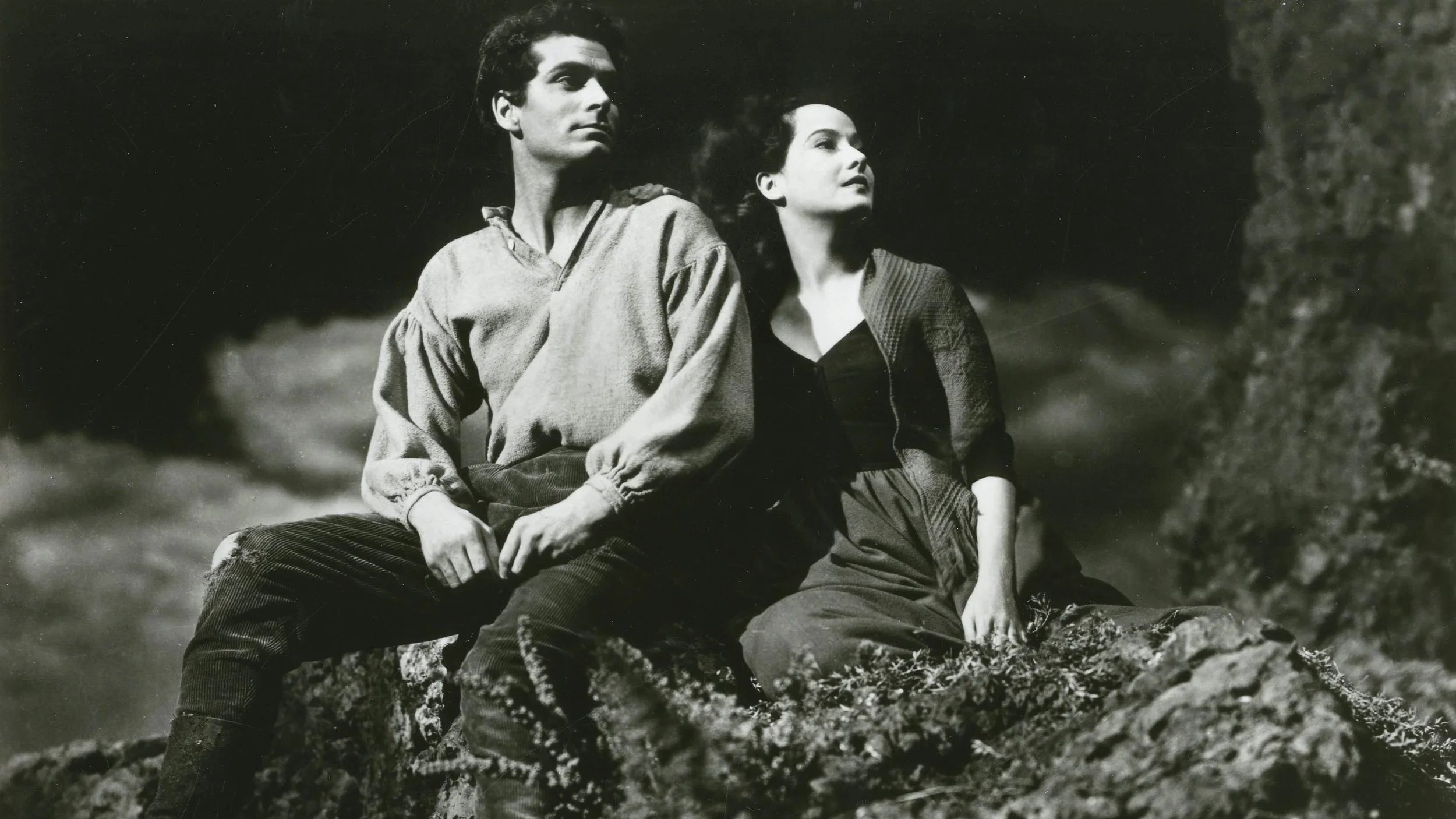
Some of the compositions are wonderful, such as the famous image of Cathy and Heathcliff on the moors: a medium wide shot, with the camera slightly tilted up at them so we can see the sky and dynamic clouds behind them, the crag’s rocks framing them, and the heather before them, blowing in the wind. They also do a good job of combining sets and scenery shot in California. It’s quite convincing.
And speaking of the movie’s feel, do you have any thoughts about Alfred Newman’s score? He is one of the great film composers, and “Cathy’s Theme” from this film is somewhat well-known. There’s a real nostalgic sadness lingering in that theme, and I love the eerie, anticipatory tune that plays when Nelly first begins to relate her story.
Aren: I confess that I don’t remember a lot of the score. It seemed appropriate at the time and classical, but it didn’t loom over my experience of the film to the extent that I can dig into it several days later.
Laurence Olivier, Merle Oberon, and the Supporting Cast
Anton: I do think Laurence Olivier is one of the better Heathcliffs we have ever gotten. I can’t say “best” because I haven’t seen enough adaptations to judge.
Aren: Olivier is very good. He captures the dismissiveness of Heathcliff, his casual cruelty. He does little to try to impress the viewer, which does a lot to make him more appealing as a romantic lead—as Marge Simpson taught us, not caring whether you’re cool is essential to being cool.
Anton: Olivier has such a distinct voice and way of delivering lines, and it really works for the contemptuous, cruel comments that Heathcliff is wont to make. But he’s also good at showing his consuming affection for Cathy when they are younger. He can also convey the savagery of the character, even though he never is made to look like some hairy dude, like Jacob Elordi is.
Aren: I don’t love Merle Oberon as Cathy. Apart from the choices in adaptation, she’s the other weakest part of the film. She plays Cathy as simultaneously too histrionic and too ordinary. I like that in the book we get the suggestion that Cathy is very clever—that she’s often outsmarting people, likely is very booksmart, and could probably be a very successful aristocrat, but that she’s too impulsive. I don’t get that with Oberon. She strikes me as a bit childish in parts, often taking the easiest route to drama within a given scene. It’s likely a result of the melodramatic acting of the time, but she doesn’t thread that needle of being a wild girl and a proper lady that I believe is core to the character.
Anton: I agree that Oberon is a weakness, but I don’t think she’s fatal. But it seems even worse when we consider that Olivier wanted Vivian Leigh to play Cathy, whom he was romantically involved with at the time (and would later marry). I think she would have made a great Cathy.
Aren: I didn’t know that, but it now makes me wish that had happened. Leigh was such a dynamic star.
Anton: Any thoughts on the supporting cast? Flora Robson is okay as the old Nelly Dean, relating the story, but the part as written for the movie doesn’t allow for much of the complexity of the narrator-character in the novel. I do like that the film preserves the character of Cathy’s brother, Hindley, and I think that Hugh Williams does a good job as the drunken, despairing, terrible Hindley.
And of course, we have to mention that master of aristocratic charm, David Niven, as Linton. With Niven as Linton, he gets to be a character, and not just a plot tool used in opposition to Heathcliff.
Aren: Niven loomed largest for me, but that’s probably because I have such strong associations with David Niven as a classic Hollywood star. His Linton is very sympathetic, but weak, which matches the character of Brontë’s novel. Linton is not a bad man, but he lacks the sort of decisive confidence that Heathcliff has in spades. Hugh Williams is also good as Hindley, who is such a noxious drunk and a sad human being.
I think Nelly is a character that no adaptation I’ve seen has cracked. She’s the maternal figure of the story as much as the core narrator, but we don’t get that in Wyler’s film or in Fennell’s. I think figures of this type often do poorly in cinematic adaptations as without the narration itself, they’re robbed of most of their interest. Robson is fine, but Wyler and company have little-to-no interest in Nelly as a character.
Final Thoughts
Anton: We are almost a century from the 1939 version of Wuthering Heights, which premiered in Hollywood on March 24 of that year. We are almost two centuries from Brontë’s novel. We need an adaptation that recognizes the generational complexity of the novel. Maybe it has to be broken up into more than one movie? I’ve heard the TV adaptations are more faithful.
Aren: I can’t make a definite comment because I haven’t seen every single adaptation. Maybe I’ll work through them all over the years and see if one of them really nails the core of the novel.
Anton: Regardless of what adaptations we get in the future, and even though I don’t think Wyler’s version is the definitive adaptation I would love to see, I do think that 1939’s Wuthering Heights will remain in memory—for the images of Heathcliff and Cathy on the moors, for Newman’s score, and for the scowling face of a legendary actor.
Wuthering Heights (1939, USA)
Directed by William Wyler; screenplay by Charles MacArthur and Ben Hecht, based on the novel by Emily Brontë; starring Merle Oberon, Laurence Olivier, David Niven, Flora Robson, Donald Crisp, Geraldine Fitzgerald, Hugh Williams.
RELATED POSTS


The Great Escape is a hugely entertaining landmark in the prison camp and action team genres.