“It would degrade me”: How Emerald Fennell Warps Emily Brontë’s Wuthering Heights
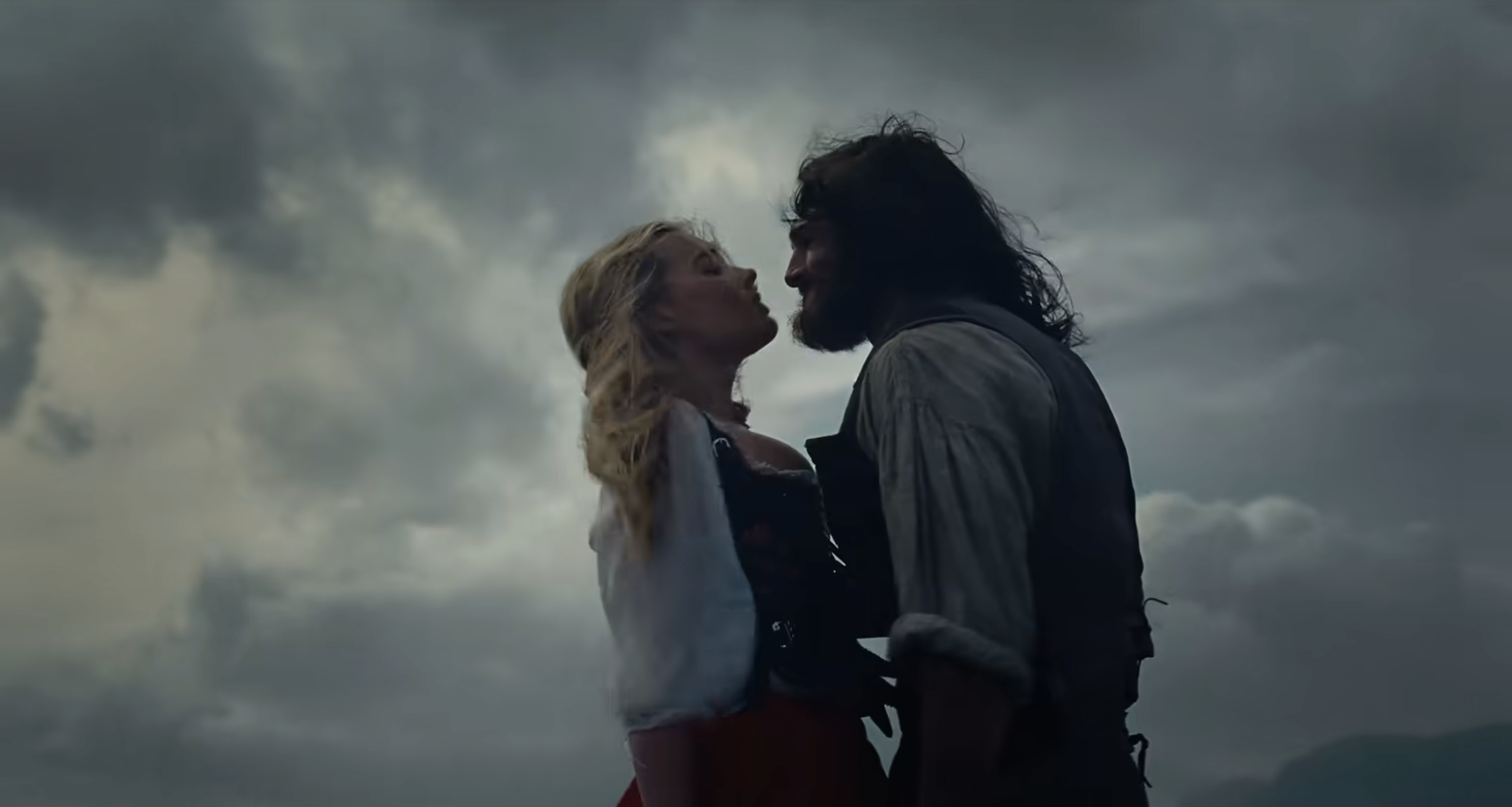

I suppose it was only a matter of time before our cultural moment would produce a miscreation like Emerald Fennell’s Wuthering Heights. Other filmmakers have taken a beloved literary classic, one with a history of adaptations, and tried to make it new by significantly changing aspects of the narrative. Greta Gerwig, for instance, tells Little Women (2019) as a non-linear narrative that ends differently than Louisa May Alcott’s 19th-century novel. Others have also overlaid their adaptations with modernizations and anachronisms. Baz Luhrmann, in Romeo + Juliet (1996), updates Shakespeare’s tragedy by making Verona a modern gangland beachside city. Fennell goes further, introducing changes that seem motivated primarily by provocation. She has seized Emily Brontë’s sole novel and transformed it into something drastically different: a stylized, BDSM-infused fantasia of destructive love produced for the TikTok generation.
I can even somewhat understand the apparent reasoning behind such an approach to Wuthering Heights, a novel tinged with Gothicism and Romanticism and set on the sparsely populated moors of Yorkshire. (The book was first published in 1847, but it’s set half a century earlier.) Brontë’s novel is full of damaged psychologies, dark insinuations, and incidents of abuse, cruelty, suffering, and revenge, in response to which critics have offered up a plethora of readings over the decades. Much of its artistic and emotional power owes to its strangeness, singularity, and ambiguity. It’s a text that begs to be explained and interpreted.
Like many Victorian novels, Wuthering Heights tells its story through nested layers of narration. Mr. Lockwood arrives at Wuthering Heights as the new tenant of the nearby manor, Thrushcross Grange, and encounters at the Heights the grim household of the old Heathcliff. Several chapters later, Nelly Dean relates to Lockwood the childhoods and past events of Catherine Earnshaw and Heathcliff, the telling of which takes up the bulk of the novel.
William Wyler’s 1939 American film adaptation (produced by Samuel Goldwyn, and scripted by Charles MacArthur and Ben Hecht) retained Brontë’s frame narrative, although it significantly pared back the novel, completely removing the storylines about Catherine’s and Heathcliff’s children. While I admire aspects of Wyler’s version—particularly Gregg Tolland’s cinematography and Laurence Olivier’s impenetrable scowl as Heathcliff—there’s a loss in the changes. Brontë’s novel is not just about Catherine and Heathcliff’s doomed love but also about generational conflict, revenge, and reconciliation, and you need the extended storyline to enact the great sweep of Brontë’s vision.
In her 2026 update, Fennell pares back Brontë’s narrative even further, removing the frame narrative involving Lockwood altogether, and turning Nelly Dean (Hong Chau) into a supporting, and more malicious, character, rather than the main narrator. On the whole, Fennell eschews the possibilities for complex narration and innovation that the original text presents a filmmaker. She chooses to refashion things as a fairly simple and straightforward story of two star-crossed lovers, Catherine and Heathcliff.
Early in the movie, Mr. Earnshaw (Martin Clunes)—whom Fennell makes a composite of the good-natured father and the drunken son, Hindley, of the novel—brings home a foundling from his trip to Liverpool. His young daughter, Catherine (Charlotte Mellington), takes an immediate liking to the boy (Owen Cooper, from Adolescence), calling him her pet. Catherine’s affection deepens after Heathcliff shields her from the drunken beatings of her father. When they grow up (now portrayed by Margot Robbie and Jacob Elordi) their sexual attractions for each other are awakened. But one day, Catherine stumbles into the more posh, pleasant world of Thrushcross Grange, the lavish neighbouring manor and the home of the wealthy Lintons. Catherine meets Edgar (Shazad Latif) and his ward, Isabella (Alison Oliver) (who is his sister in the novel). Catherine will be torn between, on the one hand, a desire to marry Edgar for his wealth and the comfort and position it will bring, or, on the other, surrendering to her wild passions for Heathcliff and a life of uncertainty yet freedom. Conflict, revenge, and tragedy ensue.
Fennel’s program, in terms of both content and style, is to make the subtleties and suggestions of Brontë’s text explicit, while reducing and simplifying them as well as adding in further exaggerations and luridness. She then sets this all against a mise-èn-scene that blends the historical, the modern, and the expressionistic. The sets and costumes recall a range of works, from the 1939 classic mentioned above, to the pastel satirizations of Tim Burton’s Edward Scissorhands (1990). No, I’m not joking. The movie at times seems like a parody of Tim Burton doing the Brontës, plus sexual fetishes. Probably a more fair assessment would be to say that the film plays like a fanfiction of Brontë’s novel. (I would also note, similarly, that much of fanfiction is preoccupied with exploring characters’ sexualities and sex lives, going beyond the conceptions of the original authors.) Fennell’s camera obsesses over wet textures, strange foods, and oozing substances, but nothing interests the film more than the obvious links between sex, violence, and death.
Sex and death are linked from the film’s opening, when we first hear male gaspings over a black screen, ambiguous noises which could be interpreted as strangulation or the prelude to orgasm. Soon we have our answer, but thematic connection seems intended, and this connection is extended throughout the film. The first image is a close up of a face suffocating behind a hood of coarse fabric, the dying breaths sucking in the fabric, creating strange shadows on the hooded head. This opening scene goes on to ludicrously insist that public hangings made people really horny, with people in the crowd getting it on in the corners. A girl, who we will learn is the young Catherine, is intensely delighted in witnessing the hangings.
Skip ahead a few years, and Fennell serves up a BDSM sex scene between servants in the stable using a horse’s bridle (refashioning the sanctimonious old servant, Joseph, of the book into a perverted farmhand). The young adult Catherine secretly watches from the loft above, but as the servants get it on, Heathcliff creeps up behind her and shields her eyes and mouth from the scene. Nevertheless, Fennell wants us to know that the scene imprints on Catherine’s budding sexuality, when later she has her husband, Edgar, repeat the position during sex, with him from behind, covering her face with his hands. In another scene, Catherine insists that her corset be pulled tighter and tighter still, in a moment of masochistic self-punishment.
Isabella is horribly abused by Heathcliff in the novel, but in the film Fennell instead makes her Heathcliff’s “sub.” We get a strange (and very modern) consent scene, where Heathcliff roughly but carefully explains to Isabella that he will misuse her (sexually and otherwise) and extracts confirmation of her consent after each elaboration, asking if she wishes to proceed. This will eventually lead to the appearance of the poor character bound on a chain, barking like a dog. How daring! Is this supposed to be funny? It’s certainly not deep. Fennell has taken a character who is sympathetic for the unjust abuse she suffers in the novel and makes her both complicit in her abuse as well as an object of ridicule. It’s as if the adaptation is participating in Heathcliff’s abuse of Isabella.
But, Anton, aren’t you just being a prude? Isn’t Fennell just making an edgy, sexy, modern version of Wuthering Heights? I’ve written on other occasions with praise for darker, and more graphic, films that explore the linkages between sex and death, such as Park Chan-wook’s Stoker (2013) or Robert Egger’s Nosferatu (2024). In the case of Wuthering Heights, I’ve taken the time to list these specific examples in order to suggest a warped method to Fennell’s alterations, rather than just offer my reactions to the film.
In truth, I got over my surprise once the film’s approach became apparent (but I can’t speak for the poor grandmothers in the audience with me). In fact, as the film nears its end, it becomes tediously provocative. When Catherine dies because she has held inside her womb a dead child and has contracted blood poisoning, Fennell provides a lavish overhead shot of all the blood oozing out from between her legs and down the sheets onto the floor. I thought to myself, “Fennel is willing to go anywhere.” (A quick reminder that in the novel, Catherine and Heathcliff each, and with separate spouses, produce a new generation.) I was somewhat surprised, however, that Fennell doesn’t have Heathcliff commit necrophilia when he mounts the bed beside Catherine’s dead corpse. It is, after all, that kind of movie.
Yes, there is a long history of provocative art and sometimes it’s effective and justified. If Fennell gets audiences to return to Brontë’s text and to think hard about its meaning, there might be some benefit. I think the shock of defamiliarization would have been more effective if done more carefully and sparingly. But, in the end, I don’t think this should be considered a serious work of shock art.
We all expected this to be a sexed-up, somewhat anachronistic version, but the film’s real raison d’être is clarified at a point later in the film. When Catherine and Heathcliff get back together once again, after insisting they shouldn’t, for the umpteenth time, and they are engaging in foreplay banter, in which Catherine playfully taunts Heathcliff about all the sexual things she does with her husband Edgar, we begin to see that the film’s true arena is less that of college English Lit. than Bridgerton or Fifty Shades of Grey. I guess there’s a market for this sort of thing, but clearly I’m not the audience for it.
We’ve all encountered at a party that particular kind of bore who doesn’t get that shock can only be used sparingly. This is just one way that the film fails in balancing its tone. Should we swoon to the swelling music and images of galloping across the devastatingly beautiful moors only to be distanced by strange tableau’s, some inadvertently hilarious and others repulsive? For instance, when Catherine’s father dies, the reverse shot reveals two farcically large piles of bottles in the corners of the room. Is that a gag about his alcoholism or just bad set decoration? At Thrushcross Grange, the walls of Catherine’s room are painted the colour of her skin—Edgar makes a big deal about it—and in a few scenes the walls appear soft and yielding like flesh. Later in the film, this results in the bizarre image of leeches placed on the skin-toned wall as well as on Catherine (the leeches are treating her blood poisoning, which was a real medical treatment in the past), at which point she is revealed to be dead. Fennell also has a tendency to intrude into scenes with off-kilter humour, much of which fell flat for my audience. Most shamelessly, Alison Oliver’s Isabella is reduced to an object of mockery and scorn and a series of nasty punchlines. She never gets to be a real person.
Admittedly, Fennell crafts some stunning shots, clever uses of editing, and some interesting contemporary references. For instance, when Heathcliff rides away, he exits through the courtyard entrance to the Heights and the blazing red sunset behind him casts his figure into a stark silhouette, recalling compositions from the film that would win for Best Picture against the nominated 1939 version of Wuthering Heights—Gone with the Wind. One of the more artistic uses of editing in the film features Fennell’s attraction to bare backs, particularly Heathcliff’s, which bears the scars he earned for Catherine. In a great transition that leaps across time, the boy’s back beneath a bloodstained shirt cuts to the muscular adult back bearing the scars, while the music thrums. Other times, the blending of Yorkshire’s wild beauty with the modern pop of Charli XCX works. But such instances cannot reconcile the overall fragmented tone and mismatched aesthetics, or redeem the dominant artistic aims of this adaptation.
Another minor issue with Fennell’s adaptation is how the casting detracts from the novel’s themes. Similar to shows like Bridgerton and other recent period pieces, Fennell casts racial minorities in historically white European roles: Linton is played by a South Asian man (Latif), and Nelly by an East Asian woman (Chau). In the world of the movie, no one remarks on what would have been out of place racially in that time and place. Sometimes, this race-blind approach to casting works: I’ve long thought that Kenneth Branagh did so excellently in his 1990s Shakespeare adaptations, such as Much Ado About Nothing (1993). As Fennell’s film is clearly not a realistic depiction of 19th-century Yorkshire, the casting choices fit the aesthetic, but an important racial dynamic in the text related to Heathcliff is thus removed. If race needs no comment in the film, then this applies to Heathcliff as well. However, in the novel, Heathcliff is described as a “dark-skinned gipsy” and a “little Lascar” (a sailor from India). It is clear he is racialized, or at least visibly foreign, to other characters. No one knows his true origins, and Nelly whimsically says to him, “your father was Emperor of China, and your mother an Indian queen.” Andrea Arnold’s 2011 adaptation actually leaned into this aspect of Heathcliff, casting a multiracial actor, James Howson. The 2026 film’s casting removes the racial, and most of the physical, otherness of Heathcliff from the picture. Jacob Elordi is just a tall handsome man, who appears rough because he has too much hair. In one of those strange paradoxes of our age, modern DEI impulses in casting have helped erase the racial complexity of Brontë’s novel, showing once again how Fennell’s adaptation flattens the story as it alters and modernizes.
Whether Fennell understands Brontë’s novel is not something I will surmise. I can only say that the aesthetics and ethics of her film involve a significant distortion of Brontë’s narrative and themes. There’s a reason that Fennell’s reimagined “Wuthering Heights” distances itself from the original through the use of scare quotes for its opening title. I found the result frustrating as an adaptation and often tedious and repellent as a film. To borrow the words of the novel’s first narrator, Mr. Lockwood (who is completely excised from this film), Fennel’s adaptation is “A perfect misanthropist’s Heaven.” The problem is that Brontë’s novel, in part, teaches Lockwood that he was wrong to initially identify with Heathcliff’s distaste for humanity. Brontë explored themes that challenged her original readers, she probed the dark regions of the soul, but she never delighted in the degraded corners of human personality. In contrast, this film’s eye seems fixated on everything vile and violent in the world it depicts, while trying to encourage us to be excited by Catherine and Heathcliff’s destructive love.
Wuthering Heights (2026, UK/USA)
Directed by Emerald Fennell; screenplay by Emerald Fennell, based on the novel by Emily Brontë; starring Margot Robbie, Jacob Elordi, Hong Chau, Shazad Latif, Alison Oliver, Ewan Mitchell, Charlotte Mellington, Owen Cooper, and Martin Clunes.
RELATED POSTS
Why Sam Raimi’s Spider-Man 2 remains one of the best superhero movies of all time.