Review: 28 Years Later: The Bone Temple (2026)
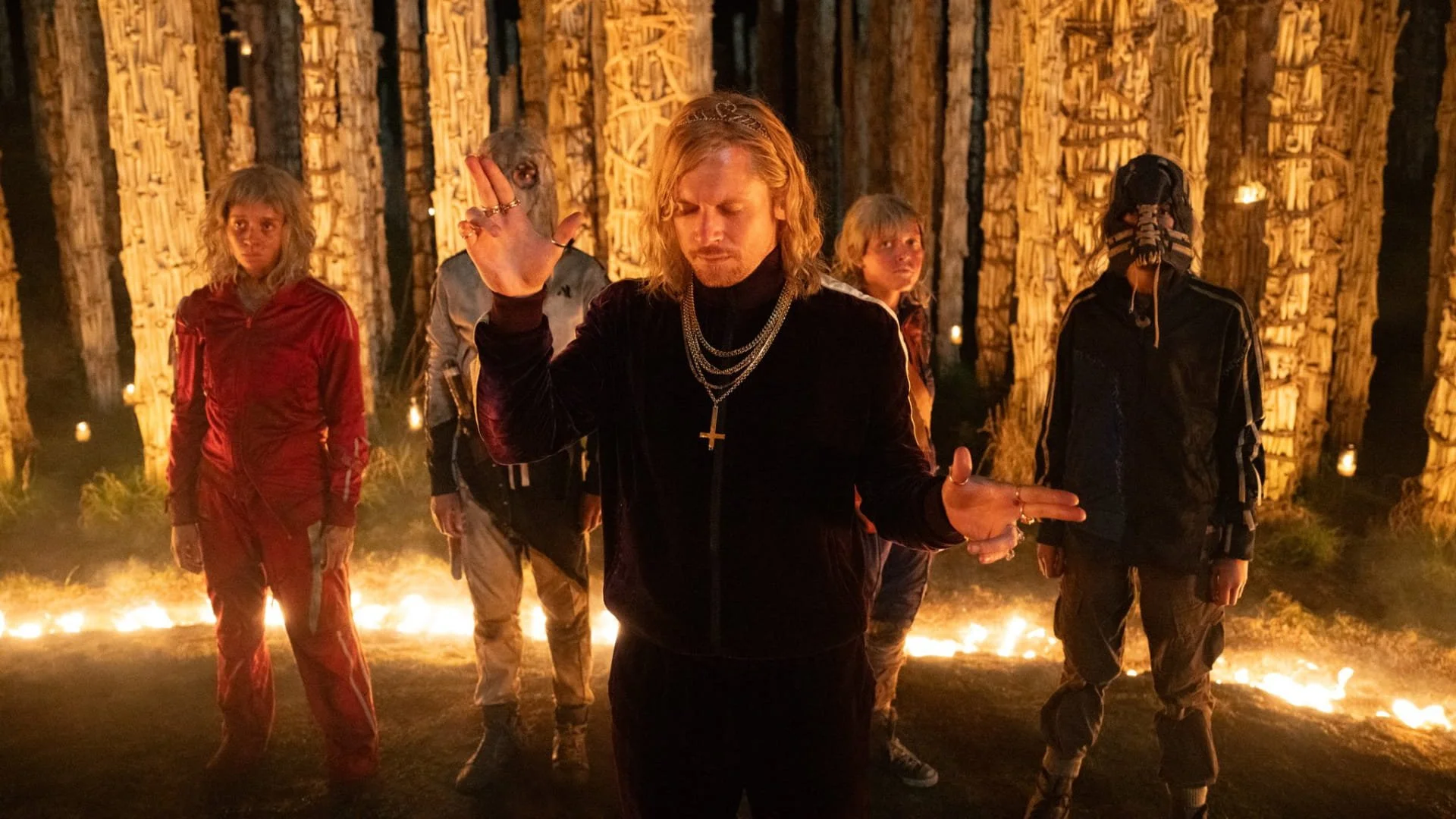

A mere 28 weeks after the previous film in this surprising new trilogy, we get 28 Years Later: The Bone Temple, a violent horror chiller that’s also an examination of Satanism as a theology of death. Where 28 Years Later is sprawling and frenetic, The Bone Temple is focused and hushed. It’s the quiet, character-focused middle chapter in this sequel trilogy, all written by Alex Garland and set in the post-apocalyptic world that Garland and Danny Boyle introduced in 2002’s 28 Days Later. Directed by Nia DaCosta, known for 2021’s Candyman legacy sequel as well as The Marvels and last year’s Hedda, the film lacks the visual grandeur and controlled editorial frenzy of Boyle’s previous entry. But what it lacks in gusto, it makes up for with an introspective approach and terrific performances that provide a chilling and provocative vision of life after the end of civilization.
Speaking of provocative, the film picks up immediately where 28 Years Later ended, with young Spike (Alfie Williams) stuck with a gang of killers all dressed like pedophile rapist Jimmy Saville. The gang’s leader, Sir Lord Jimmy Crystal (Jack O’Connell), offers Spike the chance to become one of his “Fingers,” seven followers (all called Jimmy) that he lets live for the price of doing whatever he wants at any moment. Of course, if Spike wants to become a Finger, he has to kill an existing one, so in an abandoned water park, Spike faces down a much larger, older young man with a small knife. Out of pure luck, Spike strikes an artery in his opponent, killing him, and gains entry into Sir Lord Jimmy Crystal’s gang. But his survival is hardly mercy.
Soon enough, the Fingers descend on a farmhouse and provide “charity” to the inhabitants—a sadistic euphemism for torture. During this harrowing sequence, we’re introduced to Sir Lord Jimmy Crystal’s theology of Satanism and death. Jimmy believes that the world of the Rage virus is Satan releasing his demons upon the earth, and that his calling is to follow his dark father’s will by torturing and killing anyone he finds in sacrifice to ol’ “Saint Nick,” Jimmy’s nickname for Satan.
This farmhouse sequence is disgusting, chilling, but also fascinating, showing how cults of fanaticism and sadism can find their hold in desperate circumstances. Sir Lord Jimmy Crystal is a psychopath and O’Connell’s performance relishes the psychological hold he has over his Fingers, in a manner similar to his vampire in last year’s Sinners. Much like Satan, who in the Bible as well as folklore is constantly testing people, from Job to Jesus, Jimmy relishes testing his Fingers, delighting in their servitude and observing how they react to increasingly awful commands in impossible situations. Whether he’s forcing a Finger to fight a newcomer for their own survival or commanding one to flay a human in sacrifice to Satan, we see him paying careful attention to each Finger’s face; he’s looking for vulnerability that he can exploit, or religious fervor that he can fan the flames of. Garland also adds an interesting wrinkle to Sir Lord Jimmy Crystal in how he’s not just using religion as a tool to gain power, but is a true believer. “My father speaks to me constantly,” he tells a character, tapping his head. Sure, he could be schizophrenic, or maybe he’s truly possessed; does it make a difference when his actions are so monstrous?
Like O’Connell’s Jimmy, we also observe the Fingers in this sequence in the barn. We pay careful attention to how they internalize his worldview, coming to believe that the world truly is Satan’s domain, even if they question Sir Lord Jimmy Crystal’s own part to play in Satan’s grand plan. This is most evident in the character of Jimmy Ink (Erin Kellyman), who becomes a protector for Spike even as she is one of the most ardent Satanists of the Fingers. Narratively sidelined, Spike becomes the eyes of the audience and a witness to the cruelty of this world, as he remains stuck between Jimmy and Ralph Fiennes’ Dr. Ian Kelson, who he met at the end of 28 Years Later and who plays a central role here.
The film splits its focus almost equally between the Fingers and Kelson. While the Fingers are in thrall to a Satanic understanding of the Rage virus, working to dominate this vicious world and not undo its darkness, Kelson continues to build his ossuary, the eponymous bone temple, and perhaps even ponder a way to redeem the infected.
The most introspective and curiously moving sequences of The Bone Temple follow Kelson testing Samson (Chi Lewis-Parry), the towering, naked Alpha zombie introduced in the previous film. Observing that Samson continues to return to Kelson’s ossuary only to be drugged with morphine, Kelson comes to recognize intent in Samson’s action. And if there’s intent, there’s perhaps a person hidden beneath the violent insanity of the virus that has corrupted him. Fiennes is marvellous in these scenes, expanding his gentle supporting presence in the previous film into a mysterious protagonist driven by an almost religious dedication to the Hippocratic oath. Fiennes is a mannered, reserved actor who is equally at home playing monstrous villains (Voldemort) as charming heroes (M. Gustav). Here, he gets to syncretize the two, not to say that Kelson is villainous, but that his enigmatic devotion to his macabre task gives him a terrifying pallour. The film’s climactic moments truly lean into this, conjuring what has to be one of the cinema’s great lip sync moments (more on that in a bit).
As an inversion of Sir Lord Jimmy Crystal, Kelson seeks to heal this damaged world, not brutalize it further. Of course, when you have two characters who are inversions of each other, you must have them meet, and so the final third of the film is largely focused on the collision course for these two, set at the Bone Temple itself.
The Bone Temple is ultimately an examination of these two roads through the wasteland, these two responses to the cruelty of the world. There’s Sir Lord Jimmy Crystal, channeling the evil he witnesses around him into a religion, devoting himself to the bloodshed and the cruelty. Jimmy’s worldview is informed by his past. He was the son of a parson and when the apocalypse hit, he morphed his understanding of religion to account for the monstrous things he experienced (as seen in the opening minutes of 28 Years Later). And then there’s Dr. Ian Kelson, building a monument to the loss he observes, a massive, haunting memento mori, even as he has mostly abandoned human connection. Will there be a third way? The thrilling closing moments of 28 Years Later: The Bone Temple tease the possibility, both narratively and thematically, with the final words being a question, “Should we help them?” followed by an answer, “Of course.”
The Bone Temple benefits from the rigorous focus of its themes, narrative, and performances. DaCosta is no Danny Boyle in terms of visual wit and energy, so I miss the insane intercuts and wild camera set-ups of the previous film. The film also lacks a set piece quite as thrilling and terrifying as the causeway chase in 28 Years Later. But the climactic sequence is marvellous in its own right, blending performance and music and close-ups (this movie really loves close-ups) in a thrilling manner that also plays so well into the notion of pageantry and devotion that define both Jimmy and Kelson.
Like its predecessor, The Bone Temple does not end the story, rather setting up another chapter that’ll continue this surprisingly potent examination of the world after the end. The Bone Temple is 28 Years Later in a minor key, but it’s composed with rigorous artistry and carried by thoughtful characterizations that match its larger scale predecessor. It’s a minor triumph: smart, gripping, and more thoughtful than most major Hollywood films.
8 out of 10
28 Days Later: The Bone Temple (2026, UK/USA)
Directed by Nia Dacosta; written by Alex Garland; starring Ralph Fiennes, Jack O’Connell, Alfie Williams, Erin Kellyman, Chi Lewis-Parry.
Read More Reviews

Matt Bettinelli-Olpin and Tyler Gillett’s action horror sequel is a mere reheat.