Roundtable: Avatar: Fire and Ash (2025)
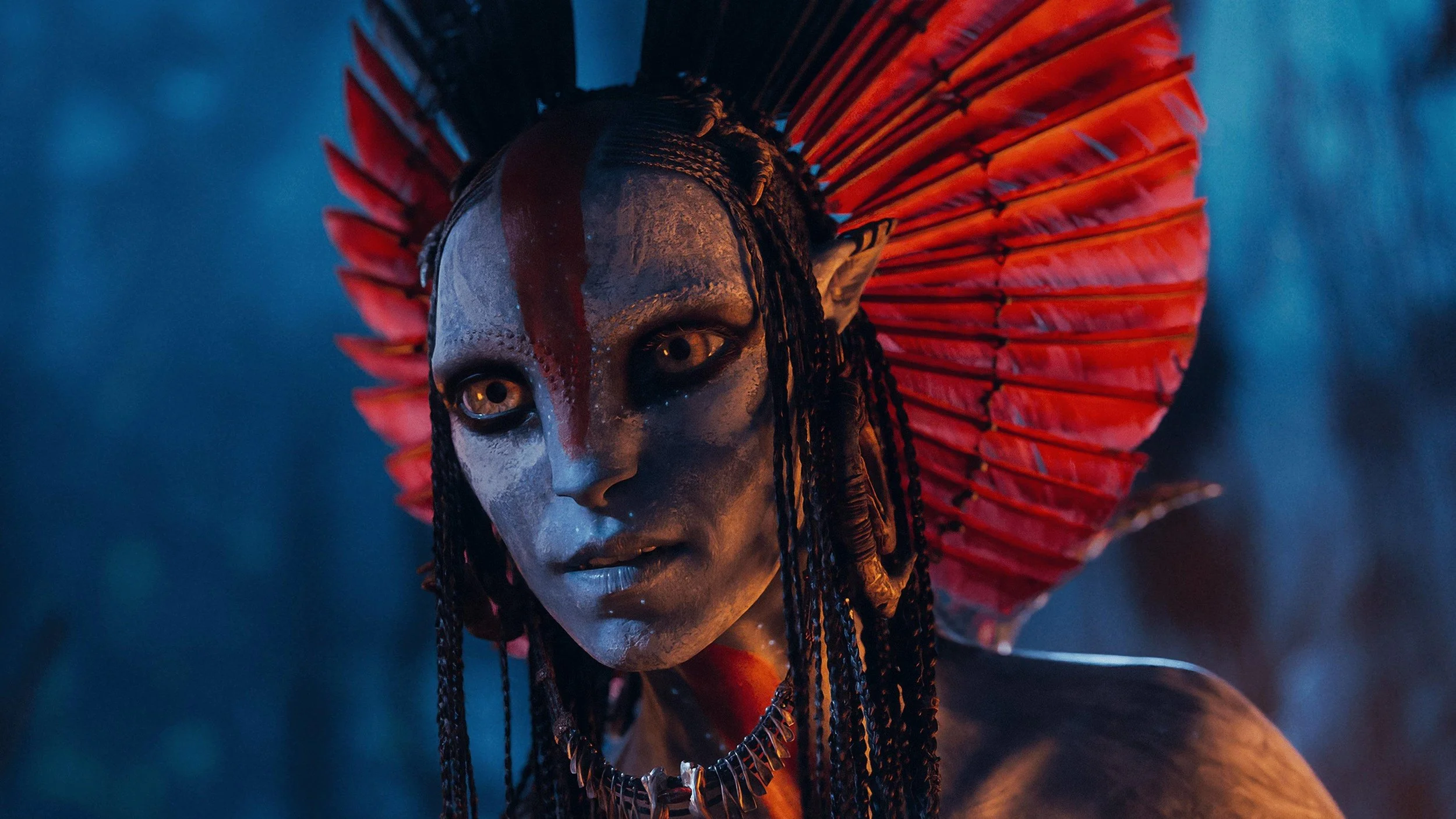

First Reactions to Avatar: Fire and Ash
Anton: Avatar: Fire and Ash, the third installment in James Cameron’s Avatar series, is a good adventure movie but not a great film in my books. But even though Fire and Ash is a step down from the previous two films, I think it’s a clarifying movie. It reveals what the series is primarily about and it establishes Avatar as the most successful and significant planetary romance in 21st-century cinema.
For those who don’t know, planetary romance is a subgenre of science fiction that focuses less on the travel to the strange planet than on the adventures there. (The “romance” in “planetary romance” means adventure plus the love stories we identify with romance today, like how a chivalric romance is an adventure about knights and their ladies and going on quests, etc.)
I know there are a lot of complaints out there that Fire and Ash doesn’t add anything new to the series. Aren, you used those observations as a launchpad in your video arguing that Fire and Ash is James Cameron’s Return of the Jedi, a work that remixes and reconciles the previous two films’ themes and conflicts, rather than going off in a new direction.
As Avatar has evolved into a sprawling serial narrative with its third installment, I’ve come to see the Avatar series as today’s version of an immensely popular planetary romance series from a century ago, Edgar Rice Burroughs’ Barsoom series, which transported its hero, John Carter, to Mars (called Barsoom) via the means of astral projection rather than a spaceship. (Aren noted Cameron’s own acknowledgement of the connection in his 2022 retrospective review of Avatar.) On the planet, John Carter becomes a super-powered warrior and we learn about the many cultures and creatures of Barsoom. I think Burroughs wrote eleven books in the Barsoom series, with the first, A Princess of Mars, appearing in magazines in 1912. Like John Carter, Jake Sully becomes a champion of the peoples he finds on the strange planet. Both creators, Burroughs and Cameron, bring many of their age’s prevalent social concerns into the works’ themes: Burroughs explored civilizational devolution and racialism, among other things, while Cameron explores colonialism and environmentalism. Avatar is essentially concerned with the human relationship with the natural world and how we exploit new terrains and their inhabitants; the strange new setting of Pandora brings our relations with nature and new peoples into a different light.
Now, before we discuss the movie’s themes and their implications further, I should shut up and check in with you brothers. Anders and Aren, I know you both liked the movie, but how much did you like it? How does it compare to the previous films in your view? And do you think the John Carter series is a useful antecedent for understanding Cameron’s series?
Anders: My completely honest reaction is that I had a giant grin on my face from start to finish while watching this movie. I loved it. This is blockbuster fantasy filmmaking on a level I don’t think anyone else really does these days. For starters, I can’t think of another film that has VFX on this level, except The Way of Water three years ago! I think that if you claim to genuinely like movies and the craft of filmmaking, you should be able to admit that Cameron’s filmmaking is itself remarkable, even if you don’t find the story as compelling as I do. I’m baffled by people who can dismiss the whole thing straight out.
I also appreciated that Fire and Ash is a film made to be watched in a movie theatre. I saw it in IMAX format with the High Frame Rate (HFR) and it looks amazing. It’s a rare filmgoing experience these days where the crowd is totally into it and even cheered at the end (and also after the trailer for Christopher Nolan’s The Odyssey, so that’s something!)
Anton: Do you think that’s just because you saw the movie on opening night, Anders?
Anders: Definitely that’s part of it. The opening night audience are a self-selected group of people who were excited about the movie coming out, but at the same time the film is clearly successful beyond that judging from the box office. Though, I think there is always a danger in the fact that this one has come out sooner after the last one (only three years versus 13 years) and people may be a bit burned out if they’re not already sold on the series. Even Return of the Jedi grossed less than Star Wars.
As for the John Carter comparison, I think it’s definitely there. I can see it. I still think that the fact that the original Avatar, not to mention Star Wars and other films influenced by Burrough’s books, came out before Andrew Stanton’s adaptation of John Carter from 2012, really hurt that movie’s reception. It felt like a lot of that stuff had been in the popular consciousness in the previous decade.
Anton: I will go to my grave defending 2012’s John Carter (as we did in a Thursday Rethink piece on the film). It’s a solid movie. I wish it had been a hit and we could have had a series.
Anders: It’s very solid. I like it a lot. But to return to Avatar, I think that the expansion of the world in these last two films makes the “planetary romance” an apt generic description.
Anton: Okay, Aren, your turn.
Aren: I also loved it. I have come to trust James Cameron absolutely and seeing the new Avatar movie is now how I felt about seeing the new Star Wars movie back in the day. There are directors I like more, such as Christopher Nolan or David Cronenberg, and there are films I liked more than Avatar: Fire and Ash in 2025, but no other movie this year made me feel like a kid the way Fire and Ash did. I don’t mean this as a backhanded compliment where I am implying that I turned off my brain and enjoyed Fire and Ash as nothing but big screen spectacle. However, Fire and Ash is the only movie in 2025 that made me marvel at just how cool movies are, and how thrilling it is to be able to spend three hours marveling at the magic of movies and be caught up in the adventure of another world. It’s something that I used to get all the time at the theatre, with The Lord of the Rings or Star Wars. I enjoyed a transporting experience with Dune, but the tone in that series is so dark and the thematic implications so haunting that it doesn’t work as escapism. So Avatar is the one series today where I truly feel like a kid watching it since I’m just so swept up in the science fiction romance of it all. I don’t think there is a better adventure spectacle out there. John Carter is an obvious influence and the connection in terms of planetary romance makes a lot of sense.
Also, something I didn’t get into in my short video reaction to Fire and Ash is that it also feels like the second part of The Way of Water, much as Return of the Jedi feels like the second part of The Empire Strikes Back. This makes a lot of sense when you realize that The Way of Water and Fire and Ash were initially meant to be one movie.
Is Fire and Ash Merely a Rehash?

Anton: So you both loved the movie, but do you think the movie is repetitive? This is the most frequent criticism levied at Fire and Ash, and I have to admit that I felt that way to some extent while watching the movie. For example, did we need another movie about Quaritch hunting down the Sullys?
Aren: I didn’t think it was too repetitive, although I acknowledge the way the narrative folds back on itself. We do get several Jake and Quaritch team ups in Fire and Ash alone, which the movie even acknowledges directly, with Quaritch’s joke about holding hands and singing together. But I actually think it’s more a clarification of what the series is about, as you implied off the top, than simple repetition. Jake and Quaritch are the two fathers to Spider—one adopted (Jake), and the other the clone of his real father (Quaritch)—and Spider, as we’ll dig into, becomes the core figure of the series in this film. He is the bridge between the worlds of Earth and Pandora, but he’s largely defined by his relationships to his two fathers. So he’s torn between allegiances. Cameron needs to get Jake and Quaritch on-screen together with Spider to really hit home all these themes.
The one part that is a tad repetitive is the action climax, where Cameron essentially combines the aerial combat of the first film with the whaling climax of the second.
Anton: Yes, this was one reason that I found the movie not as exciting as the previous two. The big action sequence doesn’t really push things into new terrain.
Aren: But even here, few directors are as good at action climaxes as Cameron. All the threads of his action scenes are clear. There are clear objectives for both heroes and villains. The visual action on screen is legible and exciting and utterly credible. He also loves to give every character a little heroic beat or breakthrough. This is one of his greatest skills as a writer: he knows how to pay off the little character threads that he introduces throughout.
Anders: I guess some people may find the structure a bit repetitive, but to me it was more in the sense that Aren noted: this is the series’ Return of the Jedi. We go back to familiar narrative beats and settings, but we also introduce bigger and more complex versions of those elements. It certainly offered new takes on things, especially the introduction of Varang (Oona Chaplin) and the Ash people. I don’t think the film’s repetition hurts my enjoyment at all.
I have to say, though, Fire and Ash is a lot of movie, in terms of runtime, imagery, plot, etc, and I think this leads people to overstate the repetition. The film throws a lot of ideas and plot points at the audience, while always being clear to follow. As far as the action sequences go, even my wife, who isn’t nearly as fond of these films as we are, noted after the screening how clear and easy to follow the action scenes are and how much more enjoyable and exciting the finale was than any Marvel film or other recent blockbuster.
Anton: I think adventures are often prone to rambling storytelling and repetitiveness, with their emphasis on action, and chases, and obtaining items, and going back to places. Think of any of the Pirates of the Caribbean movies, when sometimes you don’t know who is chasing who or what the actual goal is. But as Aren says, even if Cameron is repetitive at times, he is still clear.
Anders: I’d say Fire and Ash lacks the more relaxed, exploratory sequences that I really liked in the middle of The Way of Water (which is perhaps why that’s still my favourite film in the series). But at the same time, there’s something also to be said for not just piling more and more on for the sake of novelty and actually allowing us to get to know these characters a bit more.
For instance, the character of Jake Sully is made more complex and complicated than he was in the first film or even the second. As we can unpack, this film addresses many people’s criticisms of the character from the first film, that he’s a “white saviour” etc., criticisms which actually ring pretty hollow at this point. He’s no saviour, even if he brings a particular viewpoint to the Na’vi with his human origins and knowledge of human society and technology. In fact, at times in this film he’s a bit of a doofus who suffers from emotional damage due to the loss of his son. Even better, this film develops Quaritch beyond being just this simplistic badass villain, something that was teased near the end of The Way of Water. Quaritch has his own viewpoint and motivations that make him more than just a lackey of the Resource Development Administration (RDA), and that makes him more of a mirror of Jake. There’s also more than a hint of Darth Vader in Quaritch, especially in his pursuit of his son Spider. Can he be redeemed? What choices will he make in the end?
What Does Fire and Ash Have to Say?
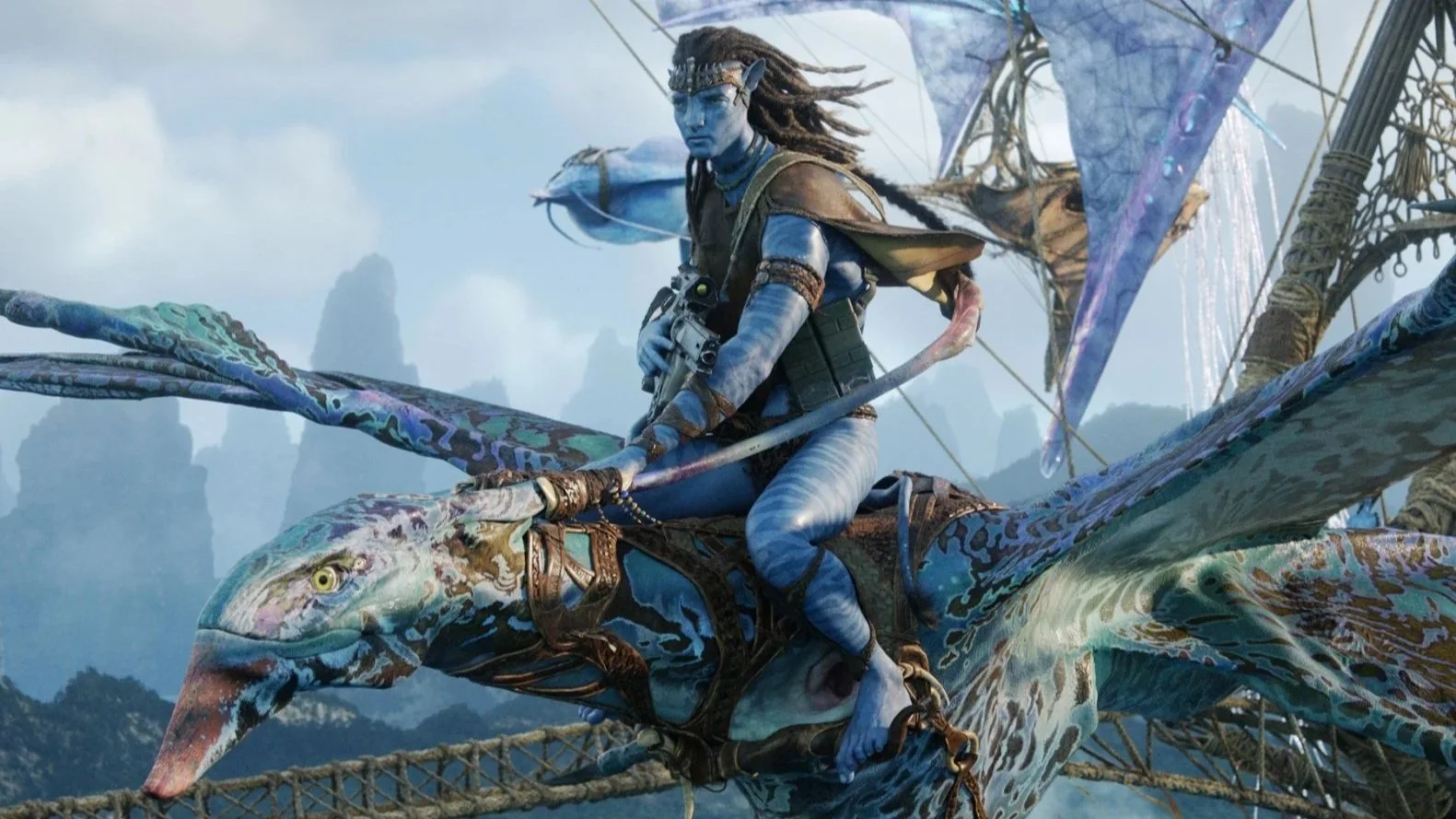
Anton: Cameron’s romanticism of the indigenous population on Pandora (the Na’vi) and his having the outsider hero become a saviour figure have led many to connect the Avatar series to other texts exploring settler colonialism, from the movie Dances with Wolves (1990) to earlier literary precursors, such as James Fenimore Cooper’s series of five novels, The Leatherstocking Tales (1823–41), about the Anglo-American pioneer Natty Bumppo, a.k.a. Hawkeye, who was raised in part by Native Americans. (Cooper’s second book in the series, The Last of the Mohicans, was put on film first in 1936 and, more recently, in Michael’s Mann version from 1992). While I think the connections are there, saying Avatar is just Dances with Wolves with blue people in space ignores how Cameron remixes and reorients some of the same concerns.
Cameron’s particular blend of themes and genres—colonialism and environmentalism with planetary romance—is what makes the series work, in my view. Cameron’s moralizing about the environment becomes not just palatable but genuinely intriguing when he is most concerned with the specifics of this strange world of Pandora.
For example, the Avatar films set up a Gaia theory about Pandora, suggesting that the planet itself might be viewed as a whole organism, with each species of creature or plant being simply the organs and members of that whole. Accordingly, the totalized consciousness of this planetary organism might be considered a god, the Eywa the Na’vi speak of and commune with. The nature of Eywa and the deity’s material basis are a root concern of the series that continues to be developed, and becomes more coherent, in Fire and Ash.
Aren: I grow ever more tired of people’s accusations about colonialism in the Avatar movies. “James Cameron needs to decolonize his writing,” etc. are the groanworthy takes. I get that some people are weirded out by the romanticism of the film’s world, how it literalizes the notion of “going native,” and has this alien species that embodies many aspects of Indigenous peoples across the Earth. But I think most people’s sticking points are not on specifics, but just on the notion of a movie engaging with any of this stuff at all. I think a portion of viewers would never accept any movie with a “going native” plotline, no matter how truly audacious elements of this narrative can be in a work like Avatar.
Like, the whole thing is that Jake literally, physically becomes a native. How can people not understand this? Cameron invents a world where spiritual transformation can be externalized through technological possibility. It’s a material understanding of spirituality and identity. It’s not just about becoming culturally different. At the same time, the Na’vi are not one-for-one stand-ins to a specific Indigenous people on Earth. They stand in for the concept of indigeneity itself, which is essential to the films’ examination of colonialism. So, I truly don’t think some people can get over a simplistic reading of a movie series that is probably more earnest and complex about these concepts than most Hollywood movies. But I digress, since I shouldn’t just rant about misguided takes online.
Anton: I remember my online war of words with people back in 2009 and early 2010 about the first Avatar. There are certain critical minds that have a tendency to allegorize their readings of social commentary in works (“This stands for That”), and, at the same time, narrow their understanding of allegory into, as you said, one-for-one stand-ins, which very few allegories involve. I think it’s really unfruitful and misguided to try to strictly identify the Na’vi with, say, Black Africans, or the First Nations in Canada. In some ways, they represent aspects of Indigenous peoples on Earth, but also—and this is important—none solely or specifically. Because at times Cameron really probes the non-humaness of the Na’vi, raising the question of whether there is something wrong embedded in all Homo sapiens (perhaps a kind of materialistic original sin).
Anders: Yeah, I just think many people are made uncomfortable by elements of these films; it’s about them as much as the movie. They’re worried that there’s something inherently wrong in portraying the Na’vi as an indigenous population and using our own history and cultures from Earth as a template. But, I genuinely wonder what, if anything, would satisfy the criticism that Avatar needs to be “decolonized?” How does one tell a story about space-colonialism? How about a film that portrays some humans and their non-human indigenous allies who reject the racial dehumanization of the Na’vi and the relentless pursuit of natural resources at any cost and join in a multi-cultural, multi-species fight for planetary liberation?
Ultimately, for many folks, it seems they’d be happier if a film just focused on how bad humans have been in the past. Or they think that a blockbuster science fiction film isn’t the appropriate venue to work out some of these ideas, even if imperfectly. But I genuinely think that James Cameron has done more to get people thinking about the concepts of indigeneity and colonialism than almost anyone else in Hollywood. And he puts it into a context that almost anyone should be able to engage with, because it places two stories—a story about harmony with nature (however romanticised) and a story about domination and exploitation—side by side, and he says, how might this work out? And frankly, I think the success and embrace of these films outside of the Anglo-American world, and especially outside of so-called WEIRD (Western, Educated, Industrialized, Rich, Democratic) societies raises some questions about who is being offended by this.
Anton: Most importantly, I think the third film shows that some of the simplistic dichotomies established earlier in the series might have been done so that later stories can actually complicate them. Or rather, making Avatar into a series (and not a standalone film) allows the themes to become more complicated and dynamic and less a static dichotomy. For example, the Na’vi are less wholly good in this third film.
Aren: Yes, the incorporation of the Ash people, led by Oona Chaplin’s Varang, is one of the core new elements in Fire and Ash and one of the most successful. They complicate the simple binaries but also offer a different religious understanding of Pandora, where not everyone submits to Eywa, even if Varang exhibits a kind of Satanic rejection of the deity rather than a denial of Eywa’s existence.
This also leads to a complication of the human enemies, as we get this rift between Quaritch’s recombinants and General Ardmore’s (Edie Falco) Resource Development Administration (RDA), which hates how Quaritch makes deals with the natives in order to further the hunt for Jake.
Anders: I do agree that Varang is one of the most successful new elements, as much for Chaplin’s excellent performance as anything. She somehow manages to make Varang both alluring and terrifying at the same time, and a fitting partner for Quaritch, especially in the wake of his growing rift with the RDA. The dual seduction scene, where Varang and Quaritch engage in this back and forth, him offering the raw firepower of human technology and her drugging him and allowing him to see the world literally through an altered state to enter into her world, is one of the film’s most interesting.
I do also have this funny idea about Chaplin’s inclusion in the film, given her family history. Oona is the granddaughter of Charlie Chaplin and his last wife, Oona O’Neil (daughter of playwright Eugene O’Neil). If we can see Avatar as a kind of late-period film, a film from a time when cinema is undergoing drastic changes and its whole future is in question, Oona Chaplin’s casting strangely unites one of cinema’s founding giants, Charlie Chaplin, with its current champion, Box Office Jim. In this way, I do think that films like this tend to thematize themselves beyond the strictly narrative elements. The film’s creation, casting, and performances create a totalizing experience that can’t be boiled down to any one element.
The Characters of Fire and Ash
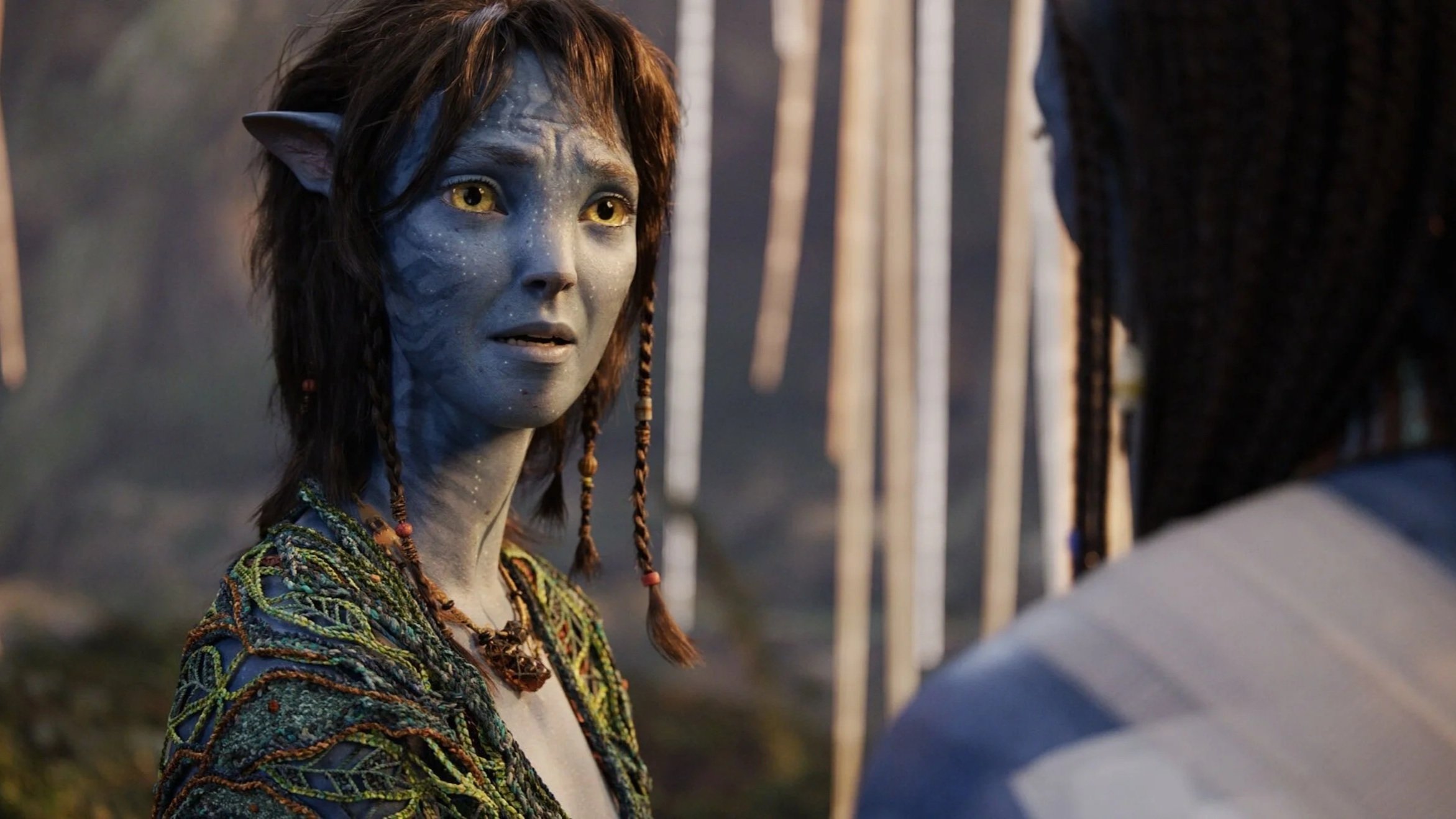
Anton: Ultimately, it is Kiri and Spider who become the audience’s avatars for exploring these themes and postulating a potential future for mankind. Their blending of human and Na’vi might be the path forward for both peoples.
Aren: Spider and Kiri are great. I think one of the big things that Fire and Ash has going for it are interesting characters. It might sound ludicrous to say this about an Avatar movie since people always complain about these movies having bland characters (not sure how Miles Quaritch is bland, but sure, complain all you want). I would counter that Spider and Kiri are weird characters with really tangible motivations and complexities. Both are isolated from their peoples by the circumstances of their birth. Spider is the human leftover from the retreating RDA, yearning to become a Na’vi but stuck being a human, a part of the Sully clan but not accepted as the same by Jake or especially Neytiri; Kiri is the Christ-like miraculous child who has no real parentage and so isn’t really linked to the other Na’vi, since she has no true family ties. She’s the other adopted child of the Sully clan, but she’s not one of them by blood. Spider is torn between his fathers and, as he develops the ability to breathe Pandora’s air due to Kiri’s intervention, he also becomes the crux for humans being able to properly colonize Pandora, so he knows that his mere existence is dangerous to the people he loves. Kiri is seeking a more profound relationship with Eywa and a more respected and stable place in the community. Both are searching for identities. Both have strange, wondrous powers. And they’re both incredibly earnest and resourceful. I kind of love them both.
Anders: I also love Spider and Kiri. I love how these characters are used to explore some of the deeper philosophical and religious questions that haunt the edges of these films. Kiri is obviously the Christ figure, but Spider is also the chosen son upon whom so much of the fate of this world hinges. One of the film’s most moving scenes is the Abraham sacrificing Isaac scene, when Jake, in the Abraham role, feels he must kill Spider (who takes the role of Isaac) and it is only at the last minute that his hand is stayed by divine intervention. Spider is spared by the voice of God in a sense (Eywa through Neytiri). It’s really moving, especially when Spider realizes what is going on and is willing to trust Jake implicitly, like Isaac going to his sacrifice. What will be provided as a substitutionary sacrifice?
Also, the film starts to complicate Cameron’s seemingly simple endorsement of revolutionary and defensive violence in the film’s final sequences, like the Tulkun tribunal for Payakan. Lo’ak and the other young people urge the Tulkun to join the fight for Pandora, which might seem like an anti-pacifist stance. But I think Cameron’s idea is more accurately articulated as, “If you can do something, you should.” Standing by and not acting when you can actually make a change is morally looked down upon.
Anton: I would say I’ve gone from being annoyed by Spider in the last film to liking him. And Kiri is interesting, especially by having an elderly actress, Sigourney Weaver, play a teenager. Weaver’s performance really gives the character on screen an uncanny “age beyond her years” quality.
By this film, I’m also fully onboard with the non-stop “Bro” and “Cuz” and “Sis” exchanges between the Sully kids and their friends. I actually think these blue alien teenagers seem more realistic than the portrayals of arch, self-aware teenagers in many other movies and TV shows. I also like the Avatar movies’ portrayal of family, which reveals the conflicts common to them but also their genuine positivity and necessity to a thriving social order.
Aren: Spider and Kiri are probably more interesting than any of the other characters in the series, but I do think that Jake and Neytiri have only grown more fascinating since the death of Neteyem in The Way of Water, with their guilt fuelling them in very different ways. Jake feels the burden of protecting his family above all else, bending his morals to do so, while Neytiri is fuelled by rage and even comes to hate aspects of her own children’s bi-species identity. Quaritch is wonderfully conflicted due to his relationship to Spider (and has really become the Boyd Crowder/Gul Ducat antihero/antagonist of the series). And Varang is a genuinely intriguing antagonist. The character building in Fire and Ash is a real strength.
Anders: Agreed, and that’s the advantage we get with Cameron repeating some elements in this film: we get to know the characters better. It's fitting, because the conceit of Avatar is that the viewers, as much as the human characters in the film, are being let into this new world. We want to hang out in it and get to know it. We get to play around in this setting, but also get to really spend time with these characters.
Avatar: Fire and Ash (2025, USA/New Zealand)
Directed by James Cameron; written by James Cameron, Rick Jaffa, and Amanda Silver; starring Sam Worthington, Zoe Saldaña, Sigourney Weaver, Stephen Lang, Oona Chaplin, Jack Champion, Kate Winslet, Cliff Curtis, and Britain Dalton.
Read More Articles

Why Sam Raimi’s Spider-Man 2 remains one of the best superhero movies of all time.