Review: Marty Supreme (2025)
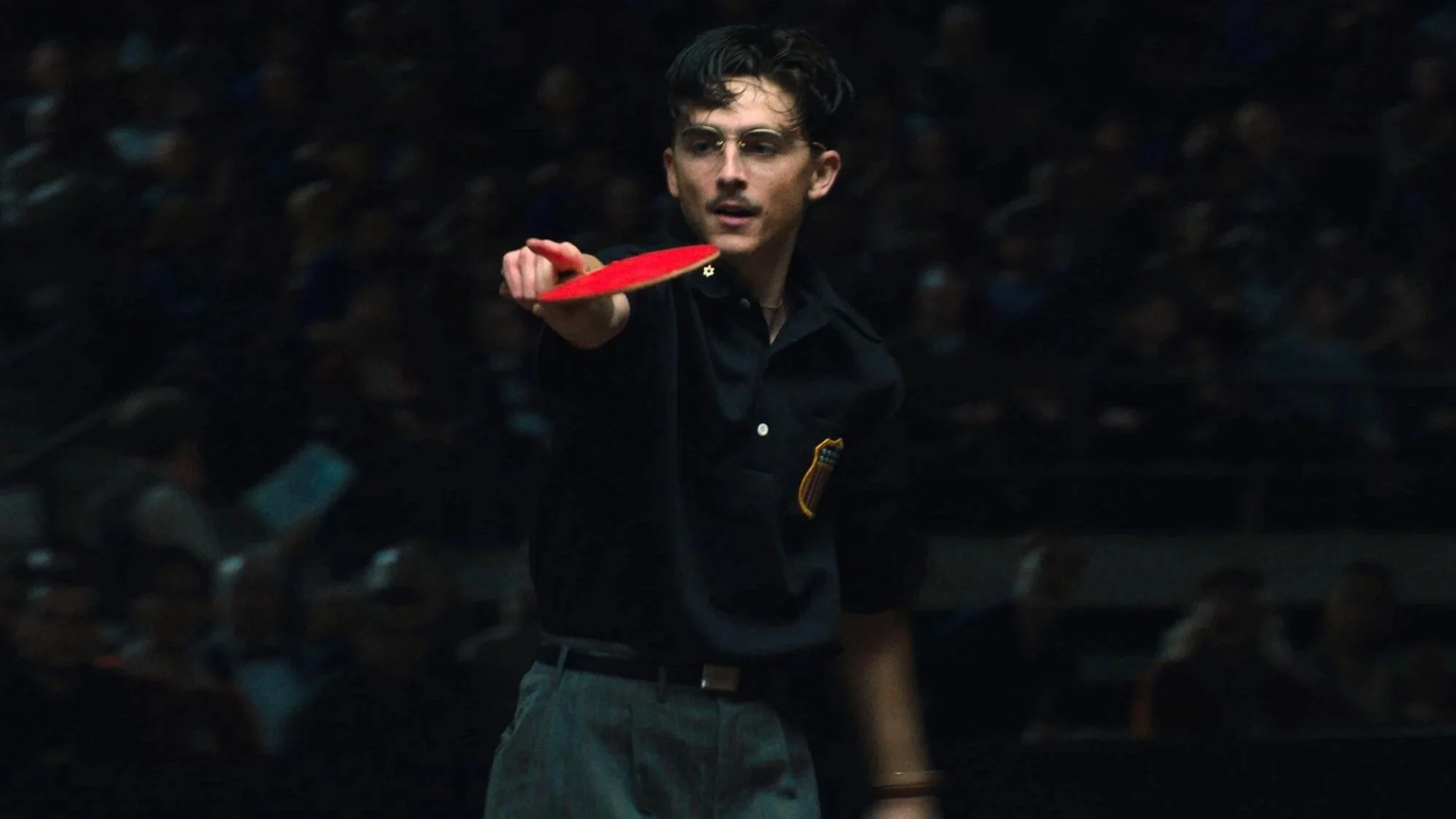

Marty Mauser will not be denied. That’s the whole point of Marty Supreme, the tremendously entertaining new picture from Josh Safdie. The subtitle, “Made in America,” drives home the subtext that Marty is America: a monster, a marvel, a dirtbag scammer with a heart of gold, or at least, enough charm to make you think he does. He’s all of these just as America is both an empire and the land of dreams. In America, it’s all a race to the top (or the bottom) and life is a non-stop series of hustles and plays and schemes and games and a breathless sprint to get what you think you’re owed. Like its good ol’ American protagonist, Marty Supreme won’t take no for an answer.
This exhilarating film stars Timothée Chalamet as the titular Marty, a ping-pong wizard who thinks he has what it takes to be world champion. It’s 1952 New York City and table tennis is even less of a thing than it is now (which is saying a lot), but Marty has hustle and drive and chutzpah. The film charts his rise and fall (and rise and fall) as he tries to hustle his way to Tokyo for the World Championship.
Building on Safdie’s previous films, Good Time (2017) and Uncut Gems (2019), which he directed with his brother Benny Safdie, Marty Supreme is a panic attack-thriller par excellence. By this I mean that it bombards the viewer with non-stop activity, visually, emotionally, aurally, such that some viewers will be overwhelmed with anxiety, much like the characters in the film. A Safdie protagonist always has to overcome impossible odds, usually because they’ve gotten themselves in a terrible mess in the first place. And there’s never been a Safdie protagonist as immensely charismatic as Marty.
Blending the ruthless brilliance of Robert Pattinson’s Connie from Good Time with the everyman charm of Adam Sandler’s Howie from Uncut Gems, Chalamet’s Marty is an infuriating but likable scamp. In the first scene, we see him working at his uncle’s shoe store, selling a pair of shoes before his married mistress, Rachel (Odessa A’zion), comes in and he sneaks away to hook up with her in the backroom. The scene is a microcosm of the Marty experience, as he offloads a problem (his customer) he’s meant to deal with in order to chase something (or someone) he’s been told he cannot have. It also makes abundantly clear that Marty is a natural salesman. The entirety of Marty Supreme is his sales pitch.
Talking a mile a minute and full of furious physicality and energy, even before we get to the table tennis scenes, Chalamet embodies Marty as endlessly hungry, mobile, and confident. He talks over others. He stares them in the eyes and lies to them. Chalamet leans on his good looks and slight physique so that others are always set off guard by Marty, someone who would never physically overpower a person and at first glance seems almost harmless, even childlike. But Marty’s mind is moving a mile a minute and you can sense Chalamet sniffing out the next game in almost every scene with other actors, as if he’s already figured out how to get what he wants from them and so is starting to play out his next coup in his mind. Just watch him work his charm on Gwyneth Paltrow’s Kay Stone, a wealthy former starlet who he sets his sights on. Of course, the joke is that sometimes he’s surprised by his own success, as when Kay enters his room late at night, dropping her robe to reveal herself in fine lingerie, and he pulls her close, looking at himself in the bedside mirror as he does so. His face betrays a slight, “Oh my God,” as if he cannot imagine that all it takes for him to conjure his fantasies into reality is pure force of will.
Once we get to the actual table tennis scenes, which are riveting, Chalamet proves his physicality is not mere playacting. He throws himself into the performance, each serve and counter rally showing not only the years of training he put into the role, but also his own lithe athleticism that’s done him well in roles such as Paul Atreides in Dune (2021) (even if CGI is used to aid the table tennis scenes). If Dune: Part Two (2024) and A Complete Unknown (2024) didn’t already prove that Chalamet is at the apex of Hollywood’s A-list pantheon, Marty Supreme makes it undeniable.
Both Pattinson and Sandler are exceptional as the leads in Safdie’s previous films, but Chalamet is a perfect match for Safdie’s sensibility as a writer and director. It’s the pace of Chalamet’s performance which syncs so well with Safdie’s frenetic camerawork, achieved through shooting close-ups on long lens, so that the camera maintains a distance and tremble that provides a subconscious voyeuristic veneer to every moment. Safdie’s script, co-written with frequent collaborator Ronald Bronstein, also matches Chalamet’s drive with a constantly escalating and scaling series of predicaments. It’s also an ideal match for table tennis, a furiously paced sport. Have you ever watched a match? It’s not a slow game. It starts quick and only goes quicker as the desperation of the players intensifies and rallies get harder and faster.
Take out the table tennis quest and Marty Supreme still operates with a furious pace as we follow a man barrelling into the problems of so many colourful characters in a compelling 1952, designed to the hilt by legendary production designer Jack Fisk (most famous for working with David Lynch and Terrence Malick). These supporting roles include not only Paltrow’s actress and A’zion’s frustrated mother-to-be, but also the millionaire businessman (and Kay’s husband), Milton Rockwell (a well-cast Kevin O’Leary from Shark Tank), a decrepit criminal named Ezra (played by legendary New York City filmmaker Abel Ferrara), Marty’s old buddy and cab driver, Wally (Tyler Okonma a.k.a. Tyler, the Creator), and his table tennis nemesis, Koto Endo (Koto Kawaguchi).
Marty Supreme runs an invisible 150 minutes, which looks onerous on paper, but is blistering in experience. The length allows the runway to provide lasting emotional whiplash, pivoting wildly from chilling visions of desperation and chicanery, to hilarious moments of vaudevillian absurdity. No sequence showcases this better than Marty taking a bath in a dingy hotel only for the floor to cave in on him, causing the bathtub to land on and crush the arm of Ferrara’s gangster. That would be enough for most films, but no sooner than Marty has gotten some clothes on, he’s armed with cash from the gangster to take care of his sick dog, and on the road with his buddy, Wally, dog in tow in the back of the cab, en route to nearby towns to hustle prospective ping pong players at bowling alleys.
In these sequences, the film resembles Robert Rossen’s The Hustler (1961), with Marty as a more wily Eddie Felson. And like The Hustler, Marty Supreme displays a general adherence to the conventions of the sports genre, with the arc of triumph, defeat, training, and pyrrhic victory. Why the fixation on sports conventions? Well, is there a more American narrative than the sports movie, where the grit and grind of the protagonist allows them to overcome social quagmires and old fashioned bad luck in order to anoint themselves as a self-made icon? That should give you your answer as to why Marty Supreme is a sports movie, and why it’s a movie about America.
But Marty has more in common with Michael Jordan (a Chalamet favourite) than Rocky Balboa, as he’s driven by an insatiable desire to be better, disrupt equilibriums, and pathologically work towards his goal, all other considerations be damned. The moving final moments of the film do complicate a cut-and-dry assessment of the film’s themes and Marty’s qualities as a character. It’s a moment of calm and grace after the whirlwind rush of the narrative. But perhaps this too is a part of the film’s scheme. Only in its final moments, when the pace cannot propel us forward, where Marty can no longer hustle us or the characters, do Safie and Chalamet force us to address the question of whether such a man as Marty Mauser, and such a place as America, is really worth it in the end? Whether there’s some genuine beauty, and potential, in a dream as big as the world.
9 out of 10
Marty Supreme (2025, USA)
Directed by Josh Safdie; written by Ronald Bronstein and Josh Safdie; starring Timothée Chalamet, Gwyneth Paltrow, Odessa A’zion, Kevin O’Leary, Tyler Okonma, Abel Ferrara, Fran Drescher, Luke Manley, Emory Cohen, Larry “Ratso” Sloman, Ralph Colucci, Géza Röhrig, Koto Kawaguchi.
Read more Reviews

Matt Bettinelli-Olpin and Tyler Gillett’s action horror sequel is a mere reheat.