Review: Train Dreams (2025)
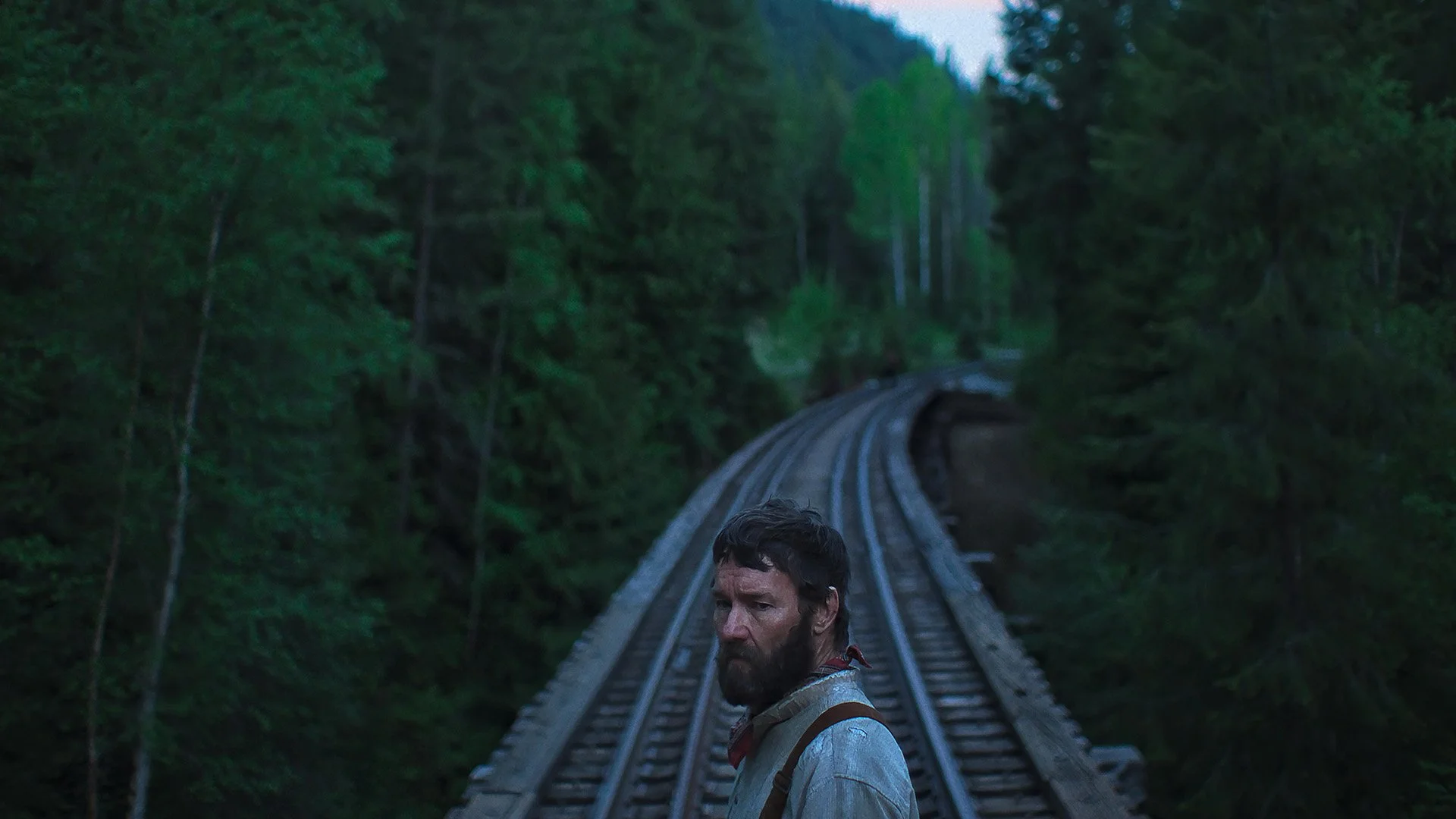

In Train Dreams, Clint Bentley seems enamoured of the work of Terrence Malick, drawing on many of the cinematic approaches of the spiritual auteur, especially those present in his Palme d’Or winning The Tree of Life from 2011. For instance: Train Dreams is a reverie that delights in nature; it uses voiceover to help us understand the spiritual malaise of its protagonist, Robert Grainer (Joel Edgerton); it frequently employs montage to recreate Robert’s memories; it even favours natural lighting, wide angle lenses for close-ups, and low angle shots that frame characters against the sky lit up in the golden hour. Sure sounds like Malick, right? But what Train Dreams doesn’t have is a sense of the transcendent behind its representations of nature and subjectivity, as Train Dreams is mostly disinterested in the life of the soul.
This comment is more descriptive than critical. Much of Train Dreams is beautiful and evokes a bygone era of America and American filmmaking. It tells the life story of Robert Grainer, a logger in Idaho who helps construct railroads and fuel the Industrial Revolution around World War I. Most of the film follows Robert’s middle years, but we also get snippets of his childhood as an orphan and his later years as a hermit.
While this sounds like the making of a conventional story of a man’s life, Train Dreams has an unruly narrative structure that resists conventional arcs. I kept wondering when the inciting incident would occur only to realize this is not a film with a typical rise and fall of action. Rather, it flits about in time, generally moving forward but more attuned to Robert’s emotional state than a rigid sense of external chronology.
Its grace as a film lives in the small moments. Much attention is paid to Robert’s marriage to Gladys (Felicity Jones) and their raising of a daughter in a cabin alongside a river in an idyllic stretch of woods in Idaho. These scenes are true Malick-lite. We get frolicking at twilight. We get fragmented scenes where Robert and Gladys pose romantic questions at each other. We even get the shot of a stalk of grass, which perhaps is more Gladiator than Malick, but has the same reverence for nature. It’s a delight to watch Edgerton in such a role, able to express so much with his mutterings and his glances, since Robert is quiet by nature. Jones is good as well, expressive, and warm. We care about them as a couple and about them as individuals, and the quiet moments they share with their daughter are touching, especially to this relatively-new father.
Robert and Gladys’ romance is sweet, but frictionless. Train Dreams becomes more engrossing when Robert is away from home logging with a group of other quiet, mysterious men. The narration by Will Patton lets us know that Robert often worked alongside men he had never spoken a single word to, growing friendship out of the shared burden rather than any discussions with them. There are meaningful conversations, however, particularly with William H. Macy’s explosives expert, Arn Peeples, who blows up parts of the forest when needed but mostly waxes poetic about the 500 year old trees they cut down.
We also see darker moments that Robert witnessed without comment, although they clearly haunt him in his dreams and later years. One is the lynching of a Chinese coworker on the railroad, when a group of men randomly grab the Chinese man and throw him to his death from the bridge, never answering what he did or why he needed to die. Bentley often cuts to an image of the man sitting silently at the campfire watching Robert, a kind of spectre of his conscience that castigates him for being a bystander.
Other moments hold less meaning for Robert but are fascinating for the viewer. At one point we meet a fellow worker who knows the Bible inside and out, speaking with such confidence and intimacy about biblical stories that the narrator remarks that it felt like the man witnessed them with his own two eyes. In a static wide shot of the man talking to Robert, a black man enters the foreground of the frame and asks whether anyone has seen a certain man. No one answers until this biblical fellow gets up and tries to flee only for the new stranger to shoot him in the back. Turns out the biblical fellow had killed the man’s brother in a racially charged murder and he is getting his revenge. The shooter apologizes for interrupting the men’s work and bids them good day.
Scenes like this one register more strongly in Train Dreams than the more overly romantic ones. The narration is also a nice touch, reminiscent more of the narration in Andrew Dominik’s The Assassination of Jesse James by the Coward Robert Ford (2007) than the whispered prayers of The Tree of Life. The film is strong at evoking the changing era, the majesty of nature, and the quiet, hard work that would disappear with the industrial growth of America. Robert becomes an avatar for the closing of the frontier. He reminds me of Arthur in Red Dead Redemption 2 and even how László Tóth becomes an avatar for the postwar immigrant experience in Brady Corbett’s The Brutalist (2024).
Train Dreams bears more than a little resemblance to The Brutalist, not only because both star Felicity Jones as the wife and both evoke bygone eras of American cinema, but also in how easily the contemporary preoccupations of the filmmakers break through the more poetic flourishes, literalizing the material in ways that you’d never get with the work of Malick or Paul Thomas Anderson (the core influences on the respective films). Bentley and co-writer Greg Kwedar wrote 2024’s Sing Sing and there are similarities in how both films are too gentle towards their characters. Robert seems plagued by guilt but we never see him commit any great sins; rather he is crippled by inaction. Inaction is haunting and can be a sin, as general confession tells us—”For what we have done and what we ought to have done.”—but the film seems scared to give Robert real rough edges, make us truly question his actions, make us really believe the credibility of the time period by having the characters inhabit beliefs and actions that are casually cruel and perplexing to us in the modern world. For instance, Robert’s racial progressivism is too modern, too obviously an opportunity for the contemporary viewer to moralize about the past rather than investigate it on its own terms.
Perhaps it’s too much to ask Train Dreams to embody a moral ambiguity or historical fidelity that isn’t vogue in 2025 cinema, but the film nails so many other hallmarks of historical setting that it’s disappointing that it lacks the verve to push further and cut deeper into America’s (and into Robert’s) histories, moral and otherwise. What we’re left with are fleeting memories of pain and loss and beauty. It’s a film of visual grace, but for something so enamoured of the deepest woods, it’s scared of wandering into the unknown.
7 out of 10
Train Dreams (2025, USA)
Directed by Clint Bentley; written by Clint Bentley and Greg Kwedar, based on the novella by Denis Johnson; starring Joel Edgerton, Felicity Jones, William H. Macy, Kerry Condon.
Read More Reviews

Matt Bettinelli-Olpin and Tyler Gillett’s action horror sequel is a mere reheat.