Review: High Pressure (1932)

There’s no confirmation that Martin Scorsese watched High Pressure before making The Wolf of Wall Street, but considering that Scorsese has seen practically every movie made before 1980, I believe there’s a good chance. Not that the Mervyn LeRoy 1932 pre-Code comedy is as raucous as Scorsese’s 2013 bacchanal, but it’s a wild film in its own right, with some scenes that seemed to be clear reference points for Scorsese’s picture. If you’re into exploring the daring world of pre-Code cinema, it’s worth spending 74 minutes with this minor little oddity.
Starring William Powell, who was best known as the martini-swilling co-lead of The Thin Man movies, High Pressure is about the art of the deal and how to sell a product when there’s no real product to sell. Powell plays Gar Evans, the best promotional man in the business, who’s an absolute ace at convincing everyone and their mother that a product is the best thing since sliced bread. He’s got one weakness—drink—usually as a result of falling out with his girlfriend, Francine (Evelyn Brent).
In the amusing opening sequence, businessman Ginsburg (George Sidney) and his new associate Mike Donahey (Frank McHugh) search for Gar to promote Ginsburg’s new product: an artificial rubber made from sewage. Sounds too good to be true (cause it is), but we’ll get there. First, they have to search every rundown gin joint in New York to find Gar, who has gone on an epic bender cause Francine has dumped him once again. He’s essentially comatose with sauce when they finally find him, having put up a several hundred dollar bar bill (which is around $4,000 in current value) in the process. We watch them get him sober with a goofy montage of people force feeding him coffee, scrubbing him down in showers, and shaving him—if you ever wanted to see a naked William Powell being bathed by a big, muscular dude who flops him around like a rag doll, here’s your chance.
Once Gar is sober, he goes to work promoting the product without once questioning whether the invention is real. He buys real estate for the new business, which he dubs the Golden Gate Artificial Rubber Company—a name meant to bestow legitimacy, much like Stratton Oakmount in The Wolf of Wall Street. He starts hiring shady con artists to work the phones. He smoothtalks every businessman and magnate he meets into buying shares. Soon enough, he’s working out of a giant office with more cash flowing in than he knows what to do with—although Ginsburg has to foot the bill for everything on the business side, much to his chagrin.
The problem is that the artificial rubber is bunk, and so the bill will come due for Gar, especially if he can’t get Francine, whom he signed over majority control of the company to, to play ball when the inspectors come knocking. As you can tell from the description, much of the plot of High Pressure is screwball and the tone is just a few degrees from being a cartoon. When we finally meet the foreign scientist who allegedly came up with the artificial rubber, you wonder whether the actor, Harry Beresford, was turned down for the role of Victor Frankenstein in some C-list picture. Watching the scientist cackle madly and chase Ginsburg around his laboratory might have been a riot in 1932, but it falls flat in 2026.
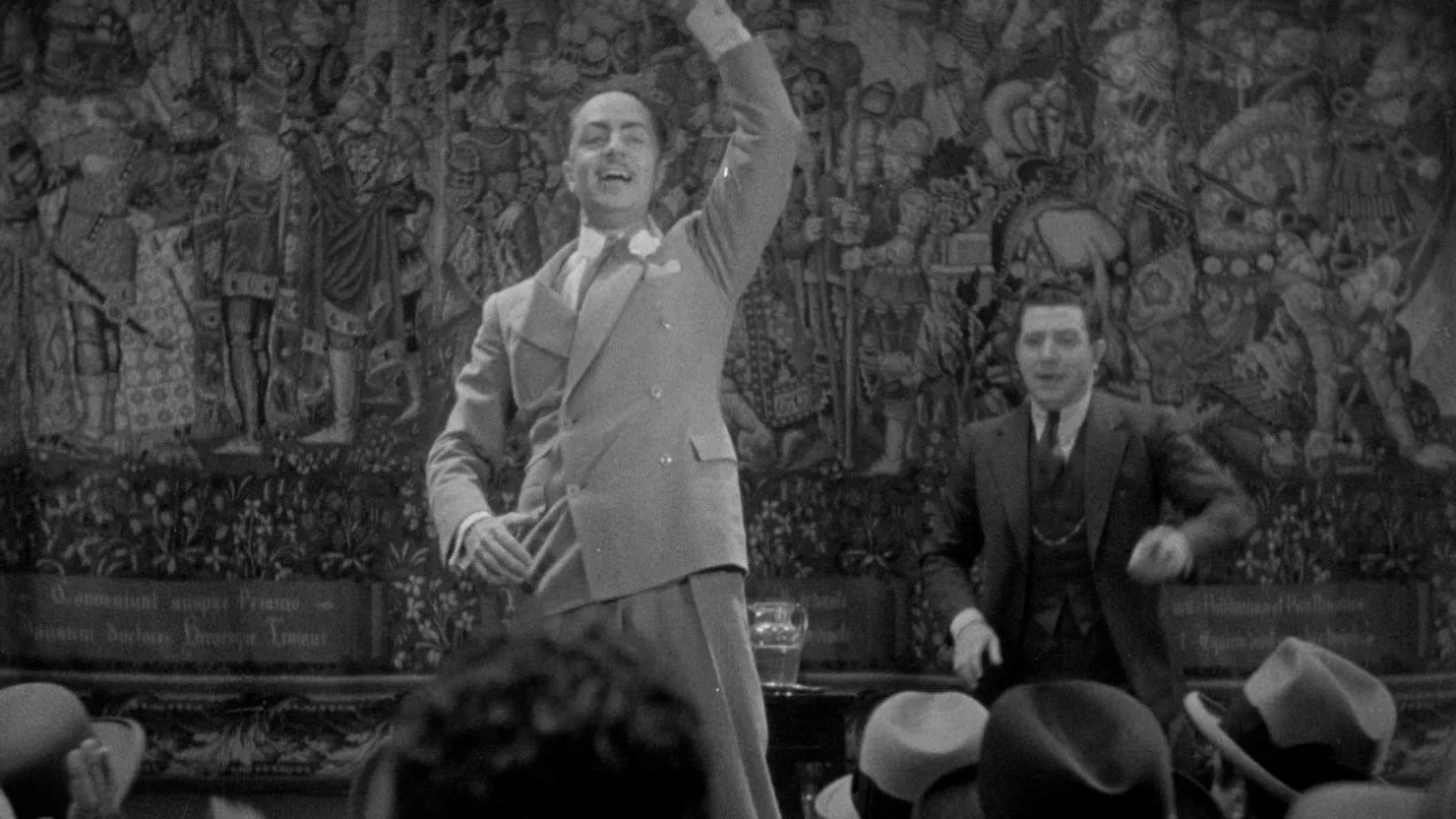
But you watch High Pressure for Powell, who is an ace with the fast patter of dialogue, and who in select scenes, displays the kind of showmanship and verve that serves as a forerunner to Leonardo DiCaprio’s Jordan Belfort. One sequence has Gar giving a big speech to all the immigrant salesmen that he’s hired to push stocks in the company. (There’s a clever recurring gag where these mostly Italian, Jewish, and Greek salesmen are so impressed with Gar, they keep bringing in their parents to meet him and lavish him with gifts.) Stumping in a big auditorium, Gar gives a rousing pep talk, playing to the underdog spirit of these disrespected salesmen, and even playing to their ethnic backgrounds with paeans to their uniquely Jewish, Greek, or Italian vigour and hard work. As he builds to a swell, I couldn’t help but think of Gar’s pep talk as the 1932 version of Jordan Belford’s many shady salesman speeches from The Wolf of Wall Street, where he puts his whole office into a frenzy.
The references are only amplified afterwards as we get a demonstration of Gar’s phone bank system, where all the salesmen hustle people over the phone and talk their marks into forking over money for worthless stock for a phony product. LeRoy tracks the camera parallel to the rows of desks where the salesmen ply their trade, much as Scorsese’s camera roves through the sales office of Stratton Oakmount. Scorsese’s film might not explicitly reference LeRoy’s, but the parallels are hard to ignore.
When the entire business venture comes crashing down, Gar Evans proves himself to be much more respectable than Jordan Belfort, taking responsibility for his actions, even as he is incapable of truly leaving his shady world of salesmanship behind. But we wouldn’t have DiCaprio’s Belfort if we didn’t have Powell’s Evans—two American hustlers born of the same cloth, albeit 80 years apart.
6 out of 10
High Pressure (1932, USA)
Directed by Mervyn LeRoy; written by Joseph Jackson, based on Hot Money by Aben Kandel; starring William Powell, Evelyn Brent, George Sidney, John Wray, Evalyn Knapp, Guy Kibbee, Frank McHugh, Harry Beresford.
Read More Reviews
Matt Bettinelli-Olpin and Tyler Gillett’s action horror sequel is a mere reheat.