Halloween Horror: The Lasting Value of the Original Hocus Pocus (1993)
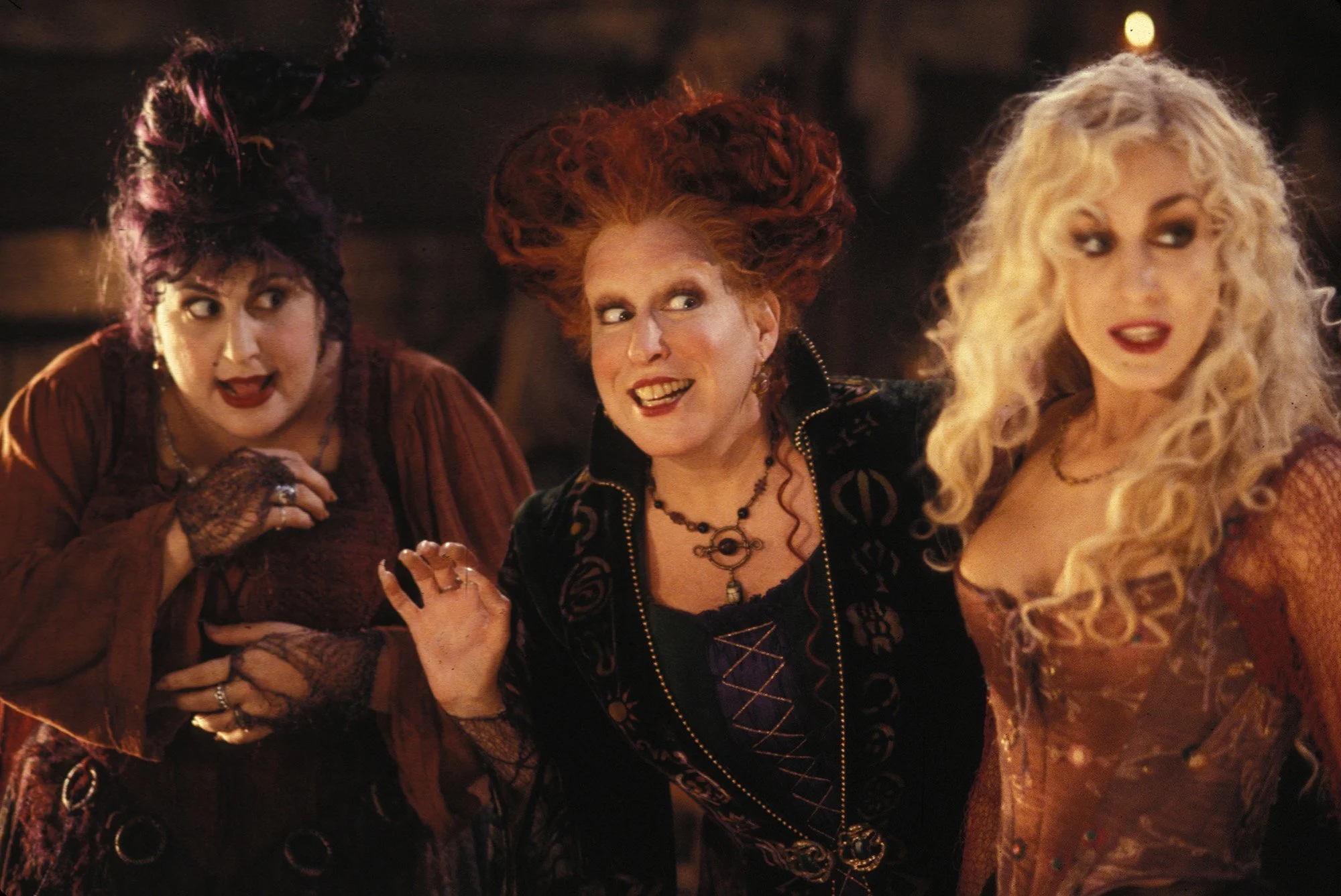

Now that 2022’s Hocus Pocus 2 has faded away, I feel freer to make my case for the value and significance of the original 1993 movie. In my view, Hocus Pocus 2 embodied everything wrong with 21st-century legacy sequels, from vapid repetitions to appended new generation casting. It both retreads and revises too much. But even if the original Hocus Pocus got a relevancy boost from its legacy sequel, I think the original is here to stay. A 2025 day trip to Salem, Massachusetts (while visiting Boston), with our walking tour guide pointing out locations from the movie alongside historical points of interest, only confirms for me the film’s persistence. Hocus Pocus is now a minor classic of family moviemaking.
This was not always the case. Not unlike another Disney Halloween movie I’ve reviewed for the site, The Haunted Mansion (2003), Hocus Pocus was not a commercial success in 1993, but it gained recognition as the film continued to play on the Disney Channel and elsewhere each October, eventually acquiring enough cult status to bolster a late sequel.
Here it is worth mentioning that I’ve come to Hocus Pocus from a different angle than most admirers. I never watched Hocus Pocus on TV growing up, so I have no childhood affection or nostalgia for it. In fact, I didn’t see it until I was an adult, when my wife made me watch it, and I didn’t much care for it at first. Since then, I’ve watched it numerous times with our boys as they grew up, and the film’s strengths have grown on me. I’ve also started to see it as in line with, or perhaps one of the last examples of, a mode of filmmaking that has largely disappeared.
Many filmwatchers would agree that there is a golden age of family adventure movies from, roughly, 1977’s Star Wars to 1993’s Jurassic Park. With Lucas and Spielberg and their compatriots—Joe Dante, Richard Donner, Jim Henson, etc.—American film gave us a wealth of fun, inventive, adventurous movies pitched towards the whole family, being enjoyable for young children as well as teens and parents, but in different ways for each age group. The range of the expected audience was reflected in the multiple levels of youth characters in the stories, which often included small children, grade schoolers, and/or teenagers. These films also burst at the seams with darker edges, strange imagery, the occasional boundary-pushing joke or gag, proficient storytelling, and energetic, inventive filmmaking.
In some ways, Hocus Pocus reminds me of those kinds of movies—like Gremlins (1984) and The Goonies (1985). It’s a bit messy. It can be silly. Like a pair of blue jeans, it’s the kind of movie that becomes better and better the more lived-in it becomes for you.
The film was based on an idea by producer David Kirschner (who came up with the story for Don Bluth’s animated movie An American Tail and produced Child’s Play and Child’s Play 2). Mike Garris first wrote the script as a darker, scarier movie with preteen protagonists, and Walt Disney bought and developed the movie under the working title, Disney’s Halloween House. Apparently, it was offered to Spielberg and Amblin Entertainment as a joint co-production, but they rejected working with their perceived rival, Disney. As development continued, director Kenny Ortega, who was an acclaimed choreographer for numerous 1980s movies (including the John Hughes movies Pretty in Pink and Ferris Bueller’s Day Off as well as Dirty Dancing) and who also directed the Disney musical Newsies (1992). With Ortega involved, the production shifted gears, becoming less of a dark horror movie and more of a comedy musical.
Given the development history, I understand that there’s another story to be told here, about Hocus Pocus as a campy musical by a guy mentored by Gene Kelly who would go on to make successful TV musicals, such as High School Musical (2006) and Descendents (2015), for the Disney Channel. You can see aspects of the Disney Channel aesthetic and approach in Hocus Pocus, such as an interest in kids within the social dynamics of school. That aspect of the film is worth exploring, but it’s not the one I’m focusing on in this essay.
In Salem, Massachusetts in 1693, the sister of Thackery Binx (played by Sean Murray, voiced by Jason Marsden) is lured into the woods by the Sanderson Sisters—Winifred, Sarah, and Mary—three evil witches who want to consume the souls of children to restore their youth and beauty. Winifred, played by Bette Midler, is the eldest sister, and she is the most competent as well as the most clever, vain, and wicked. Her sister, Sarah, played by Sarah Jessica Parker, is the most beautiful, but she is a complete idiot. Mary, played by Kathy Najimy (who also had a hit supporting performance in 1992’s Sister Act), is the most bumbling and goofy of the trio. Mary also has the ability to smell out children. Throughout, Winifred alternates between berating her foolish sisters and bonding with them.
A mob of the Puritan villagers eventually capture and hang the witches, but not before they curse Thackery with immortality as a black cat, who is usually referred to as Binx by the characters. (The script cleverly turns a common witch’s familiar into their main foe). The Sisters also curse the town with the threat of their return, if a virgin lights the Black Flame Candle in their house on a full moon on All Hallow’s Eve.
Cut to present day Salem, where Max Dennison (Omri Katz), his sister Dani (Thora Birtch), and his parents (Charles Rocket and Stephanie Faracy) have moved from Los Angeles (into a very nice seaside house with an amazing attic bedroom for Max, it should be said). The West Coast smart alec teenager has no time for all this “Hulloween” nonsense (as Americans always seem to pronounce the day), but when out Trick-or-Treating with his kid sister, he decides he wants to impress the local girl, Allison (Vinessa Shaw), by going with Allison and Dani to the old Sanderson Sisters house and lighting the Black Flame Candle.
While Hocus Pocus 2 has a tween cast of principals, the original Hocus Pocus is more like The Goonies and other 1980s family movies that tend to blend age groups, giving a younger kid for younger audiences to identify with, as well as teenagers, to add some romance and moments of older adolescent humour. For example, the emphasis on a virgin lighting the candle and on Max being a virgin is played for laughs throughout the movie (without it ever being explained to younger audiences what a virgin is). The age range helps a movie like this to play one way for small kids and another for older kids and yet another for young adults and parents.
Another part of the effectiveness of the film is its clear structure and its ability, like many movies of this period, to contain lots of exposition in well-crafted introductory scenes. The initial flashback sets up the villains clearly, and then we get an extended sequence of the present day, setting up Max and Dani’s lives and the dynamics in the town. For instance, we get one scene in class at high school where Max is the new kid trying to impress a girl. He runs into some bullies on his way home, who will obviously return later in the movie. And at home we see that his parents are kind but largely absent (as they usually are in these kinds of movies).
We also see a believable relationship between Max and Dani. They can get along at times, but their relationship is never improbably affectionate. Nor is it mechanically aggressive. They bicker and threaten each other and fight and Dani gets some good lines in, but he clearly loves his little sister. Like any good family movie, Hocus Pocus takes common problems and makes them the roots of the film’s conflicts. Moving to a new town. Trying to fit in. Having to take care of your little sister. Note that Thackery lost his sister to the witches, which motivates his quick affection for Max and Dani, as the witches are trying to kidnap Dani and consume her life force.
The clear set up of the villains followed by the believability established in the extended introduction, means that when the film nears the end of its first act and the Sanderson Sisters return, we know and care about the young heroes and heroines. The remaining structure is similarly clear, following the three-act structure (each half an hour in length), with rising action related to the problem of the emerging witches amidst Trick-or-Treating on Halloween night, a false ending, with their presumed destruction, and then a return to the witches’ house to finally resolve things.
It’s also important that the Sanderson Sisters are evil—which makes them good villains. I like that they are actually bad and actually witches, which places the story in the realm of fantasy, rather than approaching the Salem witch trials from a more historical lens to touch on matters of persecution or mass hysteria. In Hocus Pocus, the location of Salem, with its long and storied history, is mainly a way to imbue the film with the feel of authentic American folklore; a casual viewer might just assume there were Sanderson Sisters in Old Salem.
As a point of contrast, perhaps the worst part about Hocus Pocus 2 is that it inverts the original film’s stance towards the Sanderson Sisters— and witchcraft in general—making them misunderstood women with legitimate grievances who perhaps went too far, and making, worst of all, the contemporary heroines modern day witches. In the 2020s, a growing number of young people believe in the power of magic crystals, spells, and curses, as interest in the occult runs high. Likewise, everyone takes it as fact that historical witches are just martyrs of feminism. A visit to Salem today, to that inflection point of North American witch folklore, makes the modern world’s transformed view of witchcraft all the more apparent. The modern witches rule in a town where presumed witches were once executed. In seeking to reflect that transformed view, the sequel becomes yet another revisionary work, where extra motivations and sympathy (they were misunderstood!) are injected into the villains, making Hocus Pocus 2 at times into a weak-sauce version of Wicked. All this makes the original feel more like a fairy tale, and the sequel more like a product of 2022.
The original also gets that our sympathy for the witches—and yes, we have some—comes from the fact that they are often humorous characters, not that we think they are actually decent deep down, or hogwash like that. In Hocus Pocus, the Sanderson Sisters are full-on villains, who delight in sucking the life out of children—in almost Roald Dahl’s Witches fashion—but that doesn’t mean the audience doesn’t enjoy watching and reviling their fiendishness. (Likewise, I can enjoy an Alan Rickman villain without thinking he’s really the good guy.) Villains can be appealing without being misunderstood. In other words, in the world of the original Hocus Pocus, there are villains, and not just misunderstood or mistreated people.
All this talk about the wickedness of the witches shouldn’t obscure the fact that the movie blends comedy with its horror. There is a definite camp aspect to many parts of the movie, especially those associated with Bette Midler and her sisters, from Winifred’s Wicked Witch of the West striped stockings, to their humorous walking in unison, to the whole “I Put a Spell on You” musical number. But the songs are quite nicely integrated into the story world. Sarah’s eerie song is a spell she sings to lure in children. Winifred sings her version of the pop song in the context of pretending they are hired singers for an adult party, in order to curse the adults to dance until they die. This aspect of the movie can be a lot of fun, but I think it sometimes overshadows retrospective accounts of the movie—just as The Wizard of Oz is often considered a work of camp and not a landmark of fantasy cinema. In other words, I’ve been trying to show how there is more going on in Hocus Pocus than a Bette Midler camp fest.
There’s also imagination in the physical effects and sets on display that is appealing for people who like classic horror movies. There is the old, decrepit witch house in the woods, a classic graveyard, underground tunnels. At one point, Winifred resurrects Billy Butcherson, a love interest whom she had poisoned, and he walks around as a zombie with his mouth sewn shut. Billy is played by none other than Doug Jones, who with Guillermo Del Toro would achieve fame wearing masks.
I wrote that the horror classic House on Haunted Hill (1959) plays like a collection of the tropes you might see in carnival haunted houses. In many respects, Hocus Pocus assembles everything we commonly associate with Halloween—Trick-or-Treating, New England, witches, spells and curses, zombies, black cats, etc.—into one story taking place in less than 24 hours, from the afternoon on Halloween to the dawn of All Saint’s Day. This is yet another reason Hocus Pocus remains a classic for Halloween viewing.
One last comment on the film’s lasting impact. As a male critic, it is likely no surprise that my personal list of favourite 1980s and 1990s family classics leans heavily into the boys’ own adventures of that time. But Hocus Pocus can also be appreciated as part of an alternative throwback collection of 80s and 90s kids and coming-of-age movies, movies which are often more beloved by female audiences (even if those divisions don’t need to be strictly maintained). For every Stand By Me (1986), there’s Now and Then (1995). There’s Adventures in Babysitting (1987). Movies that have generally struck deeper for female audiences who grew up with them (and which I’ve mostly absorbed under my wife’s influence). A more expansive and accurate account of the story of 1980s and 1990s American family movies should probably take into account more movies like Hocus Pocus.
Hocus Pocus (1993, USA)
Directed by Kenny Ortega; screenplay by Mick Garris and Neil Cuthbert, based on a story by David Kirschner and Mike Garris; starring Bette Midler, Sarah Jessica Parker, Kathy Najimy, Omri Katz, Thora Birch, Vinessa Shaw, Charles Rocket, Stephanie Faracy, Sean Murray, Jason Marsden, Doug Jones.
RELATED POSTS
Lance Oppenheim’s Primetime offers a fascinating portrait of Chris Hansen’s complex moral and professional motivations.