Review: Coyote vs. Acme (2026)
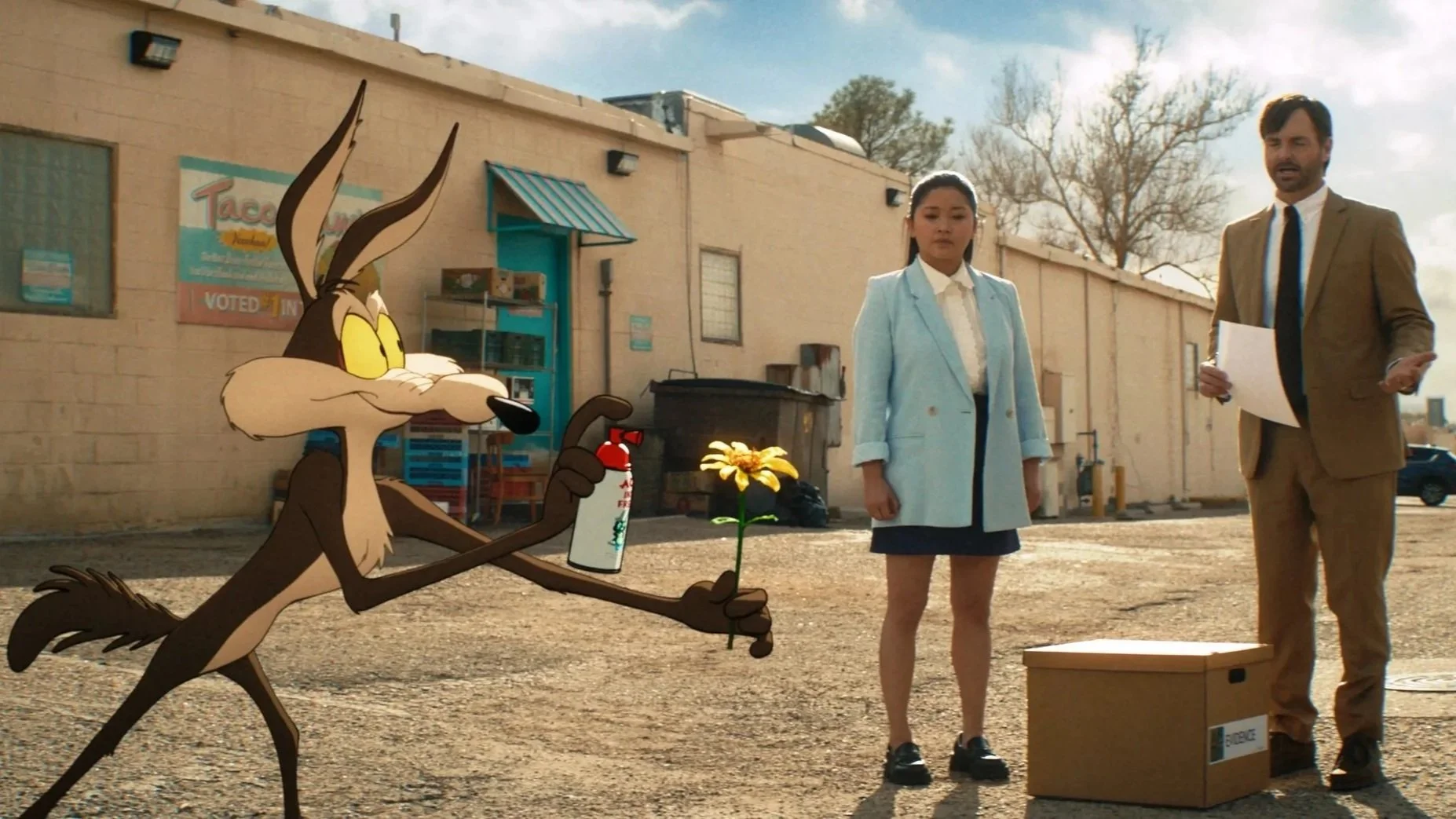
Coyote vs. Acme is frequently hilarious. It’s telling, however, that its funniest moments are when it includes snippets of the classic Looney Tunes shorts featuring Wile E. Coyote and Roadrunner, rather than the original gags of the new film. Don’t get me wrong: like last year’s The Day the Earth Blew Up, Coyote vs. Acme captures enough of the original charm of Looney Tunes to satisfy as a pretty good comedy with plenty of gags (although they taper off over the course of the film). But it never lives up to the intrigue of its real-life behind-the-scenes saga, which has added a metatextual edge that isn’t there in the actual work.
To anyone unaware, in 2023, Warner Bros. shelved Coyote vs. Acme as a tax writeoff. The film was complete, but the powers that be that control Warner Bros., including president David Zaslov, figured that the completed comedy was worth more as a means to reduce tax burdens in the immediate financial year than as a theatrical release that might make tens of millions at the box office. It was a crass financial decision—the kind becoming more common now that venture capital controls most of the Hollywood studios, and makes the sort of short-term, anti-art decisions that even the original titans and capitalists of Hollywood would’ve blanched at. Eventually, the negative press surrounding the move led Warner Bros. to put the film up for auction and Ketchup Entertainment acquired it, as they previously had The Day the Earth Blew Up, and put it out for a late August 2026 release.
The irony, of course, is that Coyote vs. Acme is a parody of courtroom dramas with Wile E. Coyote facing off against the evil Acme Corporation for all the faulty technology that’s blown up in his face (literally) while trying to catch the Roadrunner over the years. It doesn’t take much to link Warner Bros. with Acme (the movie even does this with a sight gag in the opening credits). Thus, Coyote vs. Acme is an underdog story—the scrappy animal against the big heartless corporation—and everyone loves an underdog story. But despite the narrative’s parallels to the film’s own production history, don’t mistake the movie for being a ruthless satire of corporate greed. Rather, it’s a goofy comedy full of pratfalls, sight gags, and some sly commentary on how Looney Tunes and its beloved characters have changed in the modern world—for instance, there’s a Pepé Le Pew gag that really leans on the new understanding of the word “predator.”
The plot is simple. After failing for the nth time to catch Roadrunner, Coyote sees a TV ad from billboard attorney Kevin Avery (Will Forte), who promises quick justice for consumers wronged by faulty products. Of course, Kevin’s entire business is built on settlements—a quick filing, some signatures, and a small payout. But Coyote has other things in mind and manipulates Kevin’s filing so that he ends up suing Acme for every single bit of technology Coyote has ever purchased from Acme. It becomes a big deal and soon enough, Coyote and Kevin find themselves in court against the big, powerful Acme Corporation, represented by hotshot attorney Buddy Crane, played by John Cena in his deadpan operator mode.
Though Coyote vs. Acme spends several scenes parodying courtroom dramas, and even aces the triumphant speeches and mystery witness structure of the subgenre, most of its narrative is devoted to another plot: uncovering the conspiracy behind Acme’s illicit product testing on cartoons. To be fair, many courtroom dramas involve uncovering a conspiracy in the midst of gathering evidence—investigation and proceedings are literally the two sides of Law & Order, after all.
In an amusing opening, we watch as Dr. Peter Lorre (props to Looney Tunes’ undying love for the Golden Age character actor) is disappeared by Acme goons after trying to escape the lab. Eventually, Coyote, Kevin, and Kevin’s niece, Paige (Lana Condor), who’s an intern at his law firm, pick up the trail, leading to run-ins with beloved Looney Tunes characters including Daffy Duck (who’s institutionalized), Granny (the reclusive wife of Dr. Lorre), and, of course, Bugs Bunny (who has the goods on Acme’s corporate malfeasance).
It’s a pleasure to see many of these characters on screen again. I can never get enough Daffy Duck, for instance, and his brief scene in the garden of an asylum is properly bizarre and zany. Unfortunately, Daffy and the others don’t look exactly like I remember them. The film’s animation style is a major shortcoming. Rather than recreate the exact animation of the original cartoons—as Who Framed Roger Rabbit did, becoming the gold standard for blending 2D animation with live action—Coyote vs. Acme presents the characters with a slightly rounded, cel-shaded approach that gives more depth on screen to the characters. I understand that director Dave Green and his team want to present the toons in a more dynamic way that blends with the real actors, but the animation style is frequently ungainly, especially with more human characters like Granny. Oh, how I wish the toon characters in the film looked exactly like they did in the old Chuck Jones and Michael Maltese short films.
The other issue is that the film doesn’t have much of a satirical edge. Although the real life story of the film’s production implies that the film is a swipe at Warner Bros., the film conveys the same sort of light satire as The Simpsons does about the Fox Corporation. (You can only be so critical of the guys who pay your bills.) Part of this is also due to the film’s straightforward narrative, which could’ve veered off into insane detours but holds the course in its mashup of conspiracy thriller and courtroom drama.
The film also would have benefited from leaning into its parody. Maybe I’m just influenced by recently watching the entirety of Matt Johnson’s Nirvanna the Band the Show, with its rigorous parody episodes, but I couldn’t help but think how funny a committed parody can be in contrast. Coyote vs. Acme could have used more rigour in its plotting, perhaps not as much as Matt Johnson and Jay McCarrol manage in their low-budget comedy series, but at least as much as Who Framed Roger Rabbit accomplishes while satirizing Chinatown. The opportunities are there, but Coyote vs. Acme is ultimately a family movie in 2026, which means it has to land the heartwarming resolution rather than go for the jugular, whether formally or thematically.
Oh well. I should just be happy that there’s a movie full of Anvil drops, pratfalls, sight gags, and insane puns that exists in the 2026 Hollywood landscape. Coyote vs. Acme never lives up to the ironic promise of its metacontext, but it’s a funny movie keeping alive the zany bedlam of Looney Tunes humour. Perhaps I should learn to be a bit more like Will Forte’s Kevin Avery and take what I can get.
6 out of 10
Coyote vs. Acme (2026, USA)
Directed by Dave Green; written by Samy Burch, based on a story by James Gunn, Jeremy Slater, and Samy Burch, based on the article “Coyote v. Acme” by Ian Frazier; starring Will Forte, Lana Condor, Tone Bell, Luis Guzmán, Martha Kelly, P. J. Byrne, Eric Bauza, Kenneth Choi, John Cena.

Read More Reviews


Matt Bettinelli-Olpin and Tyler Gillett’s action horror sequel is a mere reheat.