TIFF 2026 Review: Ah Girl
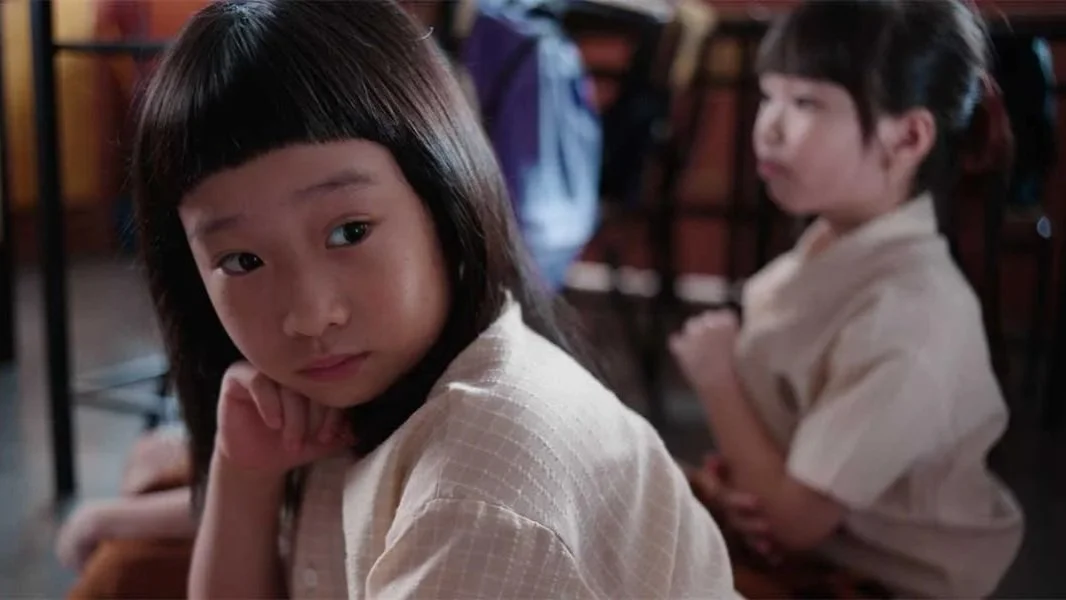
Ah Girl is subtle, authentic, observant, the kind of drama that demonstrates a careful understanding of the characters it depicts and the world it inhabits. Set in Singapore in 1994, the film follows a seven-year-old girl, Ah Girl (Ong Xuan Jing), who splits time between her laidback dad (James Seah) on weekdays and her anxious mom (Carrie Wong) on weekends. She’s too young to truly understand the dynamics of their divorce, but the world doesn’t care about her age, and seemingly neither do her parents, so she’s forced to grow up fast, particularly to make the transition easier for her four-year-old sister, Ah Tian (Sydney Wong).
Written and directed by Ang Geck Geck Priscilla in her feature debut, and based largely on Ang’s own childhood in Singapore, Ah Girl demonstrates a personal vision of adolescence, but don’t mistake this for a navel gazing enterprise. Ang isn’t interested in recreating her childhood on screen or working through her traumas in public. Rather, she leverages her own experience to give the film a lived-in authenticity, which is borne out in the kids-eye view of the world.
Ah Girl is filmed in 4:3 ratio and visually tied almost exclusively to the perspective of Ah Girl. It takes pains to recreate the past aesthetically, but it’s not depicted as a cinematic memory like other semi-autobiographical movies about young women, such as Blue Heron (2025) or Aftersun (2022). Rather, the aesthetic approach is necessary to create an unobtrusive and compelling low-key drama about children and their domestic experience depicted from their point of view. The aspect ratio helps transport us to the past—we can’t help but think of watching a tube TV from the time—and the occasional period flourishes, such as visits to a 1990s McDonalds, help convey the time and place with an authenticity that needle drops or other period markers might make too blunt. Everything lives and dies on the film’s personal perspective of Ah Girl, who glimpses some of the issues of her parents, but never truly comprehends their own immaturity or indecision. The viewer is shown a bit more than she is, but even then, most of our understanding of the parents is informed entirely by observing them interact with Ah Girl and Ah Tian.
Much of Ah Girl features scenes of its child protagonists being belittled, ignored, or otherwise mistreated by the adults. No one is being beaten or abused in more heinous ways (thank God), but it’s uncomfortable to watch nevertheless. They spend much of their time with their grandmother (Doreen Toh), who seems to resent being the primary caregiver for the children while her son works the nightshift. Granny has her own rules for what is appropriate for children and so forces Ah Girl to get a haircut. The haircut sequence is like a torture scene with close-ups of Ah Girl’s palpable dejection at losing her long, dark locks, especially coming after her crush at school let her know that he likes girls with long, beautiful hair.
Worse is witnessing the scenes with her parents, who might take the girls for a night or two, but hardly look at them, let alone engage with them as little human beings they brought into the world. The mom is working hard to get noticed at her job. The dad is working hard to get a replacement wife—one who has no interest in being a replacement mom for the girls. We never veer into the excruciating world of Hirokazu Kore-eda here, most notably Nobody Knows (2004), which might have the single worst, believably bad mother ever depicted on screen, but it’s not too far off. Further, Ang crafts a subtle cinematic tone that reminds me of Kore-eda at his best moments, when Ang’s camera and narrative are so fixated on the characters and their specific, authentic emotions that we nearly forget we’re watching a movie.
Where the film doesn’t reach the heights of Kore-eda, even his more minor work, is in its story development, as the film grows repetitive in its narrative patterns, circling around similar scenarios, similar challenges for its young protagonist, rather than developing into a clearer progression of friction and growth. Like many debut films, it’s slight in terms of structure and narrative, even accounting for its modest length of 99 minutes.
That said, perhaps the slow, similar, repetitive issues that Ah Girl faces are part of the film’s overall approach, as Ah Girl is doomed to deal with parents who don’t want to make definitive decisions, and who are happy to let things slowly disintegrate so they don’t have to make a mess destroying the things themselves. The film’s resolution isn’t riveting, but the film never loses your attention, and never betrays your trust. It’s authentic, through and through, a personal vision of a child’s uniquely universal struggle against the pressures of her time and place, and the cruel march of time.
7 out of 10
Ah Girl (2026, Singapore)
Written and directed by Ang Geck Geck Priscilla; starring Ong Xuan Jing, Sydney Wong, Doreen Toh, James Seah, Carrie Wong.
Read More Reviews

The History of Concrete is like a feature-length version of an episode of How To with John Wilson.